Abstract
Constitutional morality has emerged as a foundational principle for preserving democratic governance, protecting constitutional values, and ensuring the rule of law in contemporary constitutional democracies. It requires public institutions, constitutional authorities, and citizens to act in accordance with the spirit, values, and objectives of the Constitution rather than merely adhering to its literal provisions. Judicial activism has played a significant role in advancing constitutional morality by enabling constitutional courts to interpret legal provisions in a manner that safeguards fundamental rights, promotes equality, strengthens accountability, and addresses governance challenges arising from social, political, and technological transformation. This paper examines the evolving relationship between constitutional morality and judicial activism through a comparative legal analysis of constitutional democracies, with particular emphasis on India while drawing references from jurisdictions such as the United States, South Africa, Canada, and the United Kingdom. The study explores the theoretical foundations of constitutional morality, the expanding role of judicial review, landmark constitutional decisions, and the influence of courts in promoting democratic governance. It further analyses contemporary challenges including judicial overreach, separation of powers, majoritarian politics, constitutional populism, and the impact of digital governance on constitutional rights. The paper argues that constitutional morality and judicial activism should function as complementary constitutional mechanisms that protect democratic institutions while respecting institutional boundaries. It concludes that a balanced approach combining judicial restraint, constitutional accountability, and democratic participation is essential for strengthening constitutional governance, protecting individual liberties, and ensuring the long-term stability of constitutional democracies.
- Constitutional Governance
- Constitutional Morality
- Democracy
- Judicial Activism
- Judicial Review
- Rule of Law
- Separation of Powers
Introduction#
Constitutional democracies are founded upon the principles of the rule of law, separation of powers, protection of fundamental rights, and accountable governance. A written constitution not only establishes the institutional framework of the State but also embodies the fundamental values that guide public administration and democratic decision-making. Among these values, constitutional morality has gained increasing prominence as a guiding principle for interpreting constitutional provisions and resolving complex legal and political disputes. The concept extends beyond literal compliance with constitutional text and requires constitutional actors to uphold the underlying ideals of liberty, equality, justice, dignity, secularism, and fraternity. In recent decades, constitutional courts across the world have increasingly invoked constitutional morality to protect minority rights, strengthen democratic institutions, and prevent arbitrary exercises of governmental power. Simultaneously, judicial activism has emerged as an important constitutional doctrine through which courts adopt an expansive interpretation of constitutional rights and actively intervene to remedy executive or legislative failures. While supporters view judicial activism as an essential safeguard against constitutional violations and abuse of power, critics argue that excessive judicial intervention may undermine democratic accountability and disturb the constitutional balance among the legislature, executive, and judiciary. These competing perspectives have intensified scholarly debate regarding the appropriate role of constitutional courts within democratic governance. In India, constitutional morality has acquired particular significance through landmark decisions of the Supreme Court concerning privacy, gender equality, LGBTQ+ rights, electoral reforms, religious freedom, and constitutional accountability. Similar developments have occurred in constitutional jurisdictions such as South Africa, Canada, the United States, and the United Kingdom, where courts have increasingly interpreted constitutional provisions in light of evolving democratic values and international human rights principles.
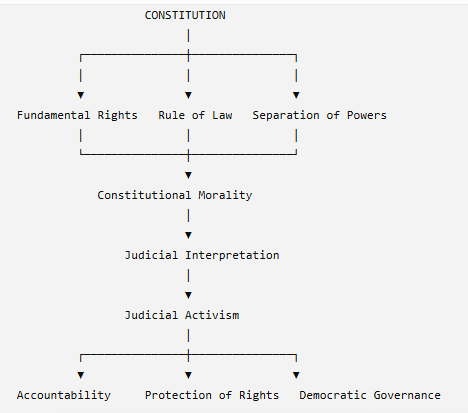
Figure: Conceptual Background
Against this background, this paper examines the relationship between constitutional morality and judicial activism within the broader framework of democratic governance. It analyses the theoretical foundations of constitutional morality, traces its historical evolution, and evaluates the role of constitutional courts in safeguarding constitutional values through judicial review. The study adopts a comparative legal methodology by examining constitutional doctrines, judicial precedents, statutory frameworks, and scholarly literature from multiple jurisdictions to identify common principles and emerging trends. Particular attention is devoted to the Indian constitutional experience, where constitutional morality has evolved from a relatively abstract constitutional ideal into a practical interpretative principle influencing numerous landmark judicial decisions. The paper also explores contemporary challenges arising from judicial overreach, constitutional populism, separation of powers, political polarization, digital governance, artificial intelligence, and the protection of constitutional rights in technologically advanced societies. By critically evaluating competing theories concerning judicial activism and constitutional interpretation, the paper seeks to identify an appropriate balance between judicial independence and democratic legitimacy. It argues that constitutional morality should function as a normative framework guiding constitutional governance, while judicial activism should remain a carefully exercised constitutional mechanism aimed at preserving democratic values rather than replacing democratic decision-making. The subsequent sections examine the conceptual development of constitutional morality, compare approaches to judicial activism across selected constitutional democracies, analyse emerging constitutional challenges, and conclude by recommending strategies for strengthening constitutional governance through principled constitutional interpretation and institutional accountability.
Concept and Evolution of Constitutional Morality in Democratic Governance#
Constitutional morality has evolved into a central principle of modern constitutional jurisprudence, guiding the interpretation and implementation of constitutional provisions in a manner that preserves democratic values and the rule of law. The concept was first articulated by the nineteenth-century British historian George Grote, who described constitutional morality as the willingness of both citizens and public authorities to respect constitutional institutions, procedures, and limitations even when doing so may conflict with immediate political interests. Over time, constitutional scholars expanded the concept beyond procedural compliance to include adherence to the substantive values embodied in a constitution, such as liberty, equality, justice, dignity, fraternity, secularism, and accountability. In contemporary constitutional democracies, constitutional morality requires all organs of the State—the legislature, executive, and judiciary—to exercise their powers consistently with constitutional principles rather than partisan or majoritarian preferences. It also emphasizes that constitutional governance must protect minority rights and individual freedoms while maintaining democratic legitimacy and institutional balance. In the Indian constitutional context, constitutional morality has acquired exceptional importance due to the transformative character of the Constitution adopted in 1950. The Constitution was designed not merely as a legal document but as an instrument of social transformation aimed at eliminating historical inequalities and promoting democratic governance founded upon justice, liberty, equality, and fraternity. Dr. B. R. Ambedkar repeatedly emphasized that constitutional morality was indispensable for the successful functioning of constitutional democracy because constitutional institutions could not survive without respect for constitutional values and democratic ethics. This vision has significantly influenced constitutional interpretation by the Supreme Court of India, particularly in matters involving fundamental rights, equality, gender justice, religious freedom, and personal liberty. Landmark decisions such as *Kesavananda Bharati v. State of Kerala* (1973), which established the Basic Structure Doctrine, recognized that certain constitutional principles are so fundamental that they cannot be destroyed even through constitutional amendments. Subsequent judgments, including *Navtej Singh Johar v. Union of India* (2018), decriminalizing consensual same-sex relationships, *Indian Young Lawyers Association v. State of Kerala* (2018), concerning the Sabarimala Temple entry issue, and *Justice K. S. Puttaswamy v. Union of India* (2017), recognizing privacy as a fundamental right, demonstrate the judiciary's reliance on constitutional morality to protect individual dignity and equality against discriminatory social practices and arbitrary state action. Similar constitutional developments can be observed in other democratic jurisdictions. The Constitutional Court of South Africa has invoked constitutional values of dignity, equality, and freedom to dismantle discriminatory legal structures inherited from apartheid, while the Supreme Court of Canada has interpreted the Canadian Charter of Rights and Freedoms in a purposive manner that promotes substantive equality and multiculturalism. Likewise, constitutional courts in Germany and other European democracies have emphasized proportionality, human dignity, and constitutional identity as guiding principles of constitutional interpretation. Despite its growing influence, constitutional morality remains a contested concept because its broad and evolving nature allows different interpretations depending on judicial philosophy and constitutional context. Critics argue that excessive reliance on constitutional morality may encourage judicial subjectivity and permit courts to substitute their own moral preferences for legislative policy choices, thereby raising concerns regarding democratic legitimacy and separation of powers. Supporters, however, contend that constitutional morality serves as an essential safeguard against majoritarian excesses, arbitrary governmental action, and violations of fundamental rights. In increasingly pluralistic and technologically advanced societies, constitutional morality provides a normative framework through which constitutional institutions can respond to emerging challenges while preserving the Constitution's core commitments to justice, equality, liberty, dignity, and democratic governance. Consequently, constitutional morality has evolved from a theoretical constitutional ideal into a practical interpretative principle that strengthens constitutionalism, promotes accountable governance, and ensures that democratic institutions function consistently with the enduring values of the Constitution.
Judicial Activism and Constitutional Interpretation: Comparative Perspectives#
Judicial activism has become a defining feature of contemporary constitutional governance, particularly in jurisdictions where constitutional courts are entrusted with safeguarding fundamental rights and maintaining the supremacy of the Constitution. Broadly understood, judicial activism refers to an interpretative approach in which courts adopt a proactive role in resolving constitutional disputes, expanding the scope of constitutional rights, and reviewing legislative or executive actions that are inconsistent with constitutional principles. Unlike judicial restraint, which emphasizes deference to elected institutions unless constitutional violations are clear, judicial activism recognizes that courts have a constitutional responsibility to intervene when democratic institutions fail to protect individual rights, uphold constitutional values, or prevent arbitrary exercises of public power. The Indian constitutional experience provides one of the most significant examples of judicial activism. Through an expansive interpretation of Articles 14, 19, 21, and 32 of the Constitution, the Supreme Court has transformed the protection of fundamental rights by recognizing rights that are not expressly enumerated but are implicit in the constitutional guarantee of life and personal liberty. Landmark decisions such as *Kesavananda Bharati v. State of Kerala* (1973) established the Basic Structure Doctrine, limiting Parliament's power to amend the Constitution, while *Maneka Gandhi v. Union of India* (1978) broadened the interpretation of Article 21 by holding that any procedure affecting personal liberty must be fair, just, and reasonable. Similarly, *Justice K. S. Puttaswamy v. Union of India* (2017) recognized the right to privacy as an intrinsic part of the right to life and personal liberty, illustrating the judiciary's willingness to adapt constitutional interpretation to changing social and technological realities. Public Interest Litigation (PIL), another distinctive feature of Indian judicial activism, has enabled courts to address issues affecting disadvantaged groups, environmental protection, prison reforms, bonded labour, and governmental accountability, thereby making constitutional remedies more accessible to marginalized communities. Comparative constitutional experiences demonstrate both similarities and differences in judicial activism. In the United States, judicial review established through *Marbury v. Madison* (1803) empowers the Supreme Court to invalidate legislation inconsistent with the Constitution. Decisions such as *Brown v. Board of Education* (1954), which declared racial segregation in public schools unconstitutional, and *Obergefell v. Hodges* (2015), recognizing same-sex marriage, illustrate how judicial interpretation has expanded constitutional protections in response to evolving societal values. In South Africa, the Constitutional Court has adopted a transformative constitutional approach rooted in the country's post-apartheid Constitution, emphasizing human dignity, equality, and socio-economic rights while actively addressing historical injustice. Canadian constitutional jurisprudence similarly reflects a purposive approach under the Canadian Charter of Rights and Freedoms, balancing individual rights with reasonable limitations through the proportionality principle established in *R. v. Oakes* (1986). In contrast, the United Kingdom traditionally adhered to the doctrine of parliamentary sovereignty, limiting judicial review of primary legislation. However, the enactment of the Human Rights Act 1998 and the development of constitutional principles by the UK Supreme Court have expanded judicial scrutiny of executive actions while preserving Parliament's legislative supremacy. Despite its significant contributions to constitutional governance, judicial activism remains a subject of continuing debate. Critics contend that excessive judicial intervention may blur the constitutional separation of powers, undermine democratic accountability, and permit unelected judges to determine matters that should properly be decided through the political process. Conversely, proponents argue that judicial activism is indispensable in constitutional democracies because it protects minority rights, preserves constitutional supremacy, strengthens institutional accountability, and prevents abuses of governmental power. A comparative analysis indicates that the legitimacy of judicial activism ultimately depends upon its constitutional justification, principled reasoning, and institutional restraint. When exercised consistently with constitutional text, democratic values, and respect for the functions of other branches of government, judicial activism serves as an essential mechanism for preserving constitutional morality, protecting fundamental rights, and strengthening democratic governance in an evolving constitutional order.
Emerging Trends, Challenges, and the Future of Constitutional Morality in Democratic Governance#
The twenty-first century has witnessed profound constitutional transformations driven by globalization, digital governance, technological innovation, political polarization, and evolving conceptions of democracy. These developments have expanded the relevance of constitutional morality beyond traditional questions of constitutional interpretation to encompass emerging issues such as digital rights, artificial intelligence, algorithmic governance, misinformation, environmental justice, electoral integrity, and institutional accountability. One of the most significant trends is the increasing digitalization of governance, whereby governments employ digital platforms, biometric identification systems, artificial intelligence, and data-driven decision-making to improve administrative efficiency and public service delivery. While these innovations enhance accessibility and transparency, they also create constitutional concerns relating to privacy, equality, freedom of expression, and procedural fairness. Constitutional courts are therefore increasingly called upon to determine whether technological governance complies with constitutional guarantees of dignity, liberty, and due process. At the same time, constitutional democracies face the growing challenge of constitutional populism, in which elected governments invoke majoritarian mandates to justify actions that may weaken independent institutions, restrict civil liberties, or undermine judicial independence. Constitutional morality serves as an important safeguard in such circumstances by requiring all constitutional actors to respect the foundational values and structural limitations embedded within the Constitution rather than merely relying on political majorities. Another emerging challenge is democratic backsliding, characterized by the gradual erosion of institutional checks and balances, reduced media freedom, weakened legislative oversight, and declining public confidence in constitutional institutions. In response, constitutional courts have increasingly exercised judicial review to preserve constitutional supremacy and protect the independence of democratic institutions. However, this expanded judicial role has also intensified debates concerning judicial accountability and the limits of judicial activism. Critics argue that courts should exercise restraint to avoid assuming policymaking functions reserved for elected representatives, whereas supporters maintain that judicial intervention becomes constitutionally necessary when other branches fail to uphold constitutional obligations or protect fundamental rights. Global constitutionalism represents another important trend influencing constitutional morality.
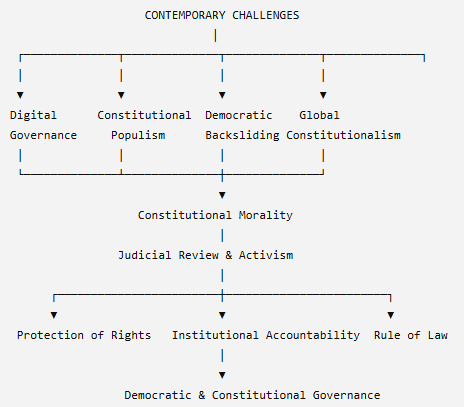
Figure: Emerging Trends, Challenges, and the Future of Constitutional Morality in Democratic Governance
International human rights conventions, comparative constitutional jurisprudence, and transnational judicial dialogue have encouraged constitutional courts to adopt broader interpretations of equality, non-discrimination, environmental protection, gender justice, and socio-economic rights. Although comparative constitutional reasoning enriches constitutional interpretation, courts must also ensure that international norms are harmonized with domestic constitutional structures and democratic legitimacy. Social media and digital communication platforms have further complicated constitutional governance by facilitating the rapid dissemination of information while simultaneously increasing the spread of misinformation, hate speech, online harassment, and electoral manipulation. Constitutional democracies must therefore balance freedom of speech with legitimate regulatory measures designed to protect public order, democratic integrity, and individual dignity. Climate change has also emerged as a constitutional issue, with several courts recognizing environmental protection as intrinsically connected to the rights to life, health, and sustainable development. These developments demonstrate that constitutional morality increasingly functions as a dynamic interpretative principle capable of addressing contemporary constitutional challenges without compromising the enduring values of the Constitution. Looking ahead, the future of democratic governance will depend upon maintaining an appropriate balance between constitutional flexibility and constitutional stability. Legislatures, executives, judiciaries, independent constitutional bodies, civil society, and citizens must collectively uphold constitutional ethics through transparency, accountability, respect for institutional boundaries, and adherence to the rule of law. Judicial activism should continue to serve as a constitutional safeguard rather than an alternative form of governance, ensuring that constitutional morality remains rooted in democratic legitimacy, institutional cooperation, and the protection of fundamental rights. By adapting constitutional principles to emerging technological and societal developments while preserving the Constitution's foundational commitments to liberty, equality, justice, and human dignity, constitutional democracies can strengthen public trust and ensure the continued vitality of constitutional governance in an increasingly complex global environment.
Conclusion#
Constitutional morality and judicial activism have become indispensable elements of modern democratic governance, ensuring that constitutional values remain effective in addressing evolving political, social, and technological challenges. This study demonstrates that constitutional morality extends beyond strict adherence to the constitutional text by requiring all constitutional institutions to act consistently with the principles of justice, liberty, equality, dignity, fraternity, secularism, and the rule of law. These foundational values provide the normative framework through which constitutional democracies preserve institutional integrity, protect individual rights, and maintain public confidence in constitutional governance. Judicial activism has complemented constitutional morality by enabling constitutional courts to interpret constitutional provisions dynamically and respond to situations where legislative or executive action threatens constitutional guarantees or fails to protect vulnerable groups. The comparative analysis of constitutional systems in India, the United States, South Africa, Canada, and the United Kingdom reveals that although the scope and intensity of judicial intervention differ across jurisdictions, constitutional courts universally perform a vital role in preserving constitutional supremacy, protecting fundamental rights, and maintaining democratic accountability. The Indian constitutional experience illustrates how judicial innovation through doctrines such as the Basic Structure Doctrine, expansive interpretation of Article 21, Public Interest Litigation, and recognition of constitutional morality has significantly contributed to the development of transformative constitutionalism. At the same time, comparative constitutional practice demonstrates that judicial activism must operate within the constitutional framework and respect the institutional roles of the legislature and executive to preserve democratic legitimacy and the principle of separation of powers. The emergence of digital governance, artificial intelligence, algorithmic decision-making, social media regulation, environmental protection, constitutional populism, and democratic backsliding has further expanded the constitutional responsibilities of courts and other constitutional institutions. These developments require constitutional interpretation to remain sufficiently flexible to address new governance challenges while remaining firmly anchored in constitutional text, democratic principles, and institutional accountability. Excessive judicial intervention may create concerns regarding judicial overreach and democratic legitimacy; however, complete judicial passivity may permit constitutional violations and weaken public confidence in democratic institutions. Therefore, the legitimacy of judicial activism depends upon principled constitutional reasoning, transparency, proportionality, and fidelity to constitutional values rather than personal judicial preferences. Strengthening constitutional governance also requires legislatures to enact constitutionally compliant laws, executives to exercise public authority responsibly, independent constitutional bodies to function without political interference, and citizens to actively participate in protecting democratic institutions. Constitutional morality is not solely a judicial doctrine but a shared constitutional responsibility that extends to every organ of the State and every participant in the democratic process. Greater constitutional literacy, institutional dialogue, judicial accountability, and public engagement are essential for promoting respect for constitutional values in an increasingly diverse and technologically advanced society. Ultimately, constitutional morality and judicial activism should function as complementary constitutional mechanisms that preserve democratic governance while maintaining institutional balance. Their shared objective is not to substitute judicial authority for democratic decision-making but to ensure that governance remains consistent with the Constitution's enduring commitment to justice, equality, liberty, dignity, and the rule of law. By promoting principled constitutional interpretation, institutional accountability, and protection of fundamental rights, constitutional morality and judicial activism will continue to serve as indispensable pillars of resilient, inclusive, and democratic constitutional governance in the twenty-first century.
Works Cited#
- Ackerman, B. (1991). We the people: Foundations. Harvard University Press.
- Baxi, U. (1985). The Indian Supreme Court and politics. Eastern Book Company.
- Dicey, A. V. (1959). Introduction to the study of the law of the Constitution (10th ed.). Macmillan. (Original work published 1885)
- Dworkin, R. (1986). Law's empire. Harvard University Press.
- Grote, G. (1862). A history of Greece (Vol. 4). John Murray.
- Jain, M. P. (2023). Indian constitutional law (9th ed.). LexisNexis.
- Kesavananda Bharati v. State of Kerala, (1973) 4 SCC 225.
- Maneka Gandhi v. Union of India, (1978) 1 SCC 248.
- Justice K. S. Puttaswamy v. Union of India, (2017) 10 SCC 1.
- Navtej Singh Johar v. Union of India, (2018) 10 SCC 1.
- Indian Young Lawyers Association v. State of Kerala, (2019) 11 SCC 1.
- The Federalist Papers. (1788).
- Marshall, G. (1984). Constitutional theory. Oxford University Press.
- Sathe, S. P. (2002). Judicial activism in India: Transgressing borders and enforcing limits. Oxford University Press.
- Sen, S. (2010). Judicial review and constitutionalism in India. Oxford University Press.
- Marbury v. Madison, 5 U.S. (1 Cranch) 137 (1803).
- Brown v. Board of Education, 347 U.S. 483 (1954).
- R. v. Oakes, [1986] 1 S.C.R. 103.
- Tushnet, M. (2020). Advanced introduction to comparative constitutional law (2nd ed.). Edward Elgar Publishing.
- Tribe, L. H. (2000). American constitutional law (3rd ed.). Foundation Press.