Abstract
Climate change has emerged as one of the most significant drivers of human mobility in the twenty-first century, contributing to displacement through rising sea levels, extreme weather events, desertification, droughts, floods, coastal erosion, and ecosystem degradation. Millions of people are compelled to leave their homes each year due to climate-related disasters and gradual environmental changes, creating complex legal, humanitarian, and policy challenges at both national and international levels. Despite the increasing scale of climate-induced migration, international law does not formally recognize "climate refugees" under the 1951 Refugee Convention, leaving many displaced persons without adequate legal protection. National governments have adopted varying legal and policy responses, including disaster management frameworks, climate adaptation strategies, relocation programmes, and social protection measures. International organizations such as the United Nations, the International Organization for Migration (IOM), the United Nations High Commissioner for Refugees (UNHCR), and the United Nations Framework Convention on Climate Change (UNFCCC) have developed non-binding principles and cooperative mechanisms to address climate-related displacement. This paper critically examines the legal responses to climate-induced migration and displacement from both national and international perspectives by analyzing existing legal frameworks, human rights obligations, disaster governance, and emerging policy developments. It further evaluates the challenges associated with legal recognition, state responsibility, international cooperation, and protection of vulnerable populations while proposing reforms aimed at strengthening climate justice, human rights protection, and sustainable governance in an era of increasing environmental displacement.
- Climate-Induced Migration
- Climate Displacement
- Climate Refugees
- Environmental Migration
- International Law
- Human Rights
- Climate Justice
- Disaster Law
- UNFCCC
- Sustainable Development
Introduction#
Climate change has become one of the most profound global challenges affecting human security, sustainable development, and international legal governance. Rising global temperatures, sea-level rise, prolonged droughts, desertification, floods, cyclones, wildfires, glacial melting, and other climate-related disasters have significantly increased the displacement of populations across national and international borders. Unlike traditional migration driven primarily by economic or political factors, climate-induced migration results from both sudden-onset disasters and slow-onset environmental degradation that threaten livelihoods, housing, food security, access to water, and public health. According to international organizations, millions of people are displaced annually due to climate-related events, and these numbers are expected to increase substantially as climate change intensifies. Small island developing states, low-lying coastal regions, arid zones, and environmentally vulnerable communities are particularly exposed to displacement risks. Despite the growing scale of climate-induced mobility, international law has yet to establish a comprehensive legal framework specifically protecting persons displaced by climate change. The 1951 Convention Relating to the Status of Refugees and its 1967 Protocol define refugees primarily in terms of persecution based on race, religion, nationality, membership of a particular social group, or political opinion, thereby excluding individuals displaced solely because of environmental or climatic factors. Consequently, the concept of "climate refugees" remains legally contested, leaving many affected persons without formal refugee status or guaranteed international protection. In response to these challenges, international institutions such as the United Nations Framework Convention on Climate Change (UNFCCC), the Paris Agreement (2015), the Global Compact for Safe, Orderly and Regular Migration (2018), the Sendai Framework for Disaster Risk Reduction (2015–2030), the International Organization for Migration (IOM), and the United Nations High Commissioner for Refugees (UNHCR) have developed policy initiatives addressing disaster displacement, planned relocation, climate adaptation, and migration governance.
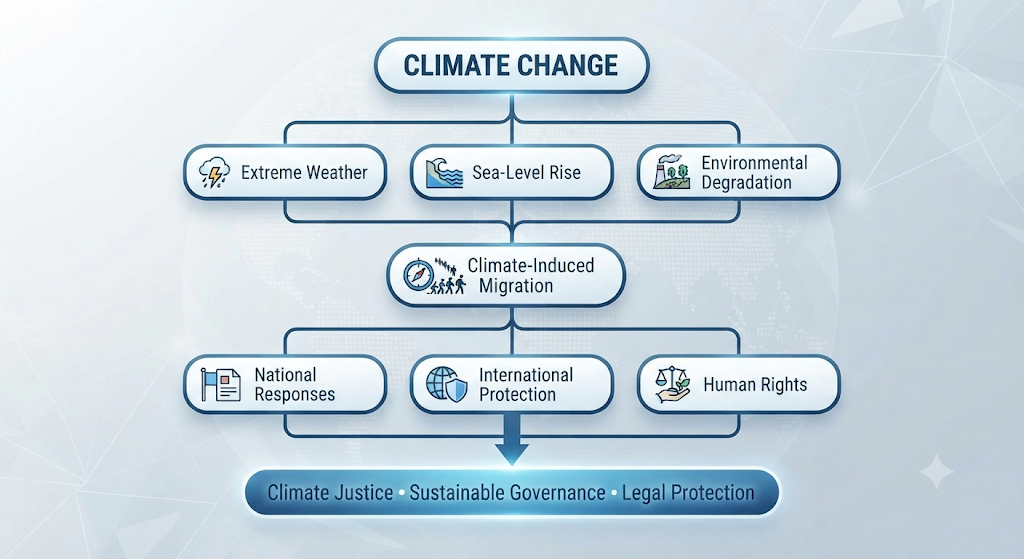
Figure: Conceptual Background
National governments have similarly introduced climate adaptation policies, disaster management legislation, relocation programmes, social protection measures, and environmental planning strategies to reduce displacement risks and enhance resilience. However, considerable legal and institutional challenges remain regarding state responsibility, cross-border protection, human rights obligations, compensation, financing, and equitable burden-sharing. Climate-induced migration also raises broader questions concerning environmental justice, intergenerational equity, loss and damage, and the disproportionate impact of climate change on vulnerable populations who contribute least to global greenhouse gas emissions. This paper critically examines legal responses to climate-induced migration and displacement from national and international perspectives by evaluating existing legal frameworks, human rights obligations, disaster governance mechanisms, and emerging international policy developments. It further explores contemporary legal challenges and proposes reforms aimed at strengthening protection for climate-displaced persons while advancing climate justice, international solidarity, and sustainable development in an increasingly climate-affected world.
International and National Legal Framework Governing Climate-Induced Migration and Displacement#
The legal framework governing climate-induced migration and displacement has evolved through the combined efforts of international environmental law, international human rights law, refugee law, disaster law, and national climate adaptation policies. Although climate-induced displacement has become an increasingly significant global phenomenon, no comprehensive international treaty specifically recognizes or protects persons displaced solely because of climate change. The principal international refugee instrument, the Convention Relating to the Status of Refugees, 1951, together with its 1967 Protocol, grants refugee status only to individuals fleeing persecution based on race, religion, nationality, membership of a particular social group, or political opinion. Consequently, persons displaced by floods, droughts, sea-level rise, desertification, or other climate-related events generally fall outside the Convention's legal protection. Nevertheless, international human rights law provides important safeguards through instruments such as the Universal Declaration of Human Rights (1948), the International Covenant on Civil and Political Rights (1966), and the International Covenant on Economic, Social and Cultural Rights (1966), which recognize the rights to life, dignity, housing, food, health, and an adequate standard of living. These rights remain applicable to climate-displaced persons irrespective of their legal status. Within the climate change regime, the United Nations Framework Convention on Climate Change (UNFCCC), 1992, and the Paris Agreement, 2015, acknowledge the adverse impacts of climate change on vulnerable communities and encourage adaptation, resilience-building, and international cooperation. The Warsaw International Mechanism for Loss and Damage, established in 2013, and the Task Force on Displacement created under the Paris Agreement, specifically examine climate-related displacement and recommend policy measures to minimize, prevent, and address human mobility associated with climate change. Similarly, the Global Compact for Safe, Orderly and Regular Migration (2018) recognizes climate change, environmental degradation, and natural disasters as important drivers of migration and encourages States to develop coordinated migration governance strategies. The Sendai Framework for Disaster Risk Reduction (2015–2030) further emphasizes disaster preparedness, resilience, and planned relocation to reduce displacement risks arising from natural hazards. The International Organization for Migration (IOM) has also developed policy frameworks promoting humane, rights-based approaches to environmental migration and disaster displacement. At the national level, several countries have incorporated climate adaptation, disaster management, and relocation strategies into domestic legislation. India's Disaster Management Act, 2005, the National Action Plan on Climate Change (NAPCC), and various State Action Plans on Climate Change provide institutional mechanisms for disaster preparedness, rehabilitation, and climate resilience. Nations such as Bangladesh, New Zealand, Fiji, and several Pacific Island States have introduced adaptation programmes, planned relocation initiatives, and community resilience measures to respond to climate-induced displacement. Judicial developments have also contributed to legal protection, particularly the UN Human Rights Committee's decision in Ioane Teitiota v. New Zealand (2020), which recognized that severe climate change may, under certain circumstances, engage the principle of non-refoulement where returning an individual would expose them to life-threatening environmental conditions. Collectively, these international and national legal instruments demonstrate an evolving recognition of climate-induced migration as a multidimensional legal issue requiring integrated approaches grounded in human rights, environmental justice, disaster governance, and international cooperation. However, the absence of a dedicated international legal regime continues to present significant protection gaps for millions of climate-displaced persons worldwide.
Contemporary Legal Challenges in Climate-Induced Migration and Displacement#
Despite growing international recognition of climate-induced migration, significant legal and institutional challenges continue to impede effective protection for displaced populations. One of the foremost challenges is the absence of an internationally accepted legal definition of a "climate refugee." Because the 1951 Refugee Convention does not recognize environmental or climate-related displacement as a basis for refugee status, millions of individuals forced to leave their homes due to rising sea levels, floods, droughts, desertification, or other climate-related disasters remain outside the scope of international refugee protection. This legal gap creates uncertainty regarding the rights of displaced persons and the obligations of receiving States. Another major challenge concerns cross-border displacement, particularly for populations from small island developing states and low-lying coastal regions threatened by permanent inundation. Existing international law provides limited guidance regarding state responsibility, residency rights, citizenship, or legal status for communities whose territories may become uninhabitable because of climate change. Internal displacement also presents significant governance difficulties, requiring governments to balance disaster response, planned relocation, land acquisition, housing, livelihood restoration, and protection of cultural identity while ensuring respect for constitutional and human rights guarantees. Climate-induced migration disproportionately affects women, children, Indigenous peoples, older persons, persons with disabilities, and economically disadvantaged communities, thereby intensifying existing social inequalities and increasing vulnerability to poverty, exploitation, trafficking, and discrimination. Another important challenge relates to loss and damage financing, as developing countries often lack sufficient financial resources to implement adaptation measures, rehabilitation programmes, and resilient infrastructure despite contributing minimally to global greenhouse gas emissions. The principle of climate justice therefore raises difficult questions concerning historical responsibility, equitable burden-sharing, and financial assistance from developed nations. Legal complexities also arise from the interaction between environmental law, human rights law, refugee law, disaster management law, and migration law, resulting in fragmented governance and inconsistent protection standards. Furthermore, slow-onset environmental processes such as desertification, salinization, coastal erosion, and ecosystem degradation often make it difficult to determine the precise legal threshold at which environmental deterioration becomes displacement. Rapid urbanization caused by climate migration places additional pressure on housing, healthcare, employment, education, sanitation, and public services in receiving communities. The increasing frequency of climate-related disasters further challenges the capacity of national institutions to respond effectively through emergency relief, rehabilitation, and long-term adaptation planning. Weak international coordination, limited data collection, insufficient early warning systems, and inconsistent national policies continue to hinder comprehensive responses to climate-induced displacement. Addressing these complex challenges requires stronger international legal cooperation, harmonized migration policies, enhanced disaster preparedness, greater climate finance, rights-based relocation strategies, and recognition that climate-induced migration represents not only an environmental issue but also a pressing matter of human rights, sustainable development, and global justice.
Future Directions and Legal Reforms for Addressing Climate-Induced Migration and Displacement#
The growing scale and complexity of climate-induced migration demand comprehensive legal reforms at both national and international levels to ensure effective protection of displaced populations while promoting climate resilience and sustainable development. Future legal frameworks should prioritize the development of an internationally recognized legal instrument or protocol specifically addressing climate-induced displacement, thereby filling the existing protection gap left by the 1951 Refugee Convention. Such a framework should clearly define the rights of climate-displaced persons, establish minimum standards of protection, clarify the responsibilities of States, and provide mechanisms for international cooperation and burden-sharing.
International organizations, including the United Nations, the International Organization for Migration (IOM), the United Nations High Commissioner for Refugees (UNHCR), and the United Nations Framework Convention on Climate Change (UNFCCC), should strengthen coordination in developing harmonized policies on planned relocation, cross-border mobility, disaster preparedness, and humanitarian assistance. Governments should integrate climate-induced migration into national climate adaptation strategies, disaster risk reduction plans, urban development policies, and sustainable development programmes. Domestic legislation should include provisions for early warning systems, community resilience, relocation assistance, livelihood restoration, access to housing, healthcare, education, and legal remedies for displaced populations. Greater emphasis should also be placed on protecting vulnerable groups, including women, children, Indigenous peoples, older persons, and persons with disabilities, who are disproportionately affected by climate-related disasters. Climate finance mechanisms, including the Loss and Damage Fund established under international climate negotiations, should be expanded to support adaptation projects, relocation programmes, resilient infrastructure, and post-disaster rehabilitation, particularly in developing countries and small island developing states. Environmental impact assessments and climate risk assessments should become mandatory components of national development planning to reduce future displacement risks. Regional organizations should establish cooperative migration agreements that facilitate humanitarian protection, temporary residence, labour mobility, and emergency assistance for climate-displaced persons. Judicial institutions should continue interpreting constitutional rights, environmental rights, and international human rights obligations in a manner that strengthens protection for individuals facing life-threatening climate conditions. Advances in geographic information systems, satellite monitoring, artificial intelligence, and climate modelling should be utilized to improve disaster forecasting, migration planning, and evidence-based policymaking. Public participation, community consultation, and respect for Indigenous knowledge should also guide relocation and adaptation initiatives to ensure culturally appropriate and socially inclusive outcomes.
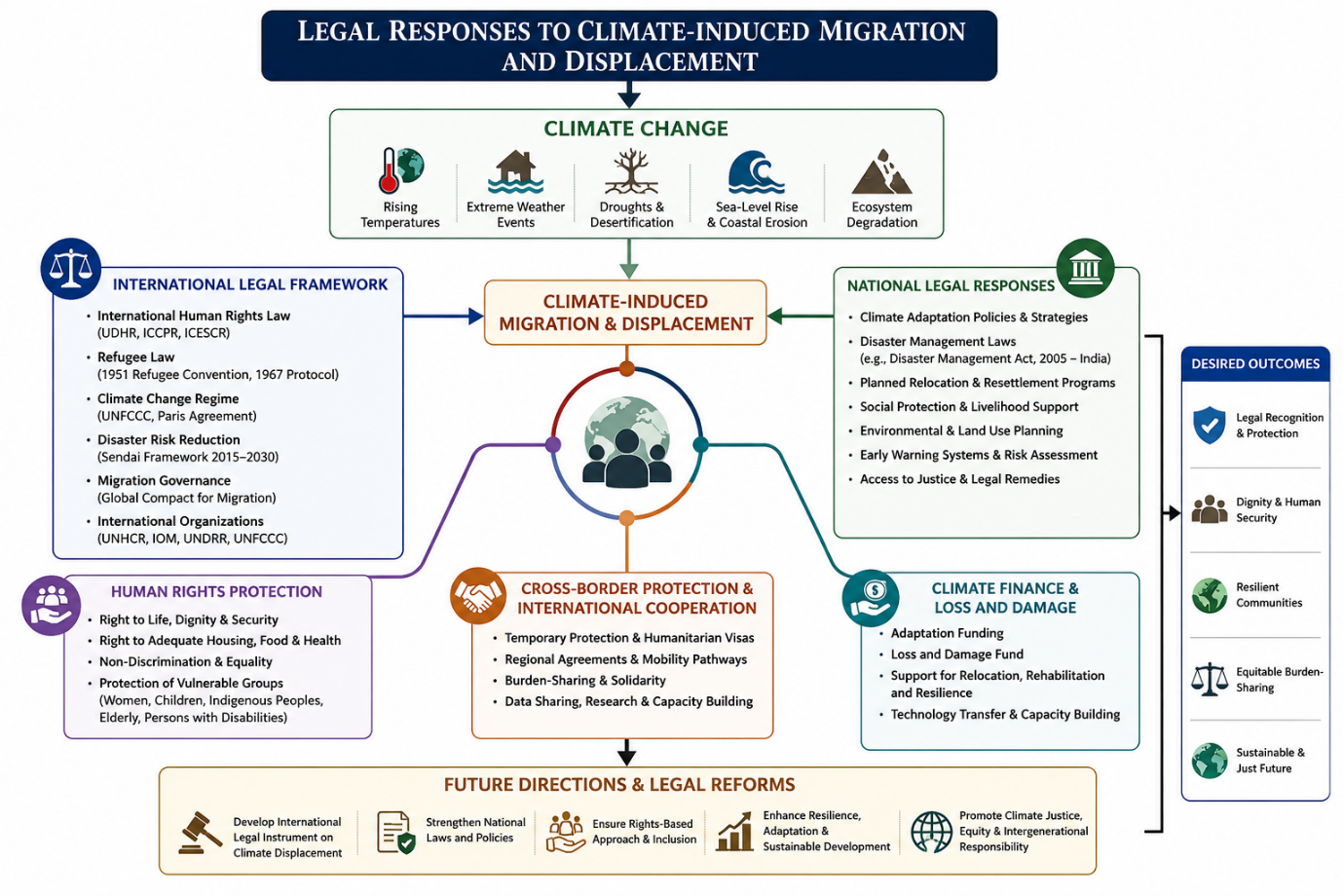
Figure: Future Directions and Legal Reforms
Ultimately, climate-induced migration should be recognized not merely as a humanitarian challenge but as an issue of environmental justice, human rights, and global governance requiring shared responsibility among nations. By strengthening legal frameworks, promoting international solidarity, expanding climate finance, and adopting rights-based approaches to migration governance, the international community can develop more effective and equitable responses to one of the defining challenges of climate change in the twenty-first century.
Role of Human Rights, Climate Justice, and International Cooperation in Protecting Climate-Displaced Persons#
The increasing incidence of climate-induced migration has reinforced the need to view environmental displacement not merely as a consequence of climate change but as a significant human rights and global justice issue. Climate-related disasters and environmental degradation threaten a wide range of internationally recognized human rights, including the rights to life, health, food, water, housing, education, work, culture, and an adequate standard of living. These rights are protected under international human rights instruments such as the Universal Declaration of Human Rights (1948), the International Covenant on Civil and Political Rights (1966), and the International Covenant on Economic, Social and Cultural Rights (1966). Although these treaties do not specifically address climate-induced migration, they establish legal obligations requiring States to protect individuals from conditions that seriously endanger their dignity and survival. Climate change increasingly affects the enjoyment of these rights by destroying homes, agricultural land, freshwater resources, and critical infrastructure, thereby forcing communities to migrate either temporarily or permanently. Consequently, a rights-based approach to climate-induced migration has become essential for ensuring that displaced persons receive legal protection, humanitarian assistance, and equal access to justice without discrimination.The principle of climate justice has emerged as one of the most influential concepts in international environmental law and climate governance. Climate justice recognizes that the impacts of climate change are distributed unequally across countries and communities. Developing countries, small island developing states, Indigenous communities, and economically disadvantaged populations often contribute the least to global greenhouse gas emissions while suffering the greatest environmental, economic, and social consequences. This disparity raises important legal and ethical questions concerning historical responsibility, equitable burden-sharing, financial assistance, and international solidarity. The principle of Common but Differentiated Responsibilities and Respective Capabilities (CBDR-RC) under the United Nations Framework Convention on Climate Change (UNFCCC) acknowledges these inequalities by requiring developed countries to provide financial resources, technology transfer, and capacity-building support to developing nations. Climate-induced migration therefore cannot be addressed solely through domestic policies but requires meaningful international cooperation based on fairness, shared responsibility, and sustainable development.
International cooperation has become increasingly important because climate-induced migration frequently involves cross-border movement and transnational humanitarian concerns. International organizations such as the United Nations High Commissioner for Refugees (UNHCR), the International Organization for Migration (IOM), the United Nations Development Programme (UNDP), the Office for the Coordination of Humanitarian Affairs (OCHA), and the Platform on Disaster Displacement play vital roles in coordinating humanitarian assistance, disaster preparedness, relocation planning, and policy development. Collaborative initiatives including the Global Compact for Safe, Orderly and Regular Migration, the Sendai Framework for Disaster Risk Reduction, and the Paris Agreement encourage States to strengthen resilience, improve disaster risk management, enhance adaptive capacity, and integrate climate mobility into national development planning. Regional organizations can also contribute by establishing cooperative mechanisms for emergency response, temporary protection, humanitarian visas, labour mobility, and managed relocation programmes for populations affected by climate-related disasters.Another important aspect of international cooperation concerns climate finance. Adequate financial assistance is essential for supporting adaptation projects, resilient infrastructure, disaster preparedness, relocation programmes, livelihood restoration, and rehabilitation of affected communities. The establishment of the Loss and Damage Fund at the United Nations Climate Change Conference (COP27) represents a significant step toward recognizing the financial needs of countries experiencing severe climate impacts. However, ensuring equitable and timely access to climate finance remains a major challenge, particularly for least developed countries and small island developing states. Financial mechanisms should prioritize vulnerable populations, support community-based adaptation projects, and strengthen local governance institutions capable of responding effectively to climate-related displacement.
The protection of vulnerable groups requires particular attention within climate migration governance. Women, children, older persons, Indigenous peoples, persons with disabilities, and marginalized communities often face disproportionate risks during displacement due to social inequalities, limited access to resources, and structural discrimination. National and international legal frameworks should therefore adopt inclusive policies that guarantee equal participation in relocation planning, protect cultural identity and traditional livelihoods, ensure access to education and healthcare, and provide effective legal remedies against discrimination and exploitation. Indigenous knowledge systems should also be recognized as valuable sources of environmental adaptation strategies capable of strengthening community resilience and sustainable resource management.Judicial institutions have increasingly contributed to the development of climate-related human rights jurisprudence by interpreting constitutional rights in light of environmental protection and climate obligations. Courts in several jurisdictions have recognized that governments possess legal duties to safeguard citizens from foreseeable climate risks and environmental harm. Such judicial developments reinforce the principle that climate-induced displacement engages not only environmental responsibilities but also constitutional guarantees relating to dignity, equality, and the right to life.
Ultimately, effective protection of climate-displaced persons requires integrating international human rights law, environmental law, disaster governance, migration policy, and sustainable development into a coherent legal framework. Governments must strengthen domestic legislation while simultaneously participating in international cooperation mechanisms that promote climate justice, financial solidarity, technological assistance, and equitable burden-sharing. A comprehensive rights-based approach supported by strong institutions, international partnerships, and inclusive policymaking will ensure that climate-induced migration is addressed with humanity, legality, and fairness, thereby protecting vulnerable populations while advancing global climate resilience and sustainable development.
Conclusion#
Climate-induced migration and displacement have emerged as some of the most significant legal and humanitarian challenges of the twenty-first century, reflecting the far-reaching consequences of climate change on human security, sustainable development, and international governance. Rising sea levels, extreme weather events, prolonged droughts, desertification, floods, and ecosystem degradation continue to force millions of individuals and communities to leave their homes, often without adequate legal recognition or protection. Although existing international legal instruments, including international human rights law, environmental law, disaster risk reduction frameworks, and climate agreements, provide important principles for protecting affected populations, the absence of a dedicated international legal regime governing climate-induced displacement remains a major gap in global governance. National governments have adopted various adaptation strategies, disaster management laws, relocation programmes, and climate resilience policies; however, significant disparities persist in institutional capacity, legal protection, and access to financial resources. Climate-induced migration disproportionately affects vulnerable populations, including women, children, Indigenous peoples, older persons, and economically disadvantaged communities, thereby intensifying existing social and economic inequalities. The principle of climate justice highlights the responsibility of the international community to support developing countries that contribute least to global greenhouse gas emissions yet suffer the most severe climate impacts. Effective legal responses therefore require stronger international cooperation, expanded climate finance, equitable burden-sharing, and greater integration of climate adaptation with migration governance and human rights protection. International institutions should continue strengthening mechanisms addressing planned relocation, disaster preparedness, cross-border mobility, and humanitarian assistance while encouraging harmonized legal standards capable of protecting climate-displaced persons. Domestic legal systems should integrate climate considerations into land-use planning, housing policy, environmental governance, disaster management, and sustainable development strategies to reduce future displacement risks. Emerging technologies, improved climate forecasting, and community-based adaptation programmes should further support evidence-based policymaking and resilience-building. Ultimately, responding effectively to climate-induced migration requires recognizing that environmental displacement is not merely an ecological consequence but a profound legal, social, and human rights issue demanding collective international action. By adopting comprehensive legal reforms, reinforcing international solidarity, safeguarding fundamental rights, and promoting sustainable development, governments and international organizations can build a more resilient and equitable framework capable of protecting climate-displaced persons while advancing environmental justice, human dignity, and global cooperation in an era of accelerating climate change.
Works Cited#
- Convention Relating to the Status of Refugees, 189 U.N.T.S. 137 (1951), and Protocol Relating to the Status of Refugees, 606 U.N.T.S. 267 (1967).
- Government of India. (2005). The Disaster Management Act, 2005. Ministry of Home Affairs.
- Intergovernmental Panel on Climate Change. (2023). Climate Change 2023: Synthesis Report. IPCC.
- International Organization for Migration. (2021). Institutional Strategy on Migration, Environment and Climate Change 2021–2030. IOM.
- International Organization for Migration. (2024). World Migration Report 2024. IOM.
- United Nations. (1948). Universal Declaration of Human Rights. United Nations.
- United Nations. (1966). International Covenant on Civil and Political Rights. United Nations.
- United Nations. (1966). International Covenant on Economic, Social and Cultural Rights. United Nations.
- United Nations Framework Convention on Climate Change. (1992). United Nations Framework Convention on Climate Change. United Nations.
- United Nations Framework Convention on Climate Change. (2015). Paris Agreement. United Nations.
- United Nations Framework Convention on Climate Change. (2023). Warsaw International Mechanism for Loss and Damage. UNFCCC.
- United Nations General Assembly. (2018). Global Compact for Safe, Orderly and Regular Migration. United Nations.
- United Nations Office for Disaster Risk Reduction. (2015). Sendai Framework for Disaster Risk Reduction 2015–2030. UNDRR.
- United Nations Human Rights Committee. (2020). Ioane Teitiota v. New Zealand, Communication No. 2728/2016.
- United Nations High Commissioner for Refugees. (2024). Global Trends: Forced Displacement in 2024. UNHCR.
- Black, R., Bennett, S. R. G., Thomas, S. M., & Beddington, J. R. (2011). Climate change: Migration as adaptation. Nature, 478(7370), 447–449.
- Clement, V., Rigaud, K. K., de Sherbinin, A., Jones, B., Adamo, S., Schewe, J., et al. (2021). Groundswell Part 2: Acting on Internal Climate Migration. World Bank.
- Kälin, W. (2010). Conceptualising Climate-Induced Displacement. In J. McAdam (Ed.), Climate Change and Displacement: Multidisciplinary Perspectives (pp. 81–103). Hart Publishing.
- Office of the United Nations High Commissioner for Human Rights. (2022). The Slow Onset Effects of Climate Change and Human Rights Protection for Cross-Border Migrants. United Nations.
- United Nations Environment Programme. (2024). Adaptation Gap Report 2024. United Nations Environment Programme.