Abstract
Comparative constitutional law has emerged as one of the most dynamic fields of legal scholarship in the twenty-first century. Increasing globalization, technological innovation, transnational judicial dialogue, democratic transformations, and the emergence of new constitutional challenges have significantly reshaped constitutional governance across the world. Modern constitutions are no longer viewed merely as domestic legal documents but increasingly function within a global constitutional ecosystem where courts, legislatures, and international institutions exchange ideas and interpret constitutional values through comparative perspectives. Issues such as digital privacy, artificial intelligence, environmental protection, climate justice, migration, public health emergencies, minority rights, and constitutional responses to authoritarianism have encouraged constitutional systems to learn from one another while preserving national sovereignty and constitutional identity.Comparative constitutional law offers valuable insights into constitutional design, judicial review, federalism, separation of powers, human rights protection, and democratic accountability. However, constitutional borrowing also raises significant concerns regarding legal transplantation, cultural diversity, constitutional legitimacy, judicial activism, and political acceptance. Different jurisdictions face varying historical, social, economic, and institutional contexts that influence constitutional interpretation and implementation. This chapter critically examines the emerging trends shaping comparative constitutional law in the twenty-first century. It explores globalization and constitutional convergence, technological and environmental constitutionalism, judicial dialogue and constitutional borrowing, as well as future challenges and opportunities in comparative constitutional governance. The study concludes that comparative constitutional law has become an indispensable tool for strengthening democratic institutions, protecting fundamental rights, and addressing complex global constitutional challenges while respecting constitutional diversity and national autonomy.
- Comparative Constitutional Law
- Constitutionalism
- Judicial Review
- Constitutional Borrowing
- Human Rights
- Globalization
- Constitutional Identity
- Democratic Governance
- Environmental Constitutionalism
- Digital Rights
Introduction#
Comparative constitutional law refers to the systematic study and comparison of constitutional systems, institutions, principles, judicial decisions, and constitutional practices across different countries. Unlike traditional constitutional law, which primarily focuses on a single nation's constitutional framework, comparative constitutional law examines similarities and differences among constitutions to understand how different legal systems address common constitutional problems. In the twenty-first century, the field has gained unprecedented importance due to globalization, international human rights movements, judicial cooperation, technological advancement, environmental challenges, and democratic transitions.
Historically, constitutions were considered expressions of national sovereignty reflecting unique historical experiences and political cultures. However, globalization has transformed constitutional governance into a more interconnected process. Constitutional courts increasingly refer to foreign judicial decisions while interpreting constitutional provisions related to equality, privacy, freedom of expression, gender justice, environmental protection, and socio-economic rights. Constitutional dialogue among courts has become an important feature of contemporary constitutional adjudication.
The emergence of constitutional democracies after the Cold War further accelerated constitutional exchanges. Newly independent and democratizing nations frequently adopted constitutional provisions inspired by successful constitutional models from countries such as Germany, South Africa, Canada, India, and the United States. These constitutional borrowings facilitated the protection of human rights, establishment of independent judiciaries, decentralization of power, and constitutional accountability.
Technological developments have introduced entirely new constitutional questions. Artificial intelligence, digital surveillance, biometric identification, cybersecurity, data privacy, algorithmic governance, and social media regulation challenge conventional constitutional doctrines concerning privacy, equality, freedom of speech, and due process. Comparative constitutional law enables policymakers and courts to examine how different jurisdictions balance technological innovation with constitutional liberties.
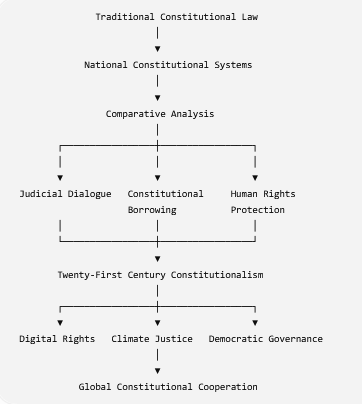
Figure: Evolution of Comparative Constitutional Law
Similarly, climate change has encouraged the recognition of environmental constitutionalism across many countries. Constitutional courts increasingly recognize environmental protection as a constitutional obligation linked with the right to life, sustainable development, and intergenerational equity. Comparative constitutional experiences provide valuable guidance for addressing climate litigation and environmental governance.
Despite these opportunities, comparative constitutional law also encounters numerous challenges. Constitutional transplantation without considering local socio-political realities may weaken constitutional legitimacy. Excessive reliance on foreign precedents can generate debates regarding judicial activism, democratic accountability, constitutional sovereignty, and national constitutional identity. Consequently, constitutional comparison requires careful adaptation rather than mechanical imitation.In today's interconnected legal environment, comparative constitutional law serves as a bridge between domestic constitutional traditions and global constitutional values. It contributes to democratic resilience, constitutional innovation, judicial learning, and effective protection of fundamental rights while preserving constitutional diversity.
Globalization, Constitutional Borrowing, and Judicial Dialogue#
The twenty-first century has witnessed an unprecedented integration of constitutional systems through globalization, judicial interaction, and the exchange of constitutional ideas across national boundaries. Comparative constitutional law has evolved from a purely academic discipline into an influential mechanism that guides constitutional reforms, judicial interpretation, and legislative policymaking. While constitutions continue to embody the historical, cultural, and political identity of individual nations, they increasingly reflect universal constitutional values such as democracy, rule of law, human rights, judicial independence, equality, and accountability. This growing interaction among constitutional systems has encouraged the development of constitutional borrowing and judicial dialogue, enabling countries to learn from one another while addressing common legal and governance challenges.
Globalization has significantly transformed constitutional governance by increasing economic interdependence, international migration, technological connectivity, and participation in global institutions. International treaties, regional organizations, and human rights conventions have influenced domestic constitutional development, compelling states to harmonize national laws with internationally accepted constitutional principles. Constitutional courts now regularly confront issues that transcend national borders, including digital privacy, climate change, transnational terrorism, refugee protection, international trade, and public health emergencies. Comparative constitutional analysis provides judges with broader perspectives and innovative legal solutions when domestic constitutional provisions offer limited guidance.
One of the most significant developments in comparative constitutional law is constitutional borrowing, also known as constitutional transplantation. Constitutional borrowing refers to the adoption of constitutional provisions, legal doctrines, institutional arrangements, or judicial principles from one jurisdiction into another. Newly independent states, transitional democracies, and countries undertaking constitutional reforms often study successful constitutional models before drafting or amending their constitutions. For example, several modern constitutions have incorporated bills of rights inspired by international human rights instruments, independent constitutional courts modeled after European systems, federal structures influenced by established federations, and mechanisms for judicial review based on comparative constitutional experiences.
Constitutional borrowing extends beyond constitutional drafting. Legislatures frequently adopt comparative approaches when enacting laws relating to privacy, environmental protection, gender equality, anti-discrimination measures, electoral reforms, and administrative accountability. Such borrowing enables policymakers to benefit from tested constitutional practices while avoiding mistakes encountered in other jurisdictions. However, constitutional borrowing is not a process of simple replication. Successful constitutional transplantation requires adaptation to local political culture, historical traditions, institutional capacity, and societal expectations. Constitutional provisions that function effectively in one country may produce unintended consequences in another if transplanted without contextual modification.
Another defining feature of modern comparative constitutional law is judicial dialogue, which refers to the practice of constitutional courts consulting, citing, and engaging with judicial decisions from foreign jurisdictions and international tribunals. Courts increasingly recognize that constitutional problems such as freedom of speech, privacy rights, equality, environmental protection, and proportionality analysis are shared across legal systems. Consequently, comparative judicial reasoning enriches constitutional interpretation by providing persuasive authority rather than binding precedent.
Judicial dialogue contributes to the gradual emergence of global constitutional principles. Courts frequently examine foreign judgments when interpreting constitutional rights related to dignity, personal liberty, religious freedom, same-sex equality, freedom of expression, and access to justice. Comparative references encourage consistency in constitutional reasoning while allowing judges to evaluate diverse legal approaches before adopting solutions suitable for domestic constitutional contexts. This dialogue has become particularly prominent among constitutional courts in democratic nations that share commitments to constitutional supremacy and the protection of fundamental rights.
Global constitutionalism has also strengthened cooperation among judges through international judicial conferences, constitutional associations, academic exchanges, and collaborative legal research. These interactions promote the sharing of constitutional experiences concerning electoral integrity, emergency powers, anti-corruption measures, separation of powers, federalism, and judicial independence. Such cooperation enhances institutional learning and improves constitutional governance across jurisdictions.
Despite its advantages, globalization presents several constitutional challenges. Critics argue that excessive reliance on foreign constitutional jurisprudence may undermine democratic legitimacy by allowing unelected judges to incorporate external legal values without adequate domestic political deliberation. Concerns also arise regarding constitutional identity, sovereignty, and cultural diversity. Every constitution reflects unique historical experiences, social values, religious traditions, and political compromises that cannot always be replicated through comparative borrowing. Therefore, courts must exercise caution when relying on comparative constitutional materials and ensure that foreign precedents complement rather than replace domestic constitutional interpretation.
Furthermore, globalization has intensified constitutional debates concerning immigration, multiculturalism, digital governance, public health regulation, economic inequality, and national security. Comparative constitutional law provides valuable analytical frameworks for balancing competing constitutional values while respecting local democratic preferences. Instead of encouraging uniform constitutional solutions, comparative constitutional analysis promotes informed constitutional decision-making based on shared experiences and contextual adaptation.
Ultimately, globalization, constitutional borrowing, and judicial dialogue have transformed comparative constitutional law into an essential instrument for constitutional innovation, democratic consolidation, and effective governance. These developments strengthen constitutional resilience by facilitating institutional learning while preserving the diversity that characterizes constitutional democracies throughout the world.
Emerging Constitutional Issues: Technology, Environment, and Human Rights#
The twenty-first century has introduced constitutional challenges that were largely unimaginable when many national constitutions were originally drafted. Rapid technological innovation, escalating environmental crises, global public health emergencies, artificial intelligence, cyber governance, and expanding human rights jurisprudence have fundamentally reshaped constitutional discourse. Comparative constitutional law provides an effective framework for understanding how different constitutional systems respond to these emerging issues while balancing individual freedoms, governmental responsibilities, and collective societal interests.
One of the most transformative developments is the constitutional impact of digital technology and artificial intelligence (AI). Governments increasingly rely on AI-driven decision-making systems, facial recognition technologies, predictive policing, biometric databases, automated public services, and algorithmic governance. Although these technologies improve administrative efficiency, they simultaneously raise significant constitutional concerns regarding privacy, equality, due process, transparency, and accountability. Constitutional courts across different jurisdictions have begun examining whether algorithmic decisions satisfy constitutional guarantees of fairness and non-discrimination. Comparative constitutional analysis enables policymakers to study how various legal systems regulate AI while safeguarding constitutional rights and democratic oversight.
Digital privacy has emerged as one of the defining constitutional rights of the information age. Massive data collection by governments, private corporations, and digital platforms has created unprecedented risks to individual autonomy and informational self-determination. Constitutional courts increasingly recognize that the right to privacy extends beyond physical spaces to include personal data, online communications, digital identities, and electronic surveillance. Comparative constitutional jurisprudence has significantly contributed to developing principles governing data protection, cybersecurity, government surveillance, and cross-border information sharing. These developments demonstrate how constitutional law continuously evolves to address technological advancements without compromising fundamental freedoms.
Freedom of expression in the digital era presents another complex constitutional challenge. Social media platforms have transformed democratic participation by enabling instant communication and public debate. However, online misinformation, hate speech, cyberbullying, election interference, and digital manipulation threaten democratic institutions and constitutional governance. Constitutional systems differ considerably in balancing freedom of speech with restrictions necessary to protect public order, national security, and human dignity. Comparative constitutional law assists legislators and courts in evaluating diverse regulatory approaches while preserving constitutional commitments to free expression and democratic accountability.
Environmental constitutionalism has also become a major area of comparative constitutional development. Climate change, biodiversity loss, environmental pollution, and resource depletion increasingly threaten the realization of constitutional rights such as life, health, livelihood, and human dignity. Many constitutions now explicitly recognize the right to a healthy environment or impose constitutional duties upon governments to protect natural resources for future generations. Constitutional courts have interpreted environmental protection as an integral component of sustainable development and intergenerational justice. Comparative constitutional experiences provide valuable guidance for climate litigation, environmental governance, and constitutional accountability concerning ecological preservation.
The constitutional recognition of climate justice has expanded significantly during recent decades. Courts increasingly acknowledge that vulnerable communities disproportionately bear the consequences of environmental degradation despite contributing least to global emissions. Comparative constitutional law facilitates the exchange of innovative legal doctrines concerning environmental rights, public trust principles, precautionary approaches, and state obligations toward future generations. These developments illustrate the growing relationship between constitutional law and sustainable development.
Human rights protection remains at the center of comparative constitutional scholarship. Contemporary constitutional systems increasingly recognize that civil, political, economic, social, cultural, and environmental rights are interdependent and mutually reinforcing. Constitutional jurisprudence has progressively expanded protections relating to gender equality, disability rights, children's rights, indigenous peoples, refugees, migrants, LGBTQ+ communities, and minority groups. Comparative constitutional analysis enables judges to examine how different legal systems interpret equality, dignity, proportionality, and non-discrimination while respecting diverse constitutional traditions.
The COVID-19 pandemic further demonstrated the importance of comparative constitutional law in responding to global emergencies. Governments introduced lockdowns, travel restrictions, vaccination policies, emergency regulations, and surveillance mechanisms to protect public health. These measures raised constitutional questions concerning proportionality, emergency powers, judicial oversight, economic freedoms, and individual liberties. Comparative constitutional experiences provided valuable lessons regarding the constitutional limits of executive authority during crises and emphasized the necessity of maintaining democratic accountability even under emergency conditions.
Emerging constitutional issues also include biotechnology, genetic engineering, digital currencies, autonomous weapons, space governance, and cross-border cybercrime. These evolving fields require constitutional systems to continuously reinterpret traditional constitutional principles within rapidly changing technological and scientific contexts. Comparative constitutional law promotes innovation by encouraging constitutional dialogue, interdisciplinary research, and international cooperation while respecting constitutional diversity.
Overall, technology, environmental sustainability, and human rights represent the most influential forces shaping constitutional development in the twenty-first century. Comparative constitutional law equips courts, legislatures, scholars, and policymakers with the analytical tools necessary to address these challenges effectively while preserving democratic governance, constitutional legitimacy, and the protection of fundamental rights.
Challenges and Future Opportunities in Comparative Constitutional Law#
Comparative constitutional law has become an indispensable discipline for understanding constitutional governance in an increasingly interconnected world; however, its continued evolution is accompanied by numerous legal, political, institutional, and technological challenges that require careful examination. One of the foremost challenges is balancing constitutional borrowing with constitutional identity. Although constitutions frequently adopt successful legal principles and institutional mechanisms from foreign jurisdictions, constitutional transplantation cannot simply replicate another country's constitutional experience because every constitution is shaped by unique historical developments, cultural traditions, political institutions, and social realities. A constitutional provision that functions effectively within one legal system may produce entirely different outcomes when implemented in another without considering local democratic values, administrative capacity, and public expectations. Consequently, constitutional borrowing must remain adaptive rather than mechanical. Another significant challenge concerns the growing debate over judicial activism and democratic legitimacy. Constitutional courts increasingly cite foreign judicial decisions while interpreting constitutional provisions on privacy, equality, human dignity, environmental protection, and freedom of expression. While comparative judicial reasoning enriches constitutional interpretation and promotes consistency in protecting fundamental rights, critics argue that excessive reliance on foreign precedents may reduce democratic accountability by allowing unelected judges to incorporate external constitutional philosophies that have not been endorsed through domestic legislative or constitutional processes. This debate reflects the continuing tension between constitutional innovation and constitutional sovereignty. The rapid advancement of digital technologies further complicates constitutional governance. Artificial intelligence, machine learning, facial recognition systems, blockchain technology, digital currencies, algorithmic governance, autonomous decision-making systems, and large-scale data analytics have created constitutional questions that traditional constitutional frameworks were never designed to address. Governments increasingly rely on digital technologies to provide public services, maintain national security, regulate financial systems, and improve administrative efficiency, yet these technologies simultaneously raise concerns regarding privacy, surveillance, equality, transparency, accountability, and procedural fairness. Comparative constitutional law provides valuable guidance by allowing constitutional courts and policymakers to examine diverse regulatory models developed across different jurisdictions while ensuring that technological innovation remains consistent with constitutional rights. Climate change represents another defining constitutional challenge of the twenty-first century. Rising global temperatures, biodiversity loss, environmental degradation, water scarcity, natural disasters, and ecological displacement have transformed environmental protection into a constitutional responsibility rather than merely a policy objective. Constitutional courts across various jurisdictions increasingly recognize environmental rights, sustainable development, intergenerational equity, and ecological justice as integral components of constitutional governance. Comparative constitutional experiences have contributed to developing legal principles such as the public trust doctrine, precautionary principle, polluter-pays principle, and constitutional duties of environmental stewardship. Future constitutional development will likely witness greater constitutional recognition of climate justice and ecological sustainability.
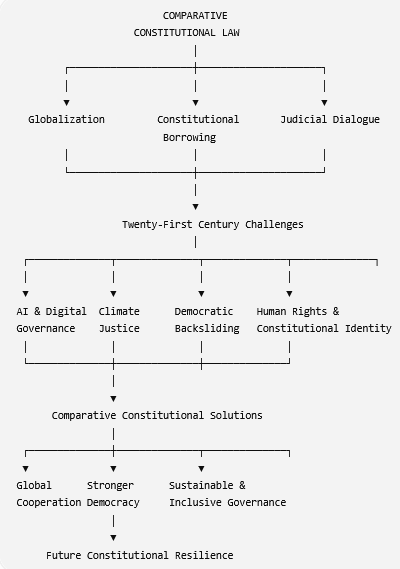
Figure: Emerging Trends, Challenges, and Opportunities in Comparative Constitutional Law
Democratic backsliding also presents a significant concern for comparative constitutional scholars. Several constitutional democracies have experienced increasing executive dominance, weakening legislative oversight, restrictions on judicial independence, declining press freedom, political polarization, and erosion of constitutional checks and balances. Comparative constitutional law provides valuable lessons by examining how different constitutional systems safeguard judicial independence, electoral integrity, federalism, separation of powers, anti-corruption mechanisms, and constitutional accountability during periods of political instability. Strengthening constitutional institutions through comparative learning can enhance democratic resilience against authoritarian tendencies. Another emerging challenge involves globalization itself. International organizations, regional human rights systems, transnational trade agreements, and global governance institutions increasingly influence domestic constitutional policymaking, creating tensions between international obligations and national constitutional autonomy. While constitutional convergence encourages the universal protection of human rights and democratic principles, constitutional pluralism emphasizes respect for constitutional diversity and national self-determination. Future comparative constitutional scholarship must therefore reconcile global constitutional values with domestic constitutional traditions by encouraging constitutional dialogue rather than constitutional uniformity. The growing recognition of socio-economic rights—including rights to education, healthcare, housing, food security, clean water, digital access, and social protection—also presents opportunities for constitutional innovation. Many constitutions increasingly acknowledge that meaningful democracy requires not only civil and political freedoms but also social and economic justice. Comparative constitutional experiences enable governments to evaluate successful constitutional models for implementing welfare rights while balancing fiscal sustainability and democratic accountability. Technological globalization, cross-border migration, cybersecurity, pandemic preparedness, biotechnology, genetic engineering, digital citizenship, and space governance will continue generating novel constitutional questions that require international cooperation and interdisciplinary research. Future constitutional courts are expected to engage more actively in transnational judicial dialogue while remaining sensitive to domestic constitutional contexts. Legal education and constitutional scholarship will likewise become increasingly comparative, interdisciplinary, and globally connected, preparing future lawyers, judges, legislators, and policymakers to address complex constitutional issues extending beyond national borders. Ultimately, the future of comparative constitutional law lies not in creating identical constitutional systems but in fostering informed constitutional dialogue, promoting institutional learning, strengthening democratic governance, protecting fundamental rights, and encouraging innovative constitutional solutions that respect both universal constitutional principles and the rich diversity of constitutional traditions across the world
Conclusion#
Comparative constitutional law has emerged as one of the most influential and rapidly evolving fields of legal scholarship in the twenty-first century, providing an essential framework for understanding how constitutional systems respond to common challenges while preserving their unique constitutional identities. The increasing interconnectedness of nations through globalization, technological advancement, international human rights norms, environmental concerns, global public health crises, and transnational governance has transformed constitutions from purely domestic legal instruments into dynamic frameworks that continuously interact with constitutional developments across the world. Modern constitutionalism is no longer confined within national boundaries; instead, constitutional courts, legislatures, policymakers, and scholars regularly engage in comparative analysis to evaluate innovative constitutional solutions for emerging legal and governance challenges. Throughout this chapter, it has been demonstrated that globalization has significantly expanded constitutional dialogue, enabling countries to learn from one another through constitutional borrowing, judicial cooperation, and the exchange of constitutional principles concerning democracy, rule of law, judicial independence, federalism, separation of powers, and human rights protection. Comparative constitutional law has facilitated constitutional reforms in both developed and developing democracies by promoting institutional learning while encouraging constitutional adaptation rather than mechanical transplantation. At the same time, the study recognizes that constitutional borrowing must always respect historical experiences, political institutions, cultural diversity, and constitutional identity because successful constitutional governance depends upon public legitimacy and local constitutional traditions. The chapter has also highlighted the growing importance of comparative constitutional approaches in addressing contemporary issues such as artificial intelligence, digital privacy, cybersecurity, algorithmic governance, online freedom of expression, climate change, environmental sustainability, migration, pandemic governance, and socio-economic rights. These challenges transcend national borders and require constitutional systems to develop innovative legal responses that protect individual liberties while ensuring effective governance. Comparative constitutional analysis enables courts and policymakers to evaluate diverse constitutional models, identify best practices, and avoid repeating institutional failures experienced elsewhere. Furthermore, the expansion of environmental constitutionalism demonstrates how constitutional law has evolved to recognize ecological sustainability, intergenerational equity, and climate justice as constitutional obligations closely connected with the protection of life, dignity, and public welfare. Similarly, the constitutional recognition of digital rights illustrates the adaptability of constitutional principles to technological transformations that were unimaginable when many constitutions were originally drafted. Despite these significant achievements, comparative constitutional law continues to face important challenges. Debates concerning judicial activism, constitutional sovereignty, democratic legitimacy, constitutional pluralism, and the appropriate use of foreign judicial precedents remain central to contemporary constitutional discourse. Excessive dependence on comparative jurisprudence without adequate consideration of domestic constitutional contexts may undermine democratic accountability and public confidence in constitutional institutions. Therefore, comparative constitutional law should function as a persuasive source of constitutional learning rather than a mandatory model for constitutional decision-making. The future of comparative constitutional law lies in maintaining a careful balance between universal constitutional values and national constitutional diversity. Constitutional systems must remain sufficiently flexible to address new technological, environmental, social, and geopolitical developments while preserving the fundamental constitutional principles that safeguard democracy, human dignity, equality, justice, and the rule of law. Emerging fields such as artificial intelligence regulation, biotechnology, digital citizenship, space governance, cyber warfare, global health governance, and climate migration will continue generating constitutional questions that require interdisciplinary research and international cooperation. Comparative constitutional law will therefore play an increasingly important role in promoting constitutional resilience, democratic stability, institutional accountability, and effective governance in an era characterized by rapid global transformation. It encourages constitutional innovation through informed dialogue rather than uniformity, allowing each nation to strengthen its constitutional framework while remaining responsive to international developments and domestic aspirations. Ultimately, comparative constitutional law represents not merely a method of comparing constitutions but a continuing process of constitutional learning that advances democratic governance, protects fundamental rights, promotes judicial excellence, and contributes to building more inclusive, accountable, and resilient constitutional democracies capable of meeting the complex legal challenges of the twenty-first century.
Works Cited#
- Ackerman, B. (1991). We the People: Foundations. Harvard University Press.
- Barak, A. (2006). The Judge in a Democracy. Princeton University Press.
- Choudhry, S. (Ed.). (2006). The Migration of Constitutional Ideas. Cambridge University Press.
- Daly, T. G. (2020). Democratic Decay and the Rule of Law. Routledge.
- Dixon, R., & Ginsburg, T. (2011). Deciding not to decide: Deferral in constitutional design. International Journal of Constitutional Law, 9(3–4), 636–672.
- Ginsburg, T. (2018). How to Save a Constitutional Democracy. University of Chicago Press.
- Ginsburg, T., & Huq, A. Z. (2018). How to Save a Constitutional Democracy. University of Chicago Press.
- Hirschl, R. (2004). Towards Juristocracy: The Origins and Consequences of the New Constitutionalism. Harvard University Press.
- Jackson, V. C. (2010). Constitutional Engagement in a Transnational Era. Oxford University Press.
- Kumm, M. (2009). The cosmopolitan turn in constitutionalism. Indiana Journal of Global Legal Studies, 16(2), 605–628.
- Rosenfeld, M., & Sajó, A. (Eds.). (2012). The Oxford Handbook of Comparative Constitutional Law. Oxford University Press.
- Saunders, C. (2013). Comparative constitutional law in the courts. International and Comparative Law Quarterly, 62(1), 1–22.
- Stone Sweet, A. (2000). Governing with Judges: Constitutional Politics in Europe. Oxford University Press.
- Tushnet, M. (2014). Advanced Introduction to Comparative Constitutional Law. Edward Elgar Publishing.
- Tushnet, M. (2018). The Constitution of the United States of America: A Contextual Analysis. Hart Publishing.
- Waldron, J. (2012). Constitutionalism: A Skeptical View. New York University School of Law.
- Wheare, K. C. (1966). Modern Constitutions. Oxford University Press.
- Bell, J. (2014). Comparative Law. Oxford University Press.
- Gardbaum, S. (2013). The New Commonwealth Model of Constitutionalism. Cambridge University Press.
- Law, D. S., & Versteeg, M. (2012). The evolution and ideology of global constitutionalism. California Law Review, 99(5), 1163–1257