Abstract
Climate change has emerged as one of the most pressing global challenges of the twenty-first century, posing significant threats to ecosystems, human rights, public health, economic development, and sustainable governance. As the adverse impacts of climate change intensify, litigation has become an increasingly important legal mechanism for enforcing environmental obligations, holding governments and corporations accountable, and protecting the rights of vulnerable communities. Climate change litigation has expanded rapidly across jurisdictions, addressing issues such as greenhouse gas emissions, environmental degradation, biodiversity conservation, adaptation measures, corporate responsibility, and intergenerational equity. Simultaneously, the concept of environmental justice has gained prominence by emphasizing the equitable distribution of environmental benefits and burdens, ensuring that marginalized and disadvantaged communities are not disproportionately affected by environmental harm. Contemporary legal systems increasingly recognize the close relationship between climate justice, constitutional rights, and international environmental obligations. Courts across various countries have relied upon constitutional provisions, statutory frameworks, international agreements, and human rights principles to strengthen environmental governance and promote sustainable development. This paper critically examines the evolving relationship between climate change litigation and environmental justice through a comparative legal analysis of recent judicial developments in India, the United States, the European Union, Australia, and other jurisdictions. It explores emerging legal principles, judicial innovations, and policy responses while highlighting challenges relating to enforcement, corporate accountability, climate adaptation, and access to justice. The study concludes that effective climate governance requires robust legal frameworks, proactive judicial intervention, international cooperation, and inclusive environmental policies capable of ensuring ecological sustainability, social equity, and long-term protection of present and future generations.
- Climate Change
- Climate Litigation
- Environmental Justice
- Sustainable Development
- Human Rights
- Constitutional Law
- Climate Governance
- Environmental Law
- Intergenerational Equity
- Green Justice
Introduction#
Climate change has become one of the most significant legal, environmental, and socio-economic challenges confronting the international community. Rising global temperatures, extreme weather events, biodiversity loss, sea-level rise, deforestation, and increasing greenhouse gas emissions have intensified concerns regarding environmental sustainability and human survival. These environmental changes have profound implications for public health, food security, water resources, economic stability, and the enjoyment of fundamental human rights. Governments, international organizations, civil society, and private corporations are therefore under growing pressure to adopt effective climate mitigation and adaptation measures. While legislative and policy initiatives remain central to addressing climate change, courts have increasingly emerged as important institutions for ensuring governmental accountability and enforcing environmental obligations. Climate change litigation has evolved into a powerful legal instrument through which individuals, communities, non-governmental organizations, and public interest groups seek judicial remedies against governments and corporations for failing to prevent or adequately respond to climate-related harms. Such litigation encompasses a wide range of issues, including greenhouse gas emissions, environmental impact assessments, biodiversity conservation, renewable energy transitions, corporate environmental responsibility, and protection of vulnerable populations. Courts worldwide have increasingly interpreted constitutional provisions, statutory laws, international treaties, and human rights principles to strengthen environmental governance and promote sustainable development. These judicial developments demonstrate the expanding role of the judiciary in addressing complex environmental challenges while balancing economic growth with ecological protection.
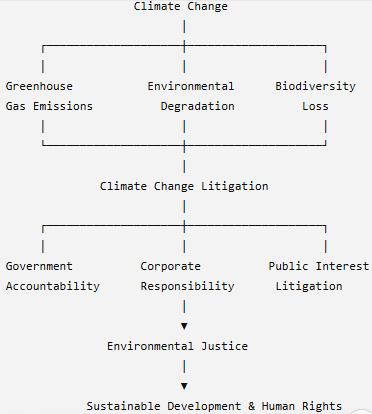
Figure: Conceptual Background
Closely associated with climate litigation is the principle of environmental justice, which emphasizes fairness in the distribution of environmental benefits and burdens. Environmental justice recognizes that marginalized communities, indigenous populations, women, children, and economically disadvantaged groups often suffer disproportionately from climate change despite contributing the least to global emissions. Consequently, legal systems are increasingly integrating environmental justice with constitutional guarantees of equality, life, dignity, and access to justice. International legal instruments such as the Paris Agreement, the United Nations Framework Convention on Climate Change (UNFCCC), the Convention on Biological Diversity, and the Sustainable Development Goals provide important normative foundations for climate governance. Judicial decisions in countries such as India, the Netherlands, Germany, Colombia, and the United States illustrate how courts have expanded environmental rights by recognizing climate protection as an essential component of constitutional governance and human rights. Simultaneously, increasing corporate climate accountability, public interest litigation, youth climate movements, and transnational environmental litigation are reshaping contemporary environmental jurisprudence. This paper examines the legal evolution of climate change litigation and environmental justice through a comparative analysis of contemporary judicial approaches, legal principles, regulatory frameworks, and emerging global trends. It argues that effective climate governance requires integrated legal strategies that combine constitutional protections, environmental legislation, judicial innovation, international cooperation, and sustainable development policies to ensure ecological resilience and environmental justice for both present and future generations.
Legal Framework Governing Climate Change Litigation#
Climate change litigation has evolved as an essential mechanism for enforcing environmental obligations and promoting accountability among governments, corporations, and other stakeholders. The legal framework governing climate change litigation is derived from a combination of international environmental agreements, constitutional provisions, statutory laws, judicial precedents, and human rights principles. At the international level, the United Nations Framework Convention on Climate Change (UNFCCC) established the foundation for global climate governance by encouraging international cooperation to stabilize greenhouse gas concentrations and prevent dangerous anthropogenic interference with the climate system. This framework was strengthened by the Kyoto Protocol, which introduced legally binding emission reduction commitments for developed countries, and later by the Paris Agreement (2015), which requires nations to undertake nationally determined contributions (NDCs) aimed at limiting global temperature rise to well below 2°C while pursuing efforts to restrict warming to 1.5°C above pre-industrial levels. Although these agreements primarily impose obligations upon states rather than individuals, courts have increasingly relied upon their principles to interpret domestic environmental laws and assess governmental responsibility in climate-related litigation. At the national level, constitutional provisions guaranteeing the right to life, equality, health, and a clean environment have become powerful legal foundations for climate litigation. Many constitutional courts have interpreted environmental protection as an integral component of the fundamental right to life, thereby requiring governments to adopt effective climate mitigation and adaptation measures. Environmental legislation such as environmental protection acts, air and water pollution control statutes, biodiversity conservation laws, forest protection legislation, and environmental impact assessment regulations further provide statutory mechanisms for challenging environmentally harmful activities. Judicial review has emerged as a critical instrument for examining whether governmental authorities have fulfilled their statutory and constitutional obligations concerning climate governance. Public Interest Litigation (PIL) has particularly expanded access to environmental justice by enabling citizens, environmental organizations, and community groups to approach courts even when they are not directly affected by environmental degradation. In India, constitutional provisions under Articles 21, 48A, and 51A(g) have enabled courts to recognize environmental protection as a constitutional obligation of both the State and citizens. Landmark judicial doctrines such as the Precautionary Principle, Polluter Pays Principle, Public Trust Doctrine, and Sustainable Development Principle have become integral components of environmental jurisprudence, guiding judicial interpretation in climate-related disputes. Similar developments have occurred in several jurisdictions where courts increasingly rely upon constitutional values, administrative law principles, and international environmental commitments to review governmental climate policies. Corporate accountability has also become an important dimension of climate litigation. Companies engaged in fossil fuel production, mining, manufacturing, and other carbon-intensive industries are increasingly facing lawsuits alleging inadequate climate disclosures, excessive greenhouse gas emissions, environmental negligence, and failure to manage climate-related financial risks. Environmental, Social, and Governance (ESG) obligations are encouraging corporations to integrate climate responsibility into business operations and risk management practices. Furthermore, international human rights bodies have increasingly recognized that climate change directly affects rights relating to life, health, housing, food, water, and cultural identity, thereby expanding opportunities for rights-based climate litigation. Recent judicial decisions across multiple jurisdictions demonstrate an increasing willingness to require governments and corporations to implement stronger climate policies consistent with constitutional principles and international environmental obligations. Nevertheless, challenges relating to jurisdiction, causation, scientific uncertainty, enforcement of judicial orders, and transboundary environmental harm continue to limit the effectiveness of climate litigation. Therefore, strengthening legal frameworks through comprehensive legislation, effective regulatory institutions, judicial capacity building, international cooperation, and robust enforcement mechanisms remains essential for ensuring that climate change litigation continues to serve as an effective instrument for environmental protection, sustainable development, and climate justice.
Environmental Justice and Climate Change: Contemporary Challenges#
Environmental justice has emerged as a fundamental principle in contemporary environmental law by emphasizing the equitable distribution of environmental benefits and burdens among all sections of society, irrespective of race, ethnicity, gender, income, or geographical location. In the context of climate change, environmental justice recognizes that the adverse effects of global warming are not experienced equally. Vulnerable populations, including indigenous communities, economically disadvantaged groups, women, children, persons with disabilities, and residents of low-lying coastal or drought-prone regions, often bear the greatest consequences of climate change despite contributing the least to greenhouse gas emissions. This unequal distribution of environmental risks raises important legal and ethical questions concerning fairness, equality, and the responsibility of states and corporations to protect affected communities. Contemporary environmental jurisprudence increasingly links climate justice with fundamental human rights such as the right to life, health, clean air, safe drinking water, adequate housing, food security, and a healthy environment. Courts across several jurisdictions have recognized that environmental degradation directly threatens these rights, thereby expanding the scope of constitutional and human rights protections in climate-related litigation. The principle of intergenerational equity has also become central to environmental justice by asserting that present generations have a legal and moral obligation to preserve natural resources and ecological balance for future generations. Consequently, governments are expected to formulate sustainable development policies that balance economic growth with environmental conservation while minimizing long-term ecological damage. Another important challenge relates to environmental displacement and climate-induced migration. Rising sea levels, desertification, floods, wildfires, and extreme weather events have displaced millions of people worldwide, creating significant legal uncertainties regarding the protection of climate refugees and internally displaced persons. Existing international refugee law does not adequately recognize climate-induced displacement, thereby highlighting the need for stronger international legal mechanisms to safeguard affected populations. Corporate accountability represents another critical dimension of environmental justice. Large multinational corporations engaged in fossil fuel extraction, mining, industrial manufacturing, and infrastructure development significantly contribute to greenhouse gas emissions and environmental degradation. Increasingly, courts are holding corporations accountable for environmental harm through climate litigation based on principles such as the polluter pays doctrine, environmental due diligence, corporate social responsibility, and Environmental, Social, and Governance (ESG) obligations. At the same time, access to environmental justice remains uneven across jurisdictions due to financial barriers, procedural complexities, limited legal awareness, and inadequate institutional capacity. Public Interest Litigation (PIL), environmental tribunals, legal aid mechanisms, and community participation have therefore become essential tools for improving access to justice and ensuring effective enforcement of environmental rights. Indigenous communities have also gained increasing recognition for their traditional ecological knowledge and their vital role in biodiversity conservation and sustainable resource management. International instruments such as the United Nations Declaration on the Rights of Indigenous Peoples emphasize the need to protect indigenous land rights and ensure their participation in environmental decision-making processes. Furthermore, climate adaptation and resilience planning have become essential components of environmental justice, requiring governments to invest in disaster preparedness, sustainable infrastructure, renewable energy, and ecosystem restoration while prioritizing the needs of vulnerable populations. Contemporary legal systems increasingly acknowledge that climate change is not merely an environmental issue but also a matter of social justice, economic equity, and human rights. Therefore, effective environmental justice requires integrated legal frameworks, inclusive governance, transparent decision-making, strong judicial oversight, and meaningful public participation. By combining constitutional protections, environmental legislation, international cooperation, and community-based approaches, legal systems can promote equitable climate governance while ensuring that environmental protection and sustainable development benefit both present and future generations.
Comparative Analysis and Emerging Trends in Climate Change Litigation#
Climate change litigation has expanded significantly across the world, reflecting growing judicial recognition of climate change as both an environmental and human rights issue. Although legal approaches differ among jurisdictions, courts increasingly acknowledge their role in ensuring governmental accountability, protecting constitutional rights, and promoting sustainable development. The European Union (EU) has established one of the most comprehensive climate governance frameworks through the European Climate Law, the European Green Deal, and the implementation of the Paris Agreement. Courts within the EU have consistently emphasized the obligation of member states to reduce greenhouse gas emissions in accordance with scientific evidence and international commitments. A landmark example is the Dutch Urgenda Foundation v. State of the Netherlands case, where the court held that the government had a legal duty to adopt stronger climate mitigation measures to safeguard the rights of present and future generations. Similarly, the German Federal Constitutional Court ruled that insufficient climate legislation unfairly shifted environmental burdens onto future generations, thereby reinforcing the principle of intergenerational equity. In the United States, climate litigation has largely focused on governmental responsibility, corporate accountability, environmental regulations, and constitutional rights.
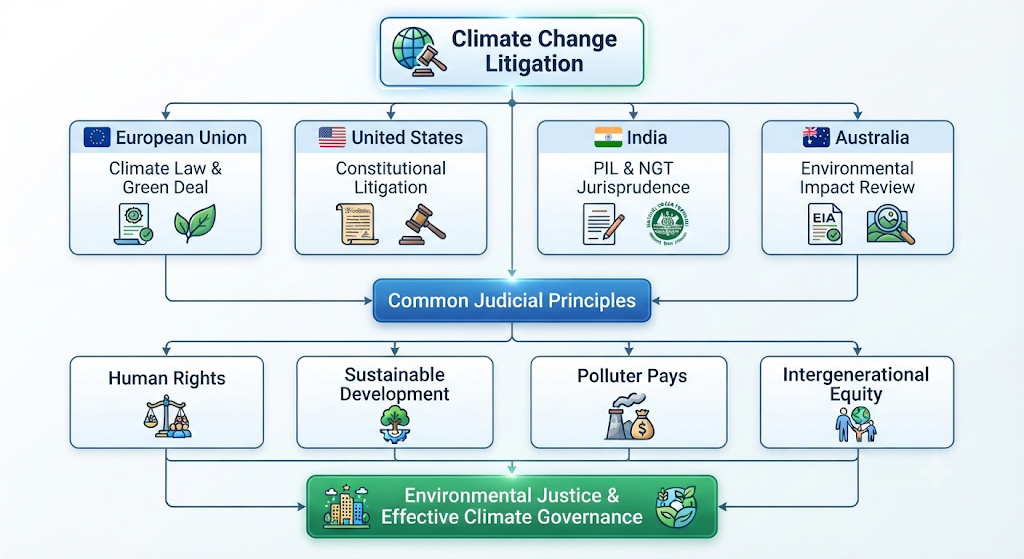
Figure: Comparative Legal Framework
Although federal climate policies have varied over time, courts have increasingly entertained lawsuits challenging inadequate environmental protections and seeking stronger regulatory action against greenhouse gas emissions. Youth-led litigation, including Juliana v. United States, has drawn international attention by arguing that inadequate climate action violates constitutional rights to life, liberty, and a stable climate system. While the litigation has encountered procedural challenges, it has significantly influenced public discourse on climate justice. India has emerged as a leading jurisdiction in environmental public interest litigation (PIL), where constitutional provisions under Articles 21, 48A, and 51A(g) have enabled courts to interpret the right to life as encompassing the right to a clean and healthy environment. The Supreme Court of India and the National Green Tribunal (NGT) have consistently applied principles such as sustainable development, the precautionary principle, the polluter pays principle, and the public trust doctrine to strengthen environmental governance. Judicial intervention has played a crucial role in addressing air pollution, industrial emissions, deforestation, waste management, and ecological conservation. Australia has also witnessed increasing climate litigation, particularly concerning environmental impact assessments, mining approvals, and governmental climate responsibilities. Courts have increasingly required authorities to consider climate risks before approving major infrastructure and fossil fuel projects. Beyond national jurisdictions, international human rights bodies have strengthened the relationship between climate protection and human rights by recognizing that environmental degradation directly affects rights to life, health, housing, food, water, and cultural identity. Contemporary trends indicate a rapid increase in litigation against multinational corporations for climate-related disclosures, environmental negligence, and inadequate emission reduction strategies. Environmental, Social, and Governance (ESG) obligations are becoming increasingly important as investors, regulators, and civil society demand greater corporate transparency and accountability. Emerging legal developments also include the recognition of the rights of nature, climate adaptation litigation, biodiversity protection, carbon neutrality commitments, and legal actions based on intergenerational justice. Furthermore, advances in climate science, satellite monitoring, artificial intelligence, and environmental data analytics are strengthening the evidentiary basis of climate litigation and improving judicial decision-making. Despite variations in legal systems, a common global trend is the increasing reliance on constitutional principles, international environmental law, and human rights frameworks to address climate change. These developments demonstrate that climate litigation has evolved from a purely environmental concern into a comprehensive legal mechanism for advancing environmental justice, strengthening democratic accountability, protecting vulnerable communities, and ensuring sustainable development in an era of accelerating climate change.
Conclusion#
Climate change represents one of the most complex legal, environmental, and human rights challenges confronting the global community. The increasing frequency of extreme weather events, biodiversity loss, rising sea levels, and environmental degradation has demonstrated that traditional regulatory measures alone are insufficient to address the growing climate crisis. Consequently, climate change litigation has emerged as a powerful legal instrument for ensuring governmental accountability, corporate responsibility, and effective implementation of environmental laws and international climate commitments. As discussed throughout this study, courts have assumed an increasingly proactive role in interpreting constitutional provisions, statutory frameworks, international environmental agreements, and human rights principles to promote climate governance and environmental protection. Judicial interventions in various jurisdictions have strengthened the principles of sustainable development, the precautionary principle, the polluter pays principle, public trust doctrine, and intergenerational equity, thereby expanding the scope of environmental jurisprudence. The comparative analysis of legal developments in the European Union, the United States, India, Australia, and other jurisdictions demonstrates a growing international consensus that environmental protection is intrinsically linked to the realization of fundamental human rights, including the rights to life, health, dignity, clean air, safe water, and a healthy environment. Furthermore, environmental justice has emerged as an essential dimension of climate governance by recognizing that vulnerable communities, indigenous populations, women, children, and economically disadvantaged groups disproportionately bear the adverse consequences of climate change despite contributing minimally to global emissions. This inequitable distribution of environmental burdens necessitates inclusive legal frameworks that promote equitable access to environmental resources, meaningful public participation, and effective judicial remedies. At the same time, increasing climate litigation against governments and multinational corporations has reinforced the importance of transparency, environmental due diligence, and corporate accountability in achieving long-term sustainability. Nevertheless, several challenges continue to hinder the effectiveness of climate litigation, including jurisdictional limitations, scientific uncertainty, enforcement difficulties, procedural barriers, and inadequate international coordination. Addressing these challenges requires stronger legislative frameworks, enhanced judicial capacity, greater international cooperation, improved climate financing, and effective implementation of environmental obligations at national and global levels. Emerging technologies, environmental data analytics, and scientific advancements are expected to further strengthen judicial decision-making by providing more accurate evidence regarding climate impacts and environmental risks. Ultimately, climate change litigation should not be viewed merely as a mechanism for resolving environmental disputes but as an essential component of democratic governance, constitutional accountability, and sustainable development. A balanced integration of judicial activism, legislative action, international cooperation, scientific innovation, and community participation is necessary to ensure effective climate governance. By strengthening environmental justice through comprehensive legal reforms and responsible governance, societies can protect ecological integrity, promote social equity, and secure a sustainable future for present and future generations.
Works Cited#
- Bodansky, D., Brunnée, J., & Rajamani, L. (2017). International climate change law. Oxford University Press.
- Boyd, D. R. (2012). The environmental rights revolution: A global study of constitutions, human rights, and the environment. UBC Press.
- Burger, M., & Gundlach, J. (2018). Climate change, public health, and the law. Cambridge University Press.
- Dehm, J. (2021). Reconsidering REDD+: Authority, power and law in the green economy. Cambridge University Press.
- European Commission. (2021). European Climate Law. https://climate.ec.europa.eu
- Gupta, J. (2014). The history of global climate governance. Cambridge University Press.
- Intergovernmental Panel on Climate Change. (2023). AR6 synthesis report: Climate change 2023. https://www.ipcc.ch
- Kotzé, L. J., & French, D. (2018). The anthropocentric ontology of international environmental law and the sustainable development goals. Journal of Human Rights and the Environment, 9(1), 5–31.
- Peel, J., & Osofsky, H. M. (2015). Climate change litigation: Regulatory pathways to cleaner energy. Cambridge University Press.
- Peel, J., & Osofsky, H. M. (2020). Climate change litigation. Annual Review of Law and Social Science, 16, 21–38.
- Rajamani, L. (2016). Innovation and experimentation in the international climate change regime. Brill.
- Sands, P., Peel, J., Fabra, A., & MacKenzie, R. (2018). Principles of international environmental law (4th ed.). Cambridge University Press.
- Setzer, J., & Higham, C. (2024). Global trends in climate change litigation: 2024 snapshot. Grantham Research Institute, London School of Economics and Political Science.
- Shue, H. (2014). Climate justice: Vulnerability and protection. Oxford University Press.
- United Nations. (1992). United Nations Framework Convention on Climate Change. https://unfccc.int
- United Nations. (2015). Paris Agreement. https://unfccc.int/process-and-meetings/the-paris-agreement
- United Nations Environment Programme. (2019). Environmental rule of law: First global report. https://www.unep.org
- Voigt, C. (Ed.). (2016). International judicial practice on the environment: Questions of legitimacy. Cambridge University Press.
- World Commission on Environment and Development. (1987). Our common future. Oxford University Press.
- World Resources Institute. (2023). State of climate action 2023. https://www.wri.org