Abstract
Environmental constitutionalism has emerged as one of the most significant developments in contemporary constitutional law, reflecting the growing recognition that environmental protection is essential for the realization of fundamental human rights. As climate change, biodiversity loss, pollution, deforestation, and environmental degradation increasingly threaten human life and sustainable development, many nations have incorporated environmental rights and duties into their constitutions. The recognition of the right to a healthy environment as a fundamental human right has strengthened judicial review, promoted governmental accountability, and enhanced public participation in environmental governance. International developments, including the 2022 United Nations General Assembly Resolution recognizing the right to a clean, healthy, and sustainable environment, have further reinforced constitutional commitments toward environmental justice. This paper critically examines the evolution of environmental constitutionalism through international legal frameworks, comparative constitutional practices, and landmark judicial decisions. It analyzes the constitutional recognition of environmental rights in countries such as India, South Africa, Brazil, Ecuador, Colombia, and France while evaluating the role of constitutional courts in enforcing environmental obligations. The study further explores contemporary legal challenges relating to climate change litigation, intergenerational equity, sustainable development, environmental governance, indigenous rights, and ecological justice. Finally, it proposes future constitutional and legislative reforms aimed at strengthening environmental democracy, ensuring effective implementation of environmental rights, and promoting sustainable development for present and future generations.
- Environmental Constitutionalism
- Right to a Healthy Environment
- Environmental Justice
- Climate Change
- Sustainable Development
- Human Rights
- Constitutional Law
- Ecological Rights
- Environmental Governance
- Public Interest Litigation
Introduction#
The twenty-first century has witnessed an unprecedented increase in environmental challenges arising from climate change, biodiversity loss, air and water pollution, deforestation, desertification, and unsustainable exploitation of natural resources. These environmental crises threaten not only ecosystems but also human health, economic development, food security, and the enjoyment of fundamental human rights. Consequently, constitutional law has increasingly evolved to recognize environmental protection as an essential component of democratic governance and human dignity. This transformation has given rise to the concept of environmental constitutionalism, which refers to the incorporation of environmental rights, environmental duties, and principles of sustainable development within constitutional frameworks. Today, more than 150 constitutions worldwide contain provisions relating to environmental protection, reflecting a global consensus that a healthy environment is indispensable for the realization of rights such as life, health, equality, livelihood, and human dignity. Constitutional recognition strengthens environmental governance by imposing obligations upon governments, empowering courts to enforce environmental standards, and enabling citizens to seek judicial remedies against environmental harm. The recognition of the right to a clean, healthy, and sustainable environment has also become a defining feature of modern human rights jurisprudence. In July 2022, the United Nations General Assembly formally recognized this right as a universal human right, marking a significant milestone in international environmental law. National constitutional courts have similarly played an increasingly active role in protecting environmental rights through innovative judicial doctrines including the precautionary principle, polluter pays principle, public trust doctrine, sustainable development, and intergenerational equity. In India, the Supreme Court has interpreted Article 21 of the Constitution to include the right to live in a pollution-free environment, while constitutional courts in Colombia, South Africa, Brazil, Ecuador, and Costa Rica have expanded constitutional protections for nature, indigenous communities, and future generations.
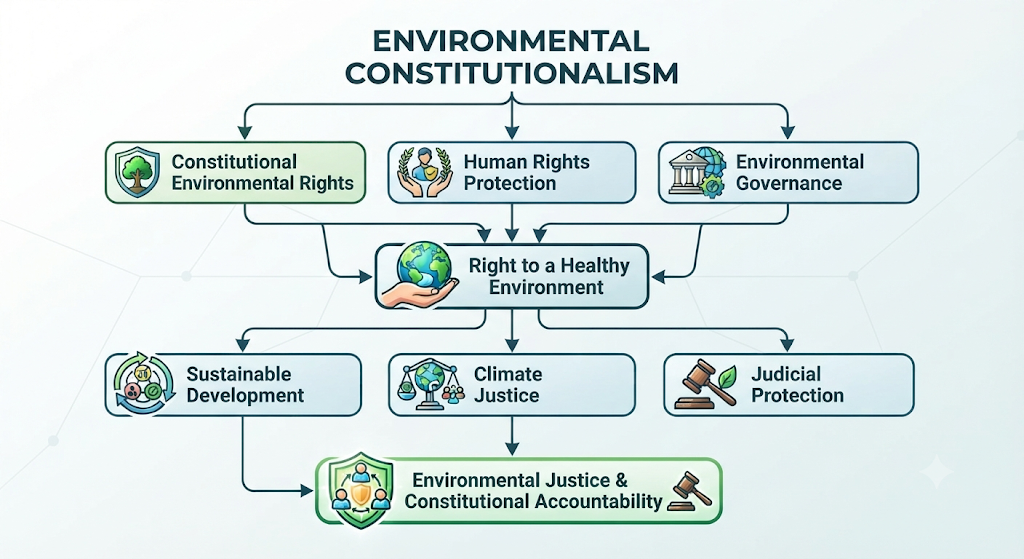
Figure: Conceptual Background
Despite these developments, significant legal challenges remain regarding effective enforcement, climate change accountability, environmental governance, balancing economic development with ecological sustainability, and ensuring environmental justice for vulnerable communities disproportionately affected by environmental degradation. Increasing industrialization, urbanization, and technological advancement continue to place enormous pressure on natural resources, making constitutional environmental protection more important than ever before. This paper critically examines the evolution of environmental constitutionalism through comparative constitutional analysis, international legal developments, judicial interpretation, and contemporary environmental governance. It evaluates the legal recognition of the right to a healthy environment, explores its relationship with human rights and sustainable development, and proposes future reforms necessary to strengthen constitutional environmental governance in an era characterized by accelerating ecological challenges and climate uncertainty.
International and Comparative Constitutional Framework for the Right to a Healthy Environment#
The recognition of the right to a healthy environment has evolved significantly within international law and comparative constitutional jurisprudence over the past five decades. Although early international human rights instruments such as the Universal Declaration of Human Rights (1948) and the International Covenant on Civil and Political Rights (1966) did not expressly recognize environmental rights, they established fundamental rights to life, health, dignity, and well-being, which later became the legal foundation for environmental protection. The Stockholm Declaration on the Human Environment (1972) marked the first major international acknowledgment that individuals possess a fundamental right to live in an environment of a quality that permits a life of dignity and well-being. This principle was further reinforced by the Rio Declaration on Environment and Development (1992), which introduced concepts such as sustainable development, public participation, environmental impact assessment, and the precautionary principle into international environmental governance. More recently, the United Nations General Assembly Resolution 76/300 (2022) formally recognized the right to a clean, healthy, and sustainable environment as a universal human right, encouraging states to strengthen environmental protection through constitutional, legislative, and administrative measures. Comparative constitutional practice demonstrates a growing trend toward explicit constitutional recognition of environmental rights. South Africa's Constitution (Section 24) guarantees every person the right to an environment that is not harmful to health or well-being and obliges the state to protect natural resources for present and future generations. Brazil's Constitution (Article 225) declares that everyone has the right to an ecologically balanced environment and imposes duties upon both the government and society to preserve it. Ecuador's Constitution (2008) introduced the innovative concept of the Rights of Nature (Pachamama), recognizing ecosystems as legal entities entitled to constitutional protection independent of human interests. Colombia's Constitutional Court has similarly recognized rivers, forests, and ecosystems as legal persons entitled to judicial protection while emphasizing intergenerational environmental rights. In India, although the Constitution does not expressly recognize the right to a healthy environment as a fundamental right, the Supreme Court has interpreted Article 21 (Right to Life) to include the right to a pollution-free and healthy environment through landmark judgments such as Subhash Kumar v. State of Bihar, M.C. Mehta v. Union of India, and Vellore Citizens' Welfare Forum v. Union of India. Directive Principles of State Policy under Articles 48A and 51A(g) further impose constitutional duties upon the State and citizens to protect and improve the environment. France incorporated the Environmental Charter of 2004 into its constitutional framework, recognizing environmental protection as a constitutional value, while numerous Latin American constitutions have expanded environmental rights to include biodiversity conservation, indigenous rights, and ecological sustainability. Comparative constitutional analysis demonstrates that environmental constitutionalism increasingly serves as a powerful legal mechanism for strengthening environmental governance, promoting sustainable development, enhancing judicial accountability, and protecting fundamental human rights against environmental degradation. As climate change and ecological crises intensify globally, constitutional recognition of environmental rights continues to play a central role in shaping contemporary environmental law and public policy.
Legal Challenges, Environmental Justice, and Constitutional Protection of Environmental Rights#
Despite significant progress in recognizing environmental rights within constitutional and international legal frameworks, numerous legal and practical challenges continue to hinder their effective realization. One of the most pressing concerns is climate change, which has intensified environmental degradation through rising global temperatures, extreme weather events, biodiversity loss, sea-level rise, desertification, and water scarcity. These environmental impacts disproportionately affect vulnerable populations, indigenous communities, women, children, and economically disadvantaged groups, thereby raising important issues of environmental justice and equality before the law. Environmental constitutionalism seeks to address these inequalities by ensuring that all individuals have equal access to environmental benefits and equal protection against environmental harm. Another significant challenge concerns the effective implementation and enforcement of constitutional environmental rights. While many constitutions recognize environmental protection, inadequate legislation, weak institutional capacity, corruption, political interference, and limited public participation often prevent effective enforcement. Courts therefore play a crucial role in translating constitutional principles into practical environmental protection through judicial review, public interest litigation, and constitutional interpretation. The rise of climate change litigation illustrates the increasing willingness of courts worldwide to hold governments and corporations accountable for failing to fulfill their constitutional environmental obligations. Landmark judgments such as Urgenda Foundation v. Netherlands, Leghari v. Federation of Pakistan, and Future Generations v. Ministry of Environment (Colombia) demonstrate how constitutional courts have required governments to strengthen climate policies, protect ecosystems, and safeguard the interests of future generations. Another important legal issue relates to balancing economic development and environmental protection. Governments frequently face difficult policy choices regarding infrastructure development, industrial expansion, mining, and energy production, which may conflict with environmental sustainability and constitutional rights. Principles such as sustainable development, the precautionary principle, the polluter pays principle, and the public trust doctrine have therefore become essential constitutional tools for achieving an appropriate balance between development and ecological conservation. The recognition of intergenerational equity has further expanded constitutional environmental jurisprudence by emphasizing that present generations have legal obligations to preserve natural resources for future generations. Indigenous communities have also gained increased constitutional protection due to their unique relationship with land, forests, biodiversity, and traditional ecological knowledge. Constitutional recognition of indigenous environmental rights strengthens cultural preservation while promoting sustainable resource management. Emerging environmental challenges associated with artificial intelligence, biotechnology, renewable energy transitions, and climate-induced migration further require constitutional adaptation to address new forms of environmental risk. Strengthening environmental constitutionalism therefore requires effective legislation, independent regulatory institutions, transparent governance, meaningful public participation, scientific decision-making, and judicial independence. By integrating environmental protection with human rights, constitutional governance can ensure that ecological sustainability, social justice, and economic development coexist in a balanced and legally accountable framework capable of responding to the environmental challenges of the twenty-first century.
Future Directions and Strengthening Environmental Constitutionalism#
Environmental constitutionalism continues to evolve as nations increasingly recognize that environmental protection is fundamental to sustainable development, democratic governance, and the enjoyment of basic human rights. Future constitutional reforms should focus on transforming environmental rights from aspirational constitutional principles into fully enforceable legal guarantees supported by effective legislation, independent regulatory institutions, and accessible judicial remedies. One of the most significant future priorities involves strengthening the constitutional recognition of the right to a clean, healthy, and sustainable environment as an enforceable fundamental right, ensuring that governments remain legally accountable for environmental degradation and climate inaction. Greater constitutional emphasis should also be placed on climate governance, requiring states to adopt legally binding climate adaptation and mitigation strategies consistent with international commitments under the Paris Agreement and other multilateral environmental agreements.
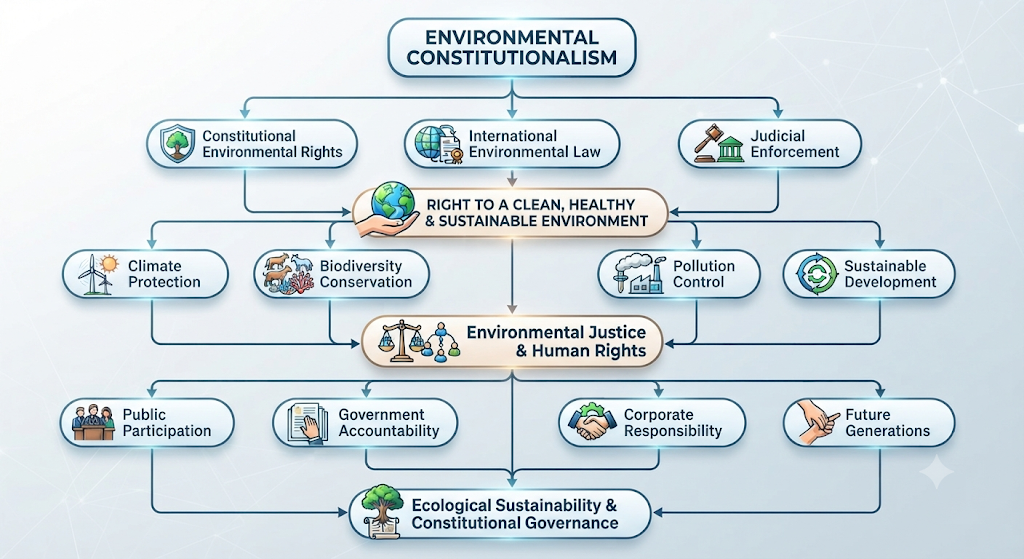
Figure: Environmental Constitutionalism and the Right to a Healthy Environment
Courts are expected to play an increasingly important role through constitutional review of governmental environmental policies, enforcement of climate obligations, and protection of future generations against irreversible ecological harm. Another emerging direction involves expanding constitutional recognition of the Rights of Nature, following the examples of Ecuador and Colombia, where ecosystems, rivers, forests, and biodiversity have been granted legal personality and judicial protection independent of human interests. Future constitutional frameworks should also strengthen the principles of intergenerational equity, ensuring that natural resources are preserved for future generations while promoting responsible environmental stewardship. Public participation, access to environmental information, and environmental education should receive greater constitutional protection to encourage environmental democracy and strengthen citizen engagement in environmental decision-making. Technological innovation, including artificial intelligence, satellite monitoring, geographic information systems, and environmental data analytics, can further enhance constitutional environmental governance by improving regulatory compliance, monitoring pollution, and supporting evidence-based policymaking. International cooperation will remain essential because environmental challenges such as climate change, biodiversity loss, marine pollution, and transboundary resource management cannot be effectively addressed by individual states acting alone. Stronger collaboration among governments, international organizations, civil society, indigenous communities, scientists, and the private sector will therefore be necessary to promote harmonized environmental standards and effective implementation of constitutional obligations. Future reforms should additionally prioritize environmental justice by ensuring equitable distribution of environmental benefits and burdens, protecting marginalized communities from disproportionate environmental risks, and integrating human rights into all aspects of environmental policymaking. Ultimately, environmental constitutionalism represents one of the most powerful legal mechanisms for achieving ecological sustainability, social justice, and accountable governance. By strengthening constitutional protection of environmental rights and promoting effective implementation through legislation, judicial enforcement, and democratic participation, constitutional systems can ensure that environmental protection becomes an integral component of human development, public welfare, and global sustainability for present and future generations.
Conclusion#
Environmental constitutionalism has emerged as a transformative development in modern constitutional law by recognizing that environmental protection is inseparable from the realization of fundamental human rights. The growing threats posed by climate change, biodiversity loss, pollution, deforestation, and unsustainable resource exploitation have demonstrated that the protection of the environment is essential for safeguarding human life, health, dignity, and sustainable development. Across the world, constitutional systems have increasingly incorporated environmental rights, duties, and principles of ecological governance, empowering courts, governments, and citizens to protect natural resources through constitutional mechanisms. International developments, including the Stockholm Declaration, the Rio Declaration, the Paris Agreement, and the 2022 United Nations General Assembly Resolution recognizing the right to a clean, healthy, and sustainable environment, have further strengthened the legal foundation of environmental constitutionalism. Comparative constitutional experiences from countries such as India, South Africa, Brazil, Ecuador, Colombia, and France demonstrate that constitutional recognition of environmental rights significantly enhances governmental accountability, judicial enforcement, and public participation in environmental governance. Judicial doctrines including sustainable development, the precautionary principle, the polluter pays principle, the public trust doctrine, and intergenerational equity have become essential legal tools for balancing environmental conservation with economic development. Nevertheless, constitutional recognition alone cannot guarantee effective environmental protection unless supported by comprehensive legislation, strong institutions, transparent governance, scientific policymaking, and meaningful citizen participation. Contemporary environmental challenges require governments to adopt integrated legal approaches that address climate change, environmental justice, biodiversity conservation, indigenous rights, and ecological sustainability simultaneously. Future constitutional reforms should therefore strengthen environmental rights as enforceable fundamental rights, improve climate governance, expand access to environmental justice, recognize the rights of future generations, and encourage international cooperation in addressing transboundary environmental problems. Technological innovations, environmental monitoring systems, and public awareness initiatives should complement constitutional protections by improving compliance and promoting sustainable development. Ultimately, environmental constitutionalism represents not merely a legal doctrine but a constitutional commitment to ensuring that present and future generations inherit a healthy, safe, and sustainable environment. By integrating environmental protection into the constitutional framework of democratic governance, societies can achieve a balanced relationship between economic progress, ecological conservation, social justice, and human rights while ensuring long-term environmental sustainability in the twenty-first century.
Works Cited#
- Boyd, D. R. (2012). The Environmental Rights Revolution: A Global Study of Constitutions, Human Rights, and the Environment. UBC Press.
- Convention on Biological Diversity. (1992). Convention on Biological Diversity. United Nations.
- Constitution of Ecuador. (2008).
- Constitution of the Republic of South Africa. (1996).
- Government of India. (1950). The Constitution of India. Ministry of Law and Justice.
- Intergovernmental Panel on Climate Change. (2023). Climate Change 2023: Synthesis Report. IPCC.
- Kotzé, L. J. (2016). Global Environmental Constitutionalism in the Anthropocene. Hart Publishing.
- Paris Agreement. (2015). United Nations Framework Convention on Climate Change.
- Rio Declaration on Environment and Development. (1992). United Nations Conference on Environment and Development.
- Shelton, D. (Ed.). (2015). The Oxford Handbook of International Environmental Law. Oxford University Press.
- Stockholm Declaration on the Human Environment. (1972). United Nations Conference on the Human Environment.
- Supreme Court of India. M.C. Mehta v. Union of India, AIR 1987 SC 1086.
- Supreme Court of India. Subhash Kumar v. State of Bihar, AIR 1991 SC 420.
- Supreme Court of India. Vellore Citizens' Welfare Forum v. Union of India, (1996) 5 SCC 647.
- United Nations. (1948). Universal Declaration of Human Rights. United Nations.
- United Nations. (2022). Resolution 76/300: The Human Right to a Clean, Healthy and Sustainable Environment. United Nations General Assembly.
- United Nations Framework Convention on Climate Change. (1992). United Nations Framework Convention on Climate Change. United Nations.
- United Nations. (2015). Transforming Our World: The 2030 Agenda for Sustainable Development. United Nations.
- United Nations Environment Programme. (2023). Global Environment Outlook 7. UNEP.
- World Commission on Environment and Development. (1987). Our Common Future. Oxford University Press.