Abstract
The rapid expansion of digital technologies, internet connectivity, cloud computing, mobile devices, and Artificial Intelligence has significantly transformed communication, commerce, governance, and social interaction. While these technological advancements have created numerous opportunities for economic and social development, they have also facilitated the emergence of sophisticated cybercrimes that transcend geographical boundaries and challenge conventional criminal justice systems. Cybercrimes such as hacking, identity theft, ransomware attacks, phishing, financial fraud, cyberterrorism, online harassment, child exploitation, and digital espionage have become increasingly prevalent, demanding effective legal and investigative responses. Simultaneously, digital evidence has become a critical component of modern criminal investigations, enabling law enforcement agencies and judicial institutions to detect, investigate, prosecute, and adjudicate cyber-related offences. However, the collection, preservation, authentication, admissibility, and interpretation of digital evidence raise complex legal and procedural issues due to technological advancements, encryption, cross-border data transfers, privacy concerns, and jurisdictional conflicts. This study examines the legal challenges associated with cybercrime and digital evidence within contemporary criminal justice systems. It explores evolving legal frameworks, forensic investigation techniques, international cooperation, data protection laws, cybersecurity regulations, and judicial practices aimed at addressing cyber threats while safeguarding fundamental rights and due process. The study concludes that strengthening cyber laws, enhancing digital forensic capabilities, promoting international collaboration, and modernizing criminal justice institutions are essential for ensuring effective cybercrime prevention, fair judicial proceedings, and secure digital governance in the modern era.
- Cybercrime
- Digital Evidence
- Criminal Justice System
- Cybersecurity
- Digital Forensics
- Electronic Evidence
- Data Protection
- Cyber Law
- Computer Crime
- Cyber Investigation
Introduction#
The digital revolution has fundamentally transformed modern societies by integrating computers, smartphones, cloud computing, social media, Artificial Intelligence, blockchain technology, and the Internet of Things (IoT) into nearly every aspect of human life. Governments, businesses, educational institutions, healthcare organizations, financial institutions, and individuals increasingly depend on digital technologies for communication, financial transactions, information storage, public administration, and service delivery. While digital transformation has accelerated economic growth and technological innovation, it has simultaneously created new opportunities for criminal activities conducted through cyberspace. Cybercrime has emerged as one of the fastest-growing forms of transnational crime, encompassing offences such as unauthorized system access, malware attacks, ransomware, phishing, identity theft, financial fraud, cyber espionage, intellectual property theft, online child exploitation, cyberstalking, digital piracy, and attacks on critical national infrastructure. Unlike conventional crimes, cybercrimes are often anonymous, borderless, technologically sophisticated, and capable of causing extensive financial losses, reputational damage, and threats to national security. Criminal organizations increasingly exploit technological vulnerabilities, encryption technologies, cryptocurrencies, dark web marketplaces, and artificial intelligence to conduct illegal activities while avoiding detection by law enforcement agencies. Consequently, criminal justice systems worldwide face significant challenges in adapting existing legal frameworks, investigative procedures, and judicial mechanisms to effectively respond to evolving cyber threats. Traditional criminal laws, originally designed to regulate physical offences, frequently prove inadequate for addressing technologically complex crimes involving digital networks, electronic communications, cloud-based systems, and multinational cyber operations.
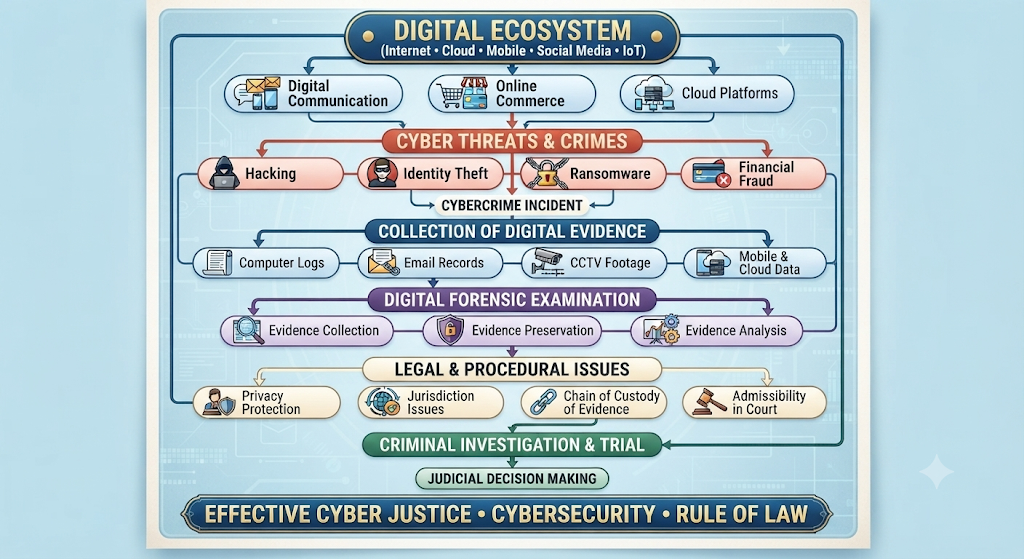
Figure: Conceptual Background
Digital evidence has therefore become one of the most significant components of modern criminal investigations because almost every cybercrime leaves electronic traces capable of identifying offenders, reconstructing criminal events, and supporting judicial decision-making. Emails, mobile phone records, social media communications, surveillance footage, GPS data, cloud storage, blockchain transactions, computer logs, metadata, and internet browsing histories frequently serve as valuable forms of digital evidence in criminal proceedings. However, collecting, preserving, authenticating, analyzing, and presenting digital evidence introduces numerous legal and procedural challenges. Electronic evidence is highly vulnerable to alteration, deletion, encryption, corruption, and unauthorized access, requiring specialized digital forensic techniques and strict chain-of-custody procedures to maintain evidentiary integrity. Questions regarding admissibility, authenticity, reliability, privacy protection, cross-border jurisdiction, data ownership, and constitutional rights have become central issues within contemporary criminal jurisprudence. Furthermore, international cooperation has become increasingly important because cybercrimes frequently originate in one country, affect victims in another, and involve digital infrastructure distributed across multiple jurisdictions. Harmonizing cyber legislation, strengthening mutual legal assistance mechanisms, improving digital forensic capabilities, and enhancing judicial expertise are therefore essential for ensuring effective investigation and prosecution of cyber offences. Understanding the relationship between cybercrime, digital evidence, and criminal justice is critical for developing adaptive legal systems capable of balancing effective law enforcement with the protection of privacy, due process, and fundamental human rights in an increasingly interconnected digital society.
Legal Challenges in Investigating and Prosecuting Cybercrime#
The rapid expansion of cyberspace has transformed the nature of criminal activities, making cybercrime one of the most complex challenges confronting contemporary criminal justice systems. Unlike conventional crimes, cybercrimes are characterized by anonymity, speed, transnational operations, technological sophistication, and the ability to cause significant financial, social, and national security consequences. Law enforcement agencies face considerable legal and procedural difficulties in investigating and prosecuting offences such as hacking, ransomware attacks, phishing, identity theft, cyber fraud, online financial crimes, cyberstalking, digital piracy, cyberterrorism, child sexual exploitation, and attacks on critical information infrastructure. One of the primary legal challenges arises from the borderless nature of cyberspace. Cybercriminals frequently operate from jurisdictions different from those of their victims, using servers, cloud services, and digital infrastructure distributed across multiple countries. This creates jurisdictional conflicts regarding which nation has the legal authority to investigate, prosecute, and punish offenders. Differences in national cyber laws, criminal procedures, evidentiary standards, extradition agreements, and privacy regulations often delay investigations and hinder international cooperation. The absence of harmonized legal frameworks further complicates the prosecution of cybercriminals who exploit legal loopholes by operating from countries with weak cybersecurity legislation or limited law enforcement capabilities. Another significant challenge involves identifying offenders who frequently conceal their identities through encryption technologies, virtual private networks (VPNs), anonymous communication platforms, cryptocurrencies, proxy servers, and the dark web. These technologies make attribution difficult, requiring investigators to employ advanced digital forensic methods while respecting legal safeguards and constitutional rights. The rapidly evolving nature of cyber threats also challenges existing criminal laws, many of which were enacted before the emergence of sophisticated technologies such as Artificial Intelligence, blockchain, cloud computing, quantum computing, and the Internet of Things (IoT). Consequently, legal systems often struggle to classify new forms of cyber offences, determine criminal intent, establish liability, and apply traditional legal doctrines to technologically advanced crimes. Cyber investigations further require highly specialized technical expertise, sophisticated forensic tools, and continuous training for investigators, prosecutors, judges, and legal practitioners. However, many criminal justice institutions continue to face shortages of qualified cybersecurity professionals, inadequate forensic infrastructure, and limited financial resources, particularly in developing countries. Privacy and data protection laws introduce additional legal complexities during cyber investigations because law enforcement agencies must balance effective crime detection with the protection of individual rights. Accessing encrypted communications, cloud storage, mobile devices, and personal digital accounts often requires judicial authorization, raising questions regarding lawful interception, proportionality, and constitutional protections against unreasonable searches and surveillance. The increasing use of end-to-end encryption by communication platforms has further complicated criminal investigations by limiting investigators' access to potentially crucial evidence. Electronic evidence is highly volatile and can be altered, deleted, or remotely manipulated within seconds, requiring investigators to follow strict forensic protocols for evidence preservation and chain of custody. Failure to maintain evidentiary integrity may result in evidence being declared inadmissible during judicial proceedings. Furthermore, cybercrime investigations frequently involve collaboration between public law enforcement agencies and private technology companies, internet service providers, financial institutions, and cloud service providers. Legal uncertainty regarding data sharing, corporate responsibilities, confidentiality obligations, and cross-border information requests often delays investigative processes. Emerging technologies such as Artificial Intelligence have also introduced new categories of cybercrime, including AI-generated phishing attacks, deepfake fraud, automated malware, synthetic identity creation, and intelligent cyberattacks capable of adapting to security measures. These developments require continuous legislative reform and adaptive legal frameworks capable of responding to rapidly changing technological environments. Governments therefore need to strengthen cyber legislation, improve digital forensic capabilities, establish specialized cybercrime courts, promote international cooperation through mutual legal assistance treaties, and invest in cybersecurity education and capacity building. Collaboration among law enforcement agencies, judiciary, technology companies, academic institutions, and international organizations is equally essential for developing effective investigative strategies and harmonized legal standards. Ultimately, addressing the legal challenges associated with investigating and prosecuting cybercrime requires modern criminal justice systems that combine technological expertise, legal innovation, international cooperation, and respect for fundamental rights to ensure effective enforcement of cyber laws while maintaining fairness, transparency, and due process in an increasingly digital world.
Digital Evidence and Its Admissibility in Contemporary Criminal Justice Systems#
Digital evidence has become one of the most significant forms of evidence in modern criminal investigations due to the increasing dependence of individuals, businesses, and governments on digital technologies. Unlike traditional physical evidence, digital evidence consists of electronic information stored or transmitted through computers, smartphones, tablets, cloud platforms, surveillance systems, wearable devices, social media applications, Internet of Things (IoT) devices, GPS systems, blockchain networks, and other digital infrastructures. Emails, instant messages, call records, CCTV footage, photographs, videos, browsing histories, metadata, transaction logs, biometric information, digital documents, cloud storage records, and social media interactions frequently serve as crucial evidence in criminal proceedings. Because most modern crimes involve some form of digital communication or electronic transaction, digital evidence has become indispensable not only in cybercrime investigations but also in cases involving homicide, terrorism, financial fraud, organized crime, drug trafficking, corruption, human trafficking, domestic violence, child exploitation, tax evasion, and intellectual property offences. Its ability to accurately reconstruct events, identify suspects, establish timelines, verify communications, and demonstrate criminal intent has significantly enhanced the efficiency of contemporary criminal investigations. However, despite its growing importance, digital evidence presents unique legal, technical, and procedural challenges that distinguish it from conventional forms of evidence. One of the primary concerns involves the authenticity and integrity of electronic evidence. Since digital files can be easily altered, copied, deleted, encrypted, or manipulated without leaving visible traces, investigators must employ scientifically validated digital forensic techniques to ensure that evidence remains accurate and unmodified throughout the investigative process. Maintaining a secure chain of custody is therefore essential to document every stage of evidence collection, transportation, storage, examination, and presentation before the court. Any break in the chain of custody may lead to questions regarding reliability and may result in the exclusion of evidence during judicial proceedings. The admissibility of digital evidence also depends upon compliance with statutory provisions governing relevance, authenticity, reliability, legality, and procedural fairness. Courts generally require prosecutors to establish that electronic evidence has been lawfully obtained, properly preserved, accurately analyzed, and presented without unauthorized modification. Digital forensic experts therefore play a vital role by recovering deleted files, analyzing metadata, examining storage devices, tracing network activities, identifying malware, authenticating digital documents, and explaining complex technical findings in a manner understandable to judges and juries. Another important legal challenge concerns privacy and constitutional rights. While electronic evidence may provide valuable information for criminal investigations, excessive surveillance, unauthorized access to personal devices, interception of communications, or indiscriminate collection of digital data may violate privacy rights and constitutional safeguards against unlawful searches and seizures. Courts must therefore balance effective law enforcement with the protection of individual liberties by ensuring that digital searches are conducted under lawful authority, supported by judicial warrants where required, and proportionate to the seriousness of the alleged offence. Cross-border cyber investigations create additional complications because electronic evidence is often stored on cloud servers located in foreign jurisdictions governed by different legal systems and data protection laws. Delays in obtaining international legal assistance, conflicting jurisdictional requirements, and varying evidentiary standards frequently hinder timely investigations and prosecutions. The increasing use of end-to-end encryption, decentralized communication platforms, cryptocurrencies, and anonymous digital networks further complicates evidence collection by limiting investigators' access to critical information. Emerging technologies such as Artificial Intelligence have simultaneously strengthened and challenged digital evidence management. AI-powered forensic tools can rapidly analyze large datasets, detect hidden patterns, identify suspicious transactions, recognize faces, recover deleted information, and automate evidence classification, thereby improving investigative efficiency. However, AI-generated evidence, deepfake videos, synthetic audio recordings, manipulated digital images, and fabricated electronic documents raise serious concerns regarding authenticity, evidentiary reliability, and judicial evaluation. Consequently, criminal justice systems must continuously modernize evidentiary laws, digital forensic standards, judicial training, and technological infrastructure to address these evolving challenges. Governments should establish comprehensive legal frameworks governing digital evidence, promote standardized forensic procedures, strengthen cybersecurity, encourage international cooperation, and invest in advanced forensic laboratories. Ultimately, ensuring the admissibility, integrity, and reliability of digital evidence is fundamental to achieving fair trials, protecting constitutional rights, strengthening public confidence in judicial institutions, and enabling contemporary criminal justice systems to respond effectively to the growing complexity of cyber-enabled crimes.
Strengthening Cyber Laws, Digital Forensics, and International Cooperation for Effective Criminal Justice#
The increasing sophistication of cybercrime and the growing reliance on digital evidence have made it essential for governments and criminal justice institutions to strengthen cyber laws, enhance digital forensic capabilities, and promote international cooperation. Traditional criminal justice systems, which were primarily designed to investigate physical crimes within national boundaries, are often inadequate for addressing offences committed through interconnected digital networks that transcend geographical jurisdictions. Consequently, legal reforms must focus on developing comprehensive cybercrime legislation that clearly defines emerging cyber offences, establishes investigative powers, protects digital rights, and provides effective mechanisms for prosecution while safeguarding constitutional principles and human rights. Existing criminal laws should be regularly updated to address new technological developments such as Artificial Intelligence, blockchain technology, cryptocurrencies, cloud computing, the Internet of Things (IoT), quantum computing, and advanced encryption techniques, all of which are increasingly exploited by cybercriminals. A risk-based legal framework should classify cyber offences according to their severity, potential societal impact, and threats to critical infrastructure, thereby enabling proportionate investigative and judicial responses. Digital forensic science must also be significantly strengthened because reliable electronic evidence forms the foundation of successful cybercrime investigations and prosecutions. Governments should establish well-equipped digital forensic laboratories capable of recovering, preserving, analyzing, and authenticating electronic evidence using internationally recognized scientific standards. Modern forensic laboratories should utilize advanced technologies, including Artificial Intelligence-assisted forensic analysis, blockchain-based evidence verification, automated malware detection, network traffic analysis, mobile device forensics, cloud forensics, and memory analysis to improve investigative accuracy and efficiency. Maintaining a secure chain of custody throughout the lifecycle of digital evidence is essential to ensure evidentiary integrity and judicial admissibility. Standardized forensic protocols should therefore be developed to regulate evidence collection, storage, examination, documentation, transportation, and courtroom presentation.
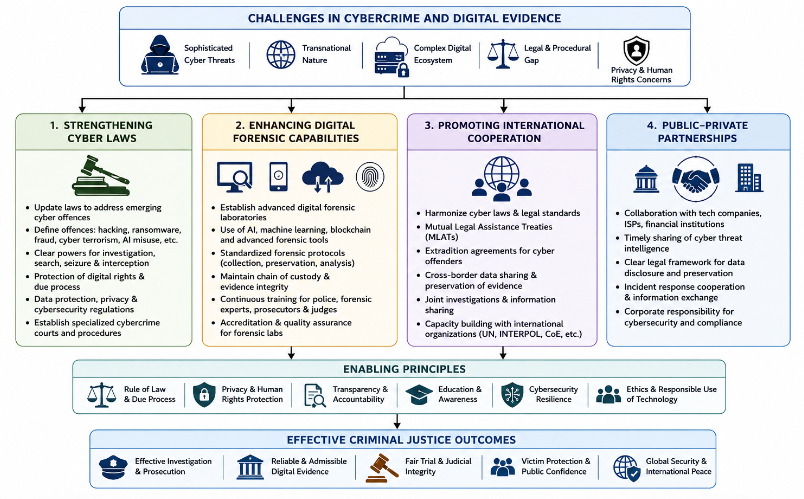
Figure: Strengthening Cyber Laws, Digital Forensics, and International Cooperation for Effective Criminal Justice
Continuous professional training for police officers, forensic experts, prosecutors, judges, and legal practitioners is equally important because rapidly evolving technologies require specialized technical knowledge and interdisciplinary expertise. Educational institutions and judicial academies should integrate cybersecurity law, digital forensics, cyber investigation techniques, electronic evidence management, and technology law into legal education and professional development programmes. International cooperation has become indispensable because cybercrime frequently involves offenders, victims, service providers, and digital infrastructure located in multiple countries. Effective criminal justice therefore depends upon harmonized cyber legislation, mutual legal assistance treaties, extradition agreements, cross-border data-sharing mechanisms, and collaborative law enforcement operations. International organizations can facilitate the development of common legal standards, best practices, technical guidelines, and coordinated responses to transnational cyber threats. Public-private partnerships also play a vital role in strengthening cybersecurity because internet service providers, cloud service companies, financial institutions, technology firms, cybersecurity organizations, and telecommunications providers possess valuable technical expertise and digital intelligence that can support criminal investigations. Clear legal frameworks governing information sharing between private organizations and law enforcement agencies should be established to ensure timely access to digital evidence while protecting commercial confidentiality and individual privacy. Privacy protection must remain a central component of cyber law reform to ensure that investigative powers are exercised proportionately and subject to judicial oversight. Strong data protection laws, judicial authorization for digital searches, transparent surveillance procedures, and independent oversight mechanisms help balance effective law enforcement with the protection of fundamental rights. Artificial Intelligence can further strengthen criminal justice by assisting in cyber threat detection, automated evidence analysis, fraud identification, predictive risk assessment, and digital forensic investigations; however, AI applications themselves must remain transparent, explainable, and accountable to prevent algorithmic bias and unlawful decision-making. Governments should also invest in public awareness campaigns that educate citizens about cyber hygiene, online safety, digital fraud prevention, password security, phishing attacks, identity theft, and responsible internet usage, thereby reducing opportunities for cybercriminals. Ultimately, strengthening cyber laws, digital forensic science, international cooperation, and institutional capacity will create resilient criminal justice systems capable of effectively preventing, investigating, prosecuting, and adjudicating cybercrime while ensuring fairness, due process, human rights protection, and public confidence in the administration of justice.
Conclusion#
The rapid expansion of digital technologies has fundamentally transformed the nature of crime, requiring criminal justice systems to evolve in response to increasingly sophisticated cyber threats and the growing importance of digital evidence. Cybercrime has emerged as one of the most significant challenges of the digital age, affecting governments, businesses, financial institutions, healthcare organizations, educational institutions, and individuals across the world. Offences such as hacking, ransomware attacks, identity theft, financial fraud, cyberterrorism, online harassment, digital espionage, and attacks on critical infrastructure demonstrate that cybercrime is no longer confined to isolated incidents but has become a major threat to economic stability, public safety, national security, and international peace. The present study highlights that effective investigation and prosecution of cybercrime require legal systems capable of addressing technological complexity, transnational criminal activities, rapidly evolving digital platforms, and sophisticated methods of concealing criminal identities. Digital evidence has become indispensable in contemporary criminal investigations because electronic records provide objective information that assists law enforcement agencies in identifying offenders, reconstructing criminal events, establishing timelines, and supporting judicial decision-making. However, the collection, preservation, authentication, analysis, and admissibility of digital evidence present numerous legal and procedural challenges, including concerns relating to privacy, constitutional rights, chain of custody, authenticity, cybersecurity, cross-border jurisdiction, and international cooperation. Criminal justice institutions must therefore adopt standardized forensic procedures and continuously modernize their legal frameworks to ensure that electronic evidence remains reliable, admissible, and scientifically credible during judicial proceedings. The study further demonstrates that strengthening cyber legislation alone is insufficient without corresponding investments in digital forensic infrastructure, specialized training, advanced investigative technologies, judicial capacity building, and interdisciplinary collaboration. Governments should establish comprehensive cybercrime laws that clearly define emerging digital offences, regulate investigative powers, protect individual rights, and facilitate international cooperation through harmonized legal standards and mutual legal assistance mechanisms. Public-private partnerships involving technology companies, financial institutions, internet service providers, academic institutions, and cybersecurity organizations are equally important for improving threat intelligence, incident response, and evidence collection. Artificial Intelligence, machine learning, blockchain technology, and advanced forensic tools offer significant opportunities for enhancing cyber investigations; however, their use must remain transparent, accountable, and subject to legal safeguards to protect due process and human rights. Continuous public awareness regarding cybersecurity practices and responsible digital behaviour will further contribute to preventing cybercrime and reducing victimization. Ultimately, contemporary criminal justice systems must balance technological innovation with constitutional protections, procedural fairness, judicial integrity, and the rule of law. By strengthening cyber laws, enhancing digital forensic capabilities, promoting international collaboration, and investing in technological and human resources, societies can build resilient legal systems capable of responding effectively to cybercrime while ensuring justice, security, accountability, and public trust in an increasingly interconnected digital world.
Works Cited#
- United Nations Office on Drugs and Crime. (2024). *Comprehensive Study on Cybercrime*. Vienna: UNODC.
- Council of Europe. (2001). *Convention on Cybercrime (Budapest Convention)*. Strasbourg: Council of Europe.
- International Criminal Police Organization. (2023). *Global Cybercrime Strategy*. Lyon: INTERPOL.
- National Institute of Standards and Technology. (2024). *Cybersecurity Framework (CSF 2.0)*.
- International Organization for Standardization. (2022). *ISO/IEC 27001: Information Security, Cybersecurity and Privacy Protection—Information Security Management Systems*.
- European Union Agency for Cybersecurity. (2023). *ENISA Threat Landscape 2023*.
- Federal Bureau of Investigation. (2023). *Internet Crime Report 2023*.
- Europol. (2024). *Internet Organised Crime Threat Assessment (IOCTA) 2024*.
- Association of Chief Police Officers. (2012). *Good Practice Guide for Digital Evidence*.
- Casey, Eoghan. (2011). *Digital Evidence and Computer Crime: Forensic Science, Computers, and the Internet* (3rd ed.). Academic Press.
- Carrier, Brian. (2005). *File System Forensic Analysis*. Addison-Wesley.
- Nelson, Bill., Phillips, Amelia., & Steuart, Christopher. (2019). *Guide to Computer Forensics and Investigations* (6th ed.). Cengage Learning.
- Kerr, Orin S.. (2005). Digital evidence and the new criminal procedure. *Columbia Law Review, 105*(1), 279–318.
- Brenner, Susan W.. (2010). *Cybercrime: Criminal Threats from Cyberspace*. Praeger.
- Wall, David S.. (2007). *Cybercrime: The Transformation of Crime in the Information Age*. Polity Press.
- International Telecommunication Union. (2024). *Global Cybersecurity Index 2024*.
- World Economic Forum. (2024). *Global Cybersecurity Outlook 2024*.
- International Association of Computer Investigative Specialists. (2023). *Best Practices in Digital Evidence Collection and Preservation*.
- United Nations Educational, Scientific and Cultural Organization. (2023). *Guidelines for Digital Governance and Information Ethics*.
- Schjolberg, Stein., & Hubbard, Solange Ghernaouti. (2015). *A Global Treaty on Cybersecurity and Cybercrime*. Geneva: Cybercrime Research Institute.