Abstract
Constitutional courts play a pivotal role in safeguarding democratic governance, protecting fundamental rights, and preserving the rule of law during national emergencies. Emergencies arising from armed conflict, terrorism, pandemics, natural disasters, economic crises, or political instability often require governments to exercise extraordinary powers to maintain public order and national security. While such emergency measures may be necessary to protect the state and its citizens, they also create significant risks of executive overreach, erosion of civil liberties, weakening of democratic institutions, and abuse of constitutional authority. Constitutional courts therefore function as essential guardians of constitutionalism by ensuring that emergency actions remain consistent with constitutional principles, proportionality, legality, necessity, and judicial accountability. Modern constitutional jurisprudence demonstrates that constitutional courts have increasingly scrutinized executive emergency powers concerning lockdowns, surveillance, preventive detention, restrictions on freedom of movement, emergency legislation, electoral postponements, and limitations on freedom of expression. Through judicial review, constitutional interpretation, and the enforcement of fundamental rights, these courts balance competing constitutional interests by protecting public safety without undermining democratic governance or constitutional supremacy. Comparative constitutional experiences further illustrate that effective judicial oversight strengthens public confidence in democratic institutions while preventing arbitrary governmental action.This chapter critically examines the constitutional role of courts during national emergencies by exploring the legal foundations of emergency powers, judicial review of executive actions, protection of democratic values and human rights, and emerging challenges associated with contemporary crises. It concludes that constitutional courts remain indispensable institutions for maintaining constitutional balance, preserving democracy, and ensuring that extraordinary governmental powers remain subject to constitutional limitations even in times of national crisis.
- Constitutional Courts
- National Emergencies
- Rule of Law
- Judicial Review
- Democratic Governance
- Constitutionalism
- Human Rights
- Emergency Powers
- Separation of Powers
- Constitutional Accountability
Introduction#
National emergencies have historically tested the resilience of constitutional democracies by requiring governments to respond swiftly to extraordinary circumstances while simultaneously preserving constitutional governance and democratic legitimacy. Emergencies may arise from armed conflicts, terrorism, pandemics, natural disasters, cyberattacks, financial crises, or widespread civil unrest, each demanding rapid governmental intervention to protect public order, national security, and human welfare. In such situations, governments often invoke constitutional or statutory emergency powers that authorize temporary restrictions on individual rights, expansion of executive authority, and expedited administrative decision-making. Although these exceptional powers may be necessary for effective crisis management, they also create opportunities for executive overreach, erosion of civil liberties, weakening of legislative oversight, and long-term threats to democratic institutions.
Constitutional courts occupy a central position in maintaining the constitutional balance during emergencies. As guardians of the constitution, they ensure that emergency measures comply with constitutional principles, remain proportionate to the crisis, respect fundamental rights, and operate within legally prescribed limits. Through judicial review, constitutional interpretation, and enforcement of constitutional guarantees, courts prevent emergency powers from becoming instruments of arbitrary governance or authoritarian consolidation.
The principle of the rule of law requires that governmental authority continue to operate within constitutional boundaries even during exceptional circumstances. Constitutional courts therefore examine whether emergency declarations satisfy constitutional requirements, whether restrictions on rights are lawful and necessary, whether executive actions remain proportionate, and whether legislative and judicial oversight continues to function effectively. Their role extends beyond resolving legal disputes; they preserve democratic accountability by ensuring that constitutional institutions continue to operate despite extraordinary challenges.
Recent global crises have further emphasized the importance of constitutional courts. The COVID-19 pandemic required governments worldwide to implement lockdowns, quarantine measures, travel restrictions, vaccination policies, digital surveillance, and emergency healthcare regulations. Courts across numerous jurisdictions reviewed these measures to balance public health objectives with constitutional rights such as privacy, freedom of movement, religious liberty, education, and access to justice. Similarly, constitutional courts have adjudicated disputes arising from counterterrorism legislation, emergency surveillance programs, military deployments, election postponements, and declarations of states of emergency.
Comparative constitutional law demonstrates considerable variation in how constitutional courts exercise judicial oversight during emergencies. Some constitutions provide extensive emergency powers subject to judicial review, while others establish strict constitutional limitations to prevent executive abuse. Nevertheless, most democratic constitutional systems recognize that emergency powers must remain temporary, proportionate, legally authorized, and subject to independent judicial scrutiny.
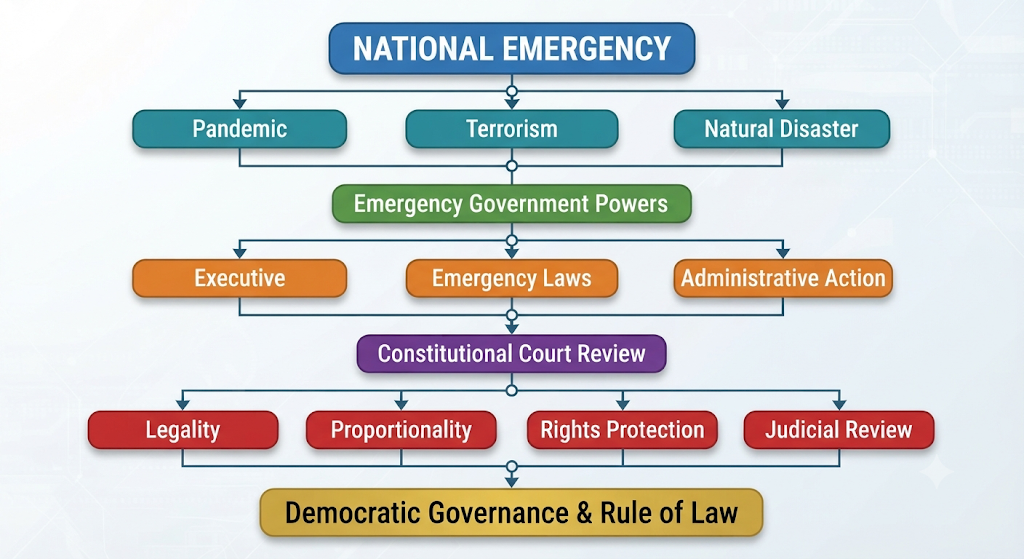
Figure: Conceptual Background
This chapter examines the evolving constitutional role of courts in protecting democratic values during national emergencies by analyzing constitutional foundations of emergency governance, judicial review of executive actions, protection of fundamental rights, comparative constitutional experiences, and future challenges confronting constitutional democracies in an increasingly uncertain global environment.
Protection of Democratic Values and Fundamental Rights during Emergencies#
National emergencies place constitutional democracies under extraordinary pressure because governments must simultaneously protect public safety and preserve the constitutional order. During such periods, democratic values—including the rule of law, separation of powers, judicial independence, constitutional supremacy, political accountability, transparency, and respect for fundamental rights—face significant challenges. Constitutional courts play an indispensable role in maintaining this delicate balance by ensuring that emergency measures remain lawful, proportionate, necessary, and consistent with constitutional principles. Rather than obstructing governmental responses to crises, constitutional courts ensure that emergency powers are exercised within constitutional limits, thereby preventing the gradual erosion of democratic governance. One of the primary democratic values protected by constitutional courts is the rule of law, which requires that every governmental action be based on legal authority and remain subject to judicial review. Even during states of emergency, governments cannot exercise unlimited or arbitrary powers. Constitutional courts examine whether emergency declarations comply with constitutional procedures, whether emergency legislation has been lawfully enacted, and whether executive authorities have acted within the scope of powers granted by the constitution or emergency statutes. Judicial review thus serves as an institutional safeguard against arbitrary executive action and reinforces the principle that constitutional supremacy continues to prevail during times of crisis. Another essential democratic value protected by constitutional courts is the separation of powers. National emergencies often result in the concentration of authority within the executive branch because rapid decision-making is necessary to address urgent threats. While temporary expansion of executive authority may be constitutionally permissible, prolonged concentration of power can weaken legislative oversight, undermine judicial independence, and disrupt the constitutional balance among branches of government. Constitutional courts therefore monitor whether emergency powers remain temporary, whether legislatures continue to perform oversight functions, and whether executive actions remain accountable to constitutional institutions. By preserving institutional checks and balances, courts prevent emergency governance from evolving into permanent executive dominance. Constitutional courts also safeguard fundamental rights and civil liberties, which frequently become subject to restrictions during emergencies. Governments may impose limitations on freedom of movement, assembly, association, expression, religious practice, privacy, education, property, and economic activities to protect public safety or national security. Although many constitutions permit temporary restrictions on certain rights during emergencies, such limitations must satisfy constitutional tests of legality, necessity, proportionality, and non-discrimination. Constitutional courts carefully assess whether emergency restrictions pursue legitimate public objectives, whether less restrictive alternatives are available, and whether governmental measures impose excessive burdens upon individuals. This proportionality analysis ensures that emergency powers do not unnecessarily compromise constitutional freedoms. The COVID-19 pandemic demonstrated the significance of judicial oversight in reviewing emergency public health measures such as lockdowns, quarantine regulations, vaccination mandates, travel restrictions, school closures, digital contact tracing, and limitations on religious gatherings. Constitutional courts across numerous jurisdictions balanced the state's responsibility to protect public health against constitutional guarantees of liberty, privacy, equality, freedom of religion, access to education, and due process. Their decisions emphasized that constitutional rights remain enforceable even during unprecedented public emergencies, although temporary limitations may be justified where supported by scientific evidence and constitutional standards. Constitutional courts further protect electoral democracy during emergencies by ensuring that electoral processes remain free, fair, and constitutionally legitimate. National crises may necessitate postponement of elections or modification of voting procedures; however, such decisions must not become instruments for extending political power or weakening democratic accountability. Courts review whether changes to electoral processes are constitutionally justified, proportionate, transparent, and limited to genuine emergency circumstances. By preserving electoral integrity, constitutional courts strengthen democratic legitimacy even under exceptional conditions. Another critical function of constitutional courts involves protecting minority rights and vulnerable populations during emergencies. Marginalized communities often experience disproportionate effects from emergency measures due to economic inequality, limited healthcare access, social discrimination, or restricted access to justice. Constitutional courts ensure that emergency regulations do not discriminate against particular groups and that governments continue fulfilling constitutional obligations relating to equality, human dignity, social welfare, and non-discrimination. Judicial oversight therefore promotes substantive equality alongside formal constitutional guarantees. Transparency and governmental accountability also constitute essential democratic values protected through constitutional adjudication. Courts may require governments to disclose the legal basis for emergency actions, provide adequate reasons for restrictions, maintain public access to information, and permit judicial challenges to administrative decisions. Such transparency strengthens public confidence in governmental institutions while reducing opportunities for abuse of emergency powers. Additionally, constitutional courts protect judicial independence, ensuring that courts themselves continue functioning effectively during emergencies through virtual hearings, electronic filings, and other procedural adaptations without compromising fairness, impartiality, or access to justice. Looking forward, emerging challenges such as cyber emergencies, artificial intelligence, climate-related disasters, transnational terrorism, and digital surveillance will require constitutional courts to develop innovative constitutional doctrines while preserving democratic governance. Comparative constitutional experiences demonstrate that the most resilient democracies are those in which constitutional courts actively defend constitutional principles without preventing governments from responding effectively to genuine emergencies. Ultimately, constitutional courts serve not merely as legal adjudicators but as guardians of democracy itself, ensuring that extraordinary governmental powers remain firmly constrained by constitutional values, human rights, judicial accountability, and the enduring principles of the rule of law.
Emerging Challenges and Future Role of Constitutional Courts During National Emergencies#
The twenty-first century has witnessed an unprecedented expansion in the scope, frequency, and complexity of national emergencies, compelling constitutional courts to adapt their judicial functions to address evolving constitutional challenges while preserving democratic governance and the rule of law. Unlike traditional emergencies arising primarily from armed conflicts or natural disasters, modern constitutional democracies increasingly confront multidimensional crises including global pandemics, cyberattacks, climate change, artificial intelligence (AI)-related risks, transnational terrorism, economic instability, misinformation campaigns, mass migration, energy shortages, and threats to critical digital infrastructure. These emerging challenges require governments to exercise extraordinary powers rapidly and decisively, yet they simultaneously increase the risk of executive overreach, prolonged emergency governance, erosion of constitutional rights, and weakening of democratic institutions. Constitutional courts therefore face the increasingly important responsibility of ensuring that emergency measures remain temporary, proportionate, constitutionally authorized, and subject to meaningful judicial oversight. One of the most significant future challenges concerns digital governance and emergency surveillance. Governments now possess sophisticated technological capabilities such as facial recognition systems, biometric identification, artificial intelligence, predictive policing, geolocation tracking, mass digital surveillance, and automated decision-making systems that may be deployed during national emergencies to protect public safety. While these technologies can improve emergency response and national security, they also present serious constitutional concerns regarding privacy, personal liberty, freedom of expression, equality, and informational self-determination. Constitutional courts will increasingly be required to establish constitutional standards governing the lawful use of surveillance technologies by ensuring that digital monitoring remains necessary, proportionate, transparent, and subject to judicial authorization. Another emerging challenge involves artificial intelligence in governmental decision-making. AI systems are increasingly used in healthcare allocation, border security, disaster management, social welfare distribution, law enforcement, judicial administration, and emergency resource planning. Although AI enhances administrative efficiency and predictive capabilities, algorithmic bias, lack of transparency, and automated decision-making may compromise constitutional guarantees of due process, equality, fairness, and accountability. Constitutional courts will play a vital role in developing constitutional doctrines requiring explainable algorithms, human oversight, independent review, and effective legal remedies for individuals adversely affected by automated governmental decisions. Climate change represents another defining constitutional challenge for future emergency governance. Increasing occurrences of floods, droughts, wildfires, hurricanes, rising sea levels, and environmental degradation require governments to invoke emergency powers more frequently. Constitutional courts will be required to balance urgent environmental protection measures with constitutional guarantees relating to property rights, economic freedoms, environmental justice, indigenous rights, and intergenerational equity. The emerging doctrine of climate constitutionalism may significantly expand judicial review concerning governmental obligations to protect the environment while safeguarding democratic accountability. Cybersecurity emergencies likewise demand enhanced constitutional oversight. Cyberattacks targeting electoral systems, healthcare infrastructure, financial institutions, transportation networks, and government databases can threaten both national security and constitutional governance.
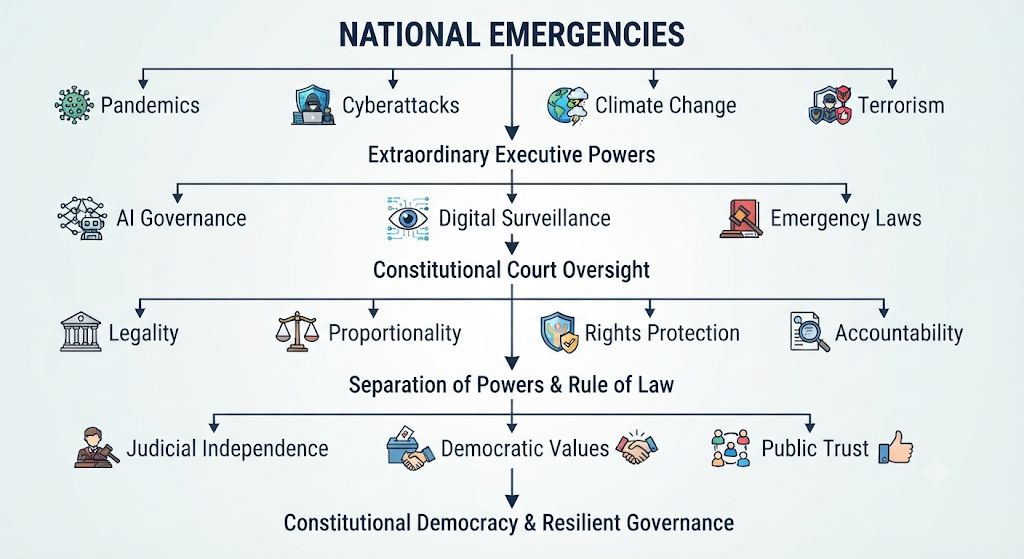
Future: Future Role of Constitutional Courts During National Emergencies
Emergency responses involving internet restrictions, digital censorship, communication monitoring, and cybersecurity regulations must remain subject to constitutional review to ensure that national security objectives do not unnecessarily restrict civil liberties or democratic participation. Constitutional courts must therefore develop balanced constitutional standards governing cyber emergency legislation while preserving digital rights and freedom of expression. Another important challenge concerns the normalization of emergency powers. Temporary emergency measures introduced during crises sometimes continue long after the original emergency has ended, creating risks of permanent executive expansion and democratic erosion. Constitutional courts will increasingly be expected to ensure that emergency powers remain exceptional rather than becoming ordinary instruments of governance. Judicial review should require governments to justify the continuation of emergency measures through objective evidence, legislative approval, and periodic constitutional reassessment. Courts should also emphasize sunset clauses, regular parliamentary oversight, and independent judicial scrutiny to prevent indefinite emergency rule. International and comparative constitutional dialogue will become increasingly influential in addressing future emergencies because many contemporary crises transcend national borders. Constitutional courts are expected to engage more actively with comparative constitutional jurisprudence concerning pandemic responses, climate litigation, digital governance, counterterrorism, migration, and cybersecurity while respecting domestic constitutional traditions and constitutional identity. Such judicial dialogue facilitates institutional learning without undermining constitutional sovereignty. Furthermore, constitutional courts must strengthen public confidence in democratic institutions by maintaining transparency, consistency, independence, and impartiality during politically sensitive emergencies. Public trust is essential because judicial legitimacy directly influences societal acceptance of constitutional decisions during times of crisis. Courts should ensure accessible judicial remedies through virtual hearings, electronic filing systems, digital evidence management, and technology-enabled access to justice while preserving procedural fairness and judicial independence. Looking ahead, constitutional courts will continue evolving from traditional constitutional adjudicators into proactive guardians of democratic resilience capable of responding effectively to increasingly complex emergencies. Their future role will extend beyond reviewing executive actions to shaping constitutional doctrines governing artificial intelligence, climate emergencies, digital governance, cyber resilience, global public health, and transnational security. Ultimately, the effectiveness of constitutional courts during national emergencies will depend upon their ability to uphold constitutional supremacy, preserve separation of powers, protect fundamental rights, ensure governmental accountability, and maintain the rule of law even under extraordinary circumstances. By balancing emergency governance with enduring constitutional principles, constitutional courts will remain indispensable institutions for safeguarding democracy, protecting human dignity, and ensuring that temporary crises do not permanently weaken constitutional democracy.
Conclusion#
National emergencies represent one of the greatest tests of constitutional democracy because they require governments to respond rapidly and decisively to extraordinary threats while simultaneously preserving constitutional governance, protecting fundamental rights, and maintaining democratic accountability. Throughout history, wars, pandemics, terrorism, natural disasters, economic crises, cyberattacks, and political instability have compelled governments to invoke emergency powers that temporarily expand executive authority and restrict certain constitutional freedoms. Although such measures may be necessary to safeguard public safety and national security, they also create significant risks of executive overreach, erosion of civil liberties, weakening of legislative oversight, and long-term damage to democratic institutions. As demonstrated throughout this chapter, constitutional courts play a central role in preventing these risks by ensuring that emergency powers remain firmly anchored within constitutional principles and the rule of law. Their primary responsibility is not to obstruct legitimate governmental action but to guarantee that extraordinary powers are exercised lawfully, proportionately, transparently, and only for the duration necessary to address the emergency. Judicial review therefore functions as one of the strongest constitutional safeguards against arbitrary government action, preserving the balance between effective crisis management and democratic governance. The chapter has highlighted how constitutional courts uphold the principles of constitutional supremacy, separation of powers, legality, proportionality, necessity, judicial independence, and accountability by carefully scrutinizing emergency legislation and executive actions. Through constitutional interpretation, courts ensure that governments cannot suspend constitutional values merely because exceptional circumstances exist. Instead, constitutional rights continue to operate, although certain temporary limitations may be justified where supported by law, necessity, and proportionality. The comparative constitutional experiences discussed in this chapter further demonstrate that constitutional courts have become increasingly active in reviewing emergency measures involving lockdowns, quarantine regulations, preventive detention, digital surveillance, election postponements, counterterrorism legislation, border controls, and public health restrictions. These judicial interventions have strengthened democratic legitimacy by ensuring that governmental responses remain consistent with constitutional guarantees while allowing authorities sufficient flexibility to protect society during crises. Another significant contribution of constitutional courts lies in protecting vulnerable populations and minority rights during emergencies. Marginalized communities frequently experience disproportionate social, economic, and legal consequences arising from emergency measures, making judicial oversight essential for ensuring equality, non-discrimination, access to justice, and respect for human dignity. Constitutional courts also preserve institutional balance by preventing the concentration of governmental authority within the executive branch and by reinforcing legislative oversight, judicial independence, and constitutional accountability. Looking toward the future, constitutional courts will encounter increasingly complex emergencies generated by artificial intelligence, cyber warfare, digital governance, climate change, environmental disasters, global pandemics, misinformation campaigns, transnational terrorism, and rapidly evolving technological innovations. These developments will require courts to formulate new constitutional doctrines capable of balancing innovation, national security, and public welfare with enduring constitutional values. The emergence of digital surveillance technologies, algorithmic governance, biometric identification systems, predictive policing, and automated administrative decision-making will further expand the judicial responsibility of protecting privacy, procedural fairness, equality, transparency, and individual liberty. Similarly, climate-related emergencies will require constitutional courts to reconcile environmental protection with property rights, sustainable development, intergenerational justice, and governmental accountability. Comparative constitutional dialogue will continue playing an increasingly influential role as courts learn from one another while respecting constitutional identity and national sovereignty. Judicial cooperation, academic scholarship, and international constitutional exchange will contribute to developing best practices for emergency governance that strengthen democratic resilience across jurisdictions. Nevertheless, constitutional courts must remain mindful that foreign constitutional experiences should inform rather than replace domestic constitutional interpretation. Public confidence in constitutional institutions will remain essential for the legitimacy of judicial decisions during emergencies. Courts must therefore continue demonstrating independence, impartiality, transparency, consistency, and commitment to constitutional values regardless of political pressure or public controversy. Ultimately, constitutional courts serve as the guardians of constitutional democracy, ensuring that temporary emergencies do not become permanent justifications for weakening democratic institutions or restricting individual freedoms. Their enduring mission is to preserve the constitutional balance between liberty and security, governmental authority and individual rights, emergency governance and democratic accountability. By faithfully enforcing constitutional limitations on emergency powers, protecting fundamental rights, strengthening judicial review, and preserving the rule of law, constitutional courts ensure that constitutional democracies remain resilient even in the face of the most severe national crises. Consequently, the protection of democratic values during national emergencies depends not only on effective executive action but equally on strong, independent, and constitutionally committed courts capable of safeguarding democracy, human dignity, and constitutional governance for present and future generations.
Works Cited#
- Ackerman, B. (2004). Before the Next Attack: Preserving Civil Liberties in an Age of Terrorism. Yale University Press.
- Barak, A. (2006). The Judge in a Democracy. Princeton University Press.
- Dyzenhaus, D. (2006). The Constitution of Law: Legality in a Time of Emergency. Cambridge University Press.
- Ferejohn, J., & Pasquino, P. (2004). The law of the exception: A typology of emergency powers. International Journal of Constitutional Law, 2(2), 210–239.
- Ginsburg, T., & Versteeg, M. (2021). Binding Emergency Constitutions. University of Chicago Law Review, 88(3), 563–627.
- Gross, O., & Ní Aoláin, F. (2006). Law in Times of Crisis: Emergency Powers in Theory and Practice. Cambridge University Press.
- Hirschl, R. (2004). Towards Juristocracy: The Origins and Consequences of the New Constitutionalism. Harvard University Press.
- Jackson, V. C. (2010). Constitutional Engagement in a Transnational Era. Oxford University Press.
- Kavanagh, A. (2009). Constitutional Review under the UK Human Rights Act. Cambridge University Press.
- Lazar, N. C. (2009). States of Emergency in Liberal Democracies. Cambridge University Press.
- Oren Gross. (2003). Chaos and rules: Should responses to violent crises always be constitutional? Yale Law Journal, 112(5), 1011–1134.
- Rosenfeld, M., & Sajó, A. (Eds.). (2012). The Oxford Handbook of Comparative Constitutional Law. Oxford University Press.
- Scheppele, K. L. (2004). Law in a time of emergency: States of exception and the temptations of 9/11. University of Pennsylvania Journal of Constitutional Law, 6(5), 1001–1083.
- Stone Sweet, A. (2000). Governing with Judges: Constitutional Politics in Europe. Oxford University Press.
- Tushnet, M. (2014). Advanced Introduction to Comparative Constitutional Law. Edward Elgar Publishing.
- United Nations. (1966). International Covenant on Civil and Political Rights. United Nations.
- Venice Commission. (2020). Respect for Democracy, Human Rights and the Rule of Law During States of Emergency. Council of Europe.
- Waldron, J. (2012). Constitutionalism: A Skeptical View. New York University School of Law.
- World Health Organization. (2021). Strengthening Preparedness for Health Emergencies. WHO.
- World Justice Project. (2023). Rule of Law Index 2023. World Justice Project