Abstract
The increasing complexity of global security threats, including terrorism, cybercrime, transnational organized crime, armed conflicts, and public health emergencies, has significantly expanded the scope of state security measures in the twenty-first century. Governments across the world have adopted extensive legal frameworks empowering surveillance, intelligence gathering, preventive detention, border control, and emergency powers to safeguard national security. While these measures are essential for maintaining public order and protecting citizens, they frequently raise concerns regarding violations of fundamental civil liberties such as privacy, freedom of expression, freedom of association, due process, equality, and personal liberty. The challenge of balancing national security with constitutional rights has become one of the most significant issues in contemporary constitutional and human rights law. Courts, legislatures, and international organizations increasingly emphasize that security measures must satisfy the principles of legality, necessity, proportionality, accountability, and judicial oversight. This paper critically examines the evolving relationship between national security and civil liberties through the lens of constitutional law, international human rights law, and comparative legal frameworks. It analyzes landmark judicial decisions, anti-terrorism legislation, surveillance laws, and emergency powers adopted in various jurisdictions, including India, the United States, the United Kingdom, and the European Union. The study further explores emerging challenges posed by digital surveillance, artificial intelligence, cybersecurity, misinformation, and cross-border terrorism. It concludes by proposing balanced legal reforms that strengthen national security while preserving democratic values, the rule of law, and the protection of fundamental human rights.
- National Security
- Civil Liberties
- Constitutional Law
- Human Rights
- Surveillance
- Privacy
- Anti-Terrorism Law
- Rule of Law
- Emergency Powers
- Comparative Constitutional Law
Introduction#
The protection of national security has always been regarded as one of the primary responsibilities of the modern state. In recent decades, however, the nature of security threats has evolved dramatically due to globalization, technological advancement, cyber warfare, international terrorism, organized crime, disinformation campaigns, pandemics, and transnational security challenges. Governments increasingly rely upon sophisticated legal and technological mechanisms to prevent and respond to these threats, including electronic surveillance, intelligence collection, preventive detention, border security measures, financial monitoring, and emergency legislation. While such measures are often justified as necessary for safeguarding public safety and maintaining national stability, they frequently intersect with fundamental constitutional rights and civil liberties guaranteed under democratic legal systems. Rights such as privacy, freedom of speech, freedom of association, freedom of movement, equality before the law, and procedural due process may be restricted during periods of heightened security concerns, giving rise to complex constitutional and human rights questions. The challenge of balancing collective security with individual liberty has therefore become one of the defining legal issues of the twenty-first century. Democratic constitutions generally recognize that certain rights may be restricted in the interests of national security; however, these restrictions must satisfy constitutional principles of legality, necessity, proportionality, and judicial accountability. International human rights instruments, including the Universal Declaration of Human Rights, the International Covenant on Civil and Political Rights, and regional human rights conventions, similarly permit limited restrictions on certain rights while prohibiting arbitrary or disproportionate governmental action. Judicial institutions across the world have played a crucial role in reviewing national security measures to ensure that executive power remains subject to constitutional limitations and the rule of law.
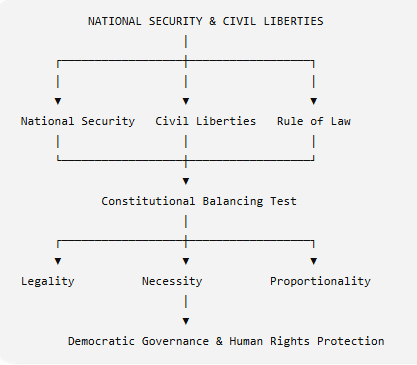
Figure: Conceptual Background
In India, the Supreme Court has emphasized that the right to privacy, personal liberty, and due process remain fundamental even when national security considerations are involved. Similarly, constitutional courts in the United States, the United Kingdom, Canada, and the European Union have continuously examined the legality of surveillance laws, emergency powers, counter-terrorism legislation, and preventive detention through constitutional review. Technological innovation has introduced additional challenges as governments increasingly employ artificial intelligence, facial recognition systems, biometric databases, mass digital surveillance, predictive policing, and cyber intelligence to combat emerging security threats. While these technologies significantly strengthen law enforcement capabilities, they also create unprecedented risks to privacy, freedom of expression, democratic participation, and human dignity. The COVID-19 pandemic further illustrated how emergency powers may substantially expand governmental authority while simultaneously raising concerns regarding proportionality, transparency, and protection of civil liberties. This paper critically examines the evolving legal relationship between national security and civil liberties through comparative constitutional analysis, international human rights law, judicial interpretation, and contemporary legislative developments. It evaluates the constitutional principles governing limitations upon individual rights, analyzes emerging legal challenges associated with modern security technologies, and proposes balanced legal reforms capable of preserving both national security and democratic constitutional values in an increasingly interconnected and technologically advanced world.
- International and Comparative Legal Framework on National Security and Civil Liberties
The relationship between national security and civil liberties is governed by a combination of international human rights law, constitutional principles, and domestic legislation that seeks to balance the legitimate security interests of the State with the protection of individual freedoms. The Universal Declaration of Human Rights (UDHR), 1948 recognizes fundamental rights including life, liberty, equality, privacy, freedom of expression, and freedom of association, while acknowledging that certain rights may be subject to limitations prescribed by law for the protection of public order and national security. Similarly, the International Covenant on Civil and Political Rights (ICCPR), 1966 guarantees civil and political rights but permits limited restrictions where they are lawful, necessary, and proportionate to safeguard national security, public safety, or public health. Article 4 of the ICCPR also allows temporary derogation from certain obligations during officially proclaimed public emergencies, provided such measures are strictly required by the situation and remain consistent with international law. Regional human rights instruments, including the European Convention on Human Rights (ECHR) and the American Convention on Human Rights, contain comparable provisions balancing state security with individual rights through judicial oversight. The European Court of Human Rights (ECtHR) has developed an extensive body of jurisprudence emphasizing that surveillance measures, preventive detention, and emergency powers must satisfy the principles of legality, proportionality, necessity, and democratic accountability. Within the United States, constitutional protections under the Bill of Rights, particularly the First, Fourth, Fifth, and Fourteenth Amendments, safeguard freedom of speech, privacy, due process, and equal protection while allowing Congress to enact national security legislation such as the USA PATRIOT Act following the September 11 terrorist attacks. The Foreign Intelligence Surveillance Act (FISA) further regulates electronic surveillance conducted for intelligence purposes under judicial supervision. In the United Kingdom, the Human Rights Act 1998, together with the Investigatory Powers Act 2016, establishes legal safeguards governing surveillance, interception of communications, and intelligence gathering while preserving judicial review and parliamentary oversight. In India, constitutional protections under Articles 14, 19, 21, and 22 guarantee equality, freedom of speech, personal liberty, and procedural safeguards against arbitrary detention. National security legislation such as the Unlawful Activities (Prevention) Act, 1967 (UAPA), the National Security Act, 1980, and provisions under the Information Technology Act, 2000 provide mechanisms for addressing terrorism, cyber threats, and unlawful activities, subject to constitutional review by the judiciary. Landmark judgments including Justice K.S. Puttaswamy (Retd.) v. Union of India (2017) have affirmed that even national security measures must respect the constitutional right to privacy and satisfy the test of proportionality. Comparative legal analysis demonstrates that democratic societies increasingly recognize that national security and civil liberties are not mutually exclusive objectives but complementary constitutional values requiring careful legal balancing. Effective governance therefore depends upon robust legislative safeguards, independent judicial review, transparent executive action, and adherence to international human rights standards that prevent excessive state power while enabling governments to respond effectively to genuine security threats.
Contemporary Legal Challenges in Balancing National Security and Civil Liberties#
The rapidly changing nature of modern security threats has created significant legal challenges in balancing effective national security measures with the protection of civil liberties. One of the most debated issues is mass surveillance, where governments increasingly employ advanced technologies such as facial recognition, biometric databases, artificial intelligence, internet monitoring, and metadata collection to identify security threats. Although these technologies strengthen intelligence gathering and crime prevention, they also raise serious concerns regarding the constitutional right to privacy, freedom of expression, and protection against arbitrary governmental interference. The widespread collection and processing of personal data without adequate safeguards may undermine democratic freedoms and create opportunities for misuse of state power. Cybersecurity represents another major challenge as governments seek broader legal authority to prevent cyberattacks targeting critical infrastructure, financial institutions, healthcare systems, and national defense networks. Expanding investigative powers, however, often requires interception of electronic communications and access to encrypted data, creating tension between public safety and digital privacy. Counter-terrorism legislation also presents complex constitutional questions. Laws permitting preventive detention, extended investigation periods, asset freezing, travel restrictions, and expanded police powers are frequently criticized for potentially affecting due process, the presumption of innocence, and access to fair trial guarantees. Ensuring that such powers are exercised only where strictly necessary remains essential for maintaining public confidence in the rule of law. The increasing use of artificial intelligence and predictive policing introduces additional legal concerns regarding algorithmic bias, transparency, accountability, and discrimination. AI-based risk assessment tools may inadvertently target particular communities or individuals if trained on biased datasets, potentially violating principles of equality and non-discrimination. Another important issue involves the declaration of states of emergency, during which governments may temporarily restrict movement, assembly, expression, and commercial activities. Experiences during the COVID-19 pandemic demonstrated that although emergency powers may be necessary to protect public health and national security, prolonged or inadequately supervised emergency measures can threaten democratic governance and constitutional accountability. The spread of misinformation, disinformation, and online extremism has further complicated legal regulation. Governments increasingly regulate digital platforms to combat hate speech, terrorist propaganda, and foreign interference in democratic processes; however, excessive regulation may interfere with freedom of expression and media independence. Cross-border terrorism and international organized crime also require greater international legal cooperation involving extradition treaties, intelligence sharing, mutual legal assistance, and harmonized cybersecurity standards while respecting international human rights obligations. Constitutional courts therefore continue to play an indispensable role in reviewing security legislation, ensuring that restrictions on civil liberties satisfy the principles of legality, necessity, proportionality, and judicial oversight. Achieving an appropriate constitutional balance requires transparent governance, effective parliamentary supervision, independent judicial review, human rights impact assessments, and clearly defined legal limitations upon executive authority. Such safeguards enable democratic societies to respond effectively to evolving security threats while preserving the constitutional freedoms that distinguish democratic governance from authoritarian rule.
Future Directions and Legal Reforms for Balancing Security and Liberty#
The evolving landscape of global security requires legal frameworks that are flexible enough to address emerging threats while remaining firmly grounded in constitutional principles and human rights protections. Future reforms should prioritize the adoption of rights-based national security legislation that clearly defines governmental powers, establishes procedural safeguards, and ensures accountability through independent oversight mechanisms. One of the most important reforms involves strengthening judicial review, enabling courts to assess whether surveillance measures, preventive detention orders, emergency regulations, and intelligence operations satisfy constitutional requirements of legality, necessity, proportionality, and reasonableness. Legislative bodies should also enhance parliamentary oversight of intelligence agencies by establishing independent review committees responsible for monitoring surveillance activities, budgetary expenditures, and compliance with constitutional standards. Another significant area of reform concerns the regulation of artificial intelligence and emerging surveillance technologies.
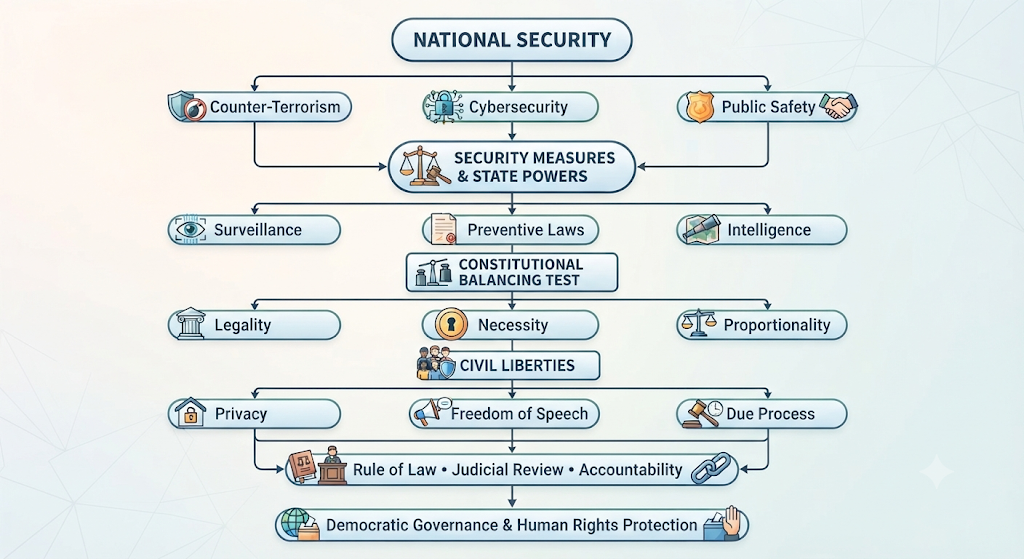
Figure: Balancing National Security and Civil Liberties
Governments should adopt comprehensive legal frameworks governing facial recognition systems, biometric identification, predictive policing, and automated decision-making to ensure transparency, explainability, data protection, and protection against algorithmic discrimination. Data privacy legislation should incorporate stronger safeguards regarding collection, storage, retention, and sharing of personal information obtained for national security purposes, together with effective remedies for individuals whose rights are violated. Future legal reforms should also promote cybersecurity governance through international cooperation, harmonized legal standards, and public-private partnerships capable of addressing cross-border cyber threats while respecting digital rights. During declared emergencies, constitutional safeguards should require periodic legislative review, judicial supervision, sunset clauses, and transparent publication of executive decisions to prevent unnecessary or prolonged restrictions upon civil liberties. International collaboration remains equally essential because terrorism, cybercrime, money laundering, trafficking, and transnational organized crime cannot be effectively addressed through unilateral national action alone. Organizations such as the United Nations, Interpol, the Financial Action Task Force (FATF), and regional security institutions play an increasingly important role in promoting coordinated legal responses consistent with international human rights obligations. Public awareness and civic education should also be strengthened to ensure that citizens understand both their constitutional rights and their responsibilities in maintaining national security. Training programs for law enforcement agencies, intelligence officials, judges, and policymakers should emphasize constitutional values, ethical governance, and respect for human rights when implementing security measures. Ultimately, democratic constitutional systems must reject the false assumption that national security and civil liberties are opposing objectives. Instead, effective security depends upon public trust, transparent governance, judicial accountability, and adherence to the rule of law. By developing balanced legal frameworks that protect both collective security and individual freedoms, states can strengthen democratic institutions, preserve constitutional legitimacy, and ensure that national security policies remain compatible with the fundamental principles of justice, liberty, equality, and human dignity in the twenty-first century
Conclusion#
Balancing national security and civil liberties remains one of the most complex and evolving challenges in contemporary constitutional and international law. The emergence of terrorism, cybercrime, transnational organized crime, misinformation, artificial intelligence, and other non-traditional security threats has compelled governments to adopt increasingly sophisticated legal and technological mechanisms to protect national interests and public safety. While these measures are indispensable for safeguarding citizens and maintaining social stability, they inevitably affect fundamental constitutional rights, including privacy, freedom of expression, personal liberty, equality, and due process. Democratic constitutional systems therefore require that all restrictions on civil liberties satisfy well-established legal principles of legality, necessity, proportionality, and accountability. International human rights instruments, constitutional provisions, and judicial precedents consistently emphasize that national security cannot serve as an unlimited justification for expanding executive power or undermining the rule of law. Comparative legal analysis demonstrates that constitutional courts across jurisdictions have played a crucial role in reviewing surveillance laws, preventive detention, emergency legislation, and intelligence operations to ensure that governmental actions remain consistent with constitutional guarantees and democratic values. The rapid integration of artificial intelligence, biometric surveillance, predictive policing, and digital intelligence has further highlighted the need for modern legal safeguards capable of protecting privacy and preventing arbitrary state interference. Effective national security policies should therefore combine technological innovation with transparent governance, independent oversight, parliamentary scrutiny, and judicial review. Equally important is the promotion of public trust through accountability, ethical law enforcement, and respect for human rights. International cooperation has become indispensable in addressing cross-border terrorism, cyber threats, financial crimes, and organized criminal networks while ensuring compliance with international legal standards. Future legal reforms should strengthen data protection laws, regulate emerging surveillance technologies, improve oversight of intelligence agencies, and establish clear procedural safeguards for emergency powers. Ultimately, national security and civil liberties should not be viewed as competing objectives but as complementary pillars of constitutional democracy. A secure society cannot flourish without protecting individual freedoms, just as the meaningful enjoyment of civil liberties depends upon the existence of peace, public order, and effective governance. By maintaining an appropriate constitutional balance between collective security and individual rights, democratic societies can effectively respond to evolving security challenges while preserving justice, human dignity, the rule of law, and the fundamental freedoms that define constitutional governance in the twenty-first century.
Works Cited#
- Council of Europe. (1950). European Convention on Human Rights. Council of Europe.
- European Court of Human Rights. (1978). Klass and Others v. Germany, Application No. 5029/71.
- Financial Action Task Force. (2023). International Standards on Combating Money Laundering and Terrorist Financing. FATF.
- Government of India. (1950). The Constitution of India. Ministry of Law and Justice.
- Government of India. (1967). The Unlawful Activities (Prevention) Act, 1967. Ministry of Home Affairs.
- Government of India. (1980). The National Security Act, 1980. Ministry of Home Affairs.
- Government of India. (2000). The Information Technology Act, 2000. Ministry of Electronics and Information Technology.
- Supreme Court of India. Justice K.S. Puttaswamy (Retd.) v. Union of India, (2017) 10 SCC 1.
- Supreme Court of India. A.K. Gopalan v. State of Madras, AIR 1950 SC 27.
- United Nations. (1948). Universal Declaration of Human Rights. United Nations.
- United Nations. (1966). International Covenant on Civil and Political Rights. United Nations Treaty Series.
- United Nations Office of Counter-Terrorism. (2023). United Nations Global Counter-Terrorism Strategy. United Nations.
- United States Congress. (2001). USA PATRIOT Act. Public Law 107–56.
- United States Congress. (1978). Foreign Intelligence Surveillance Act (FISA).
- Roach, K. (2021). Comparative Counter-Terrorism Law (3rd ed.). Cambridge University Press.
- Cole, D., & Dempsey, J. X. (2017). Terrorism and the Constitution: Sacrificing Civil Liberties in the Name of National Security (3rd ed.). The New Press.
- Fenwick, H. (2020). Civil Liberties and Human Rights (6th ed.). Routledge.
- Barak, A. (2012). Proportionality: Constitutional Rights and Their Limitations. Cambridge University Press.
- Inter-Parliamentary Union. (2022). Parliamentary Oversight of the Security Sector. IPU.
- Organisation for Economic Co-operation and Development. (2023). Recommendation on Government Access to Personal Data Held by Private Sector Entities. OECD Publishing.