Abstract
Social media has transformed global communication by enabling individuals to share information, express opinions, participate in democratic discourse, and engage in social, political, and economic activities without geographical limitations. Platforms such as Facebook, X (formerly Twitter), Instagram, YouTube, and TikTok have become central to public debate, journalism, political campaigns, and digital commerce. However, the rapid expansion of social media has also created significant legal challenges involving misinformation, hate speech, online harassment, privacy violations, fake news, cybercrime, election manipulation, and algorithmic content moderation. Governments worldwide have introduced various legislative and regulatory measures to address these concerns while attempting to preserve the fundamental right to freedom of expression. The legal balance between protecting individual liberties and preventing harmful online content remains one of the most debated issues in contemporary constitutional and international law. This paper critically examines the legal dimensions of social media regulation through a comparative analysis of international human rights standards, constitutional protections, and national regulatory frameworks. It evaluates the role of intermediary liability, platform accountability, judicial oversight, content moderation policies, and emerging digital governance mechanisms in safeguarding freedom of expression. The study further analyzes recent legislative developments, judicial decisions, and regulatory reforms in jurisdictions including the European Union, the United States, India, and other democratic nations. It concludes that effective social media regulation requires transparent governance, proportionate legal restrictions, independent judicial review, algorithmic accountability, protection of digital rights, and international cooperation to ensure that online platforms remain spaces for free, safe, and responsible democratic participation while respecting fundamental human rights.
- Social Media Regulation
- Freedom of Expression
- Digital Rights
- Content Moderation
- Intermediary Liability
- Hate Speech
- Online Privacy
- Digital Governance
- Constitutional Law
- Human Rights
Introduction#
The emergence of social media has fundamentally transformed the manner in which individuals communicate, access information, participate in political discourse, and exercise their right to freedom of expression. Digital platforms have democratized communication by allowing users to publish opinions, share news, organize social movements, and engage with audiences across national boundaries in real time. Unlike traditional media, social media enables decentralized communication where individuals function simultaneously as content creators, publishers, and consumers. These developments have strengthened democratic participation by facilitating public debate, increasing government accountability, supporting civic activism, and providing marginalized communities with platforms to express their views. However, the unprecedented growth of digital communication has also generated complex legal challenges involving misinformation, fake news, hate speech, cyberbullying, online defamation, extremist content, election interference, privacy violations, and cross-border dissemination of harmful information.
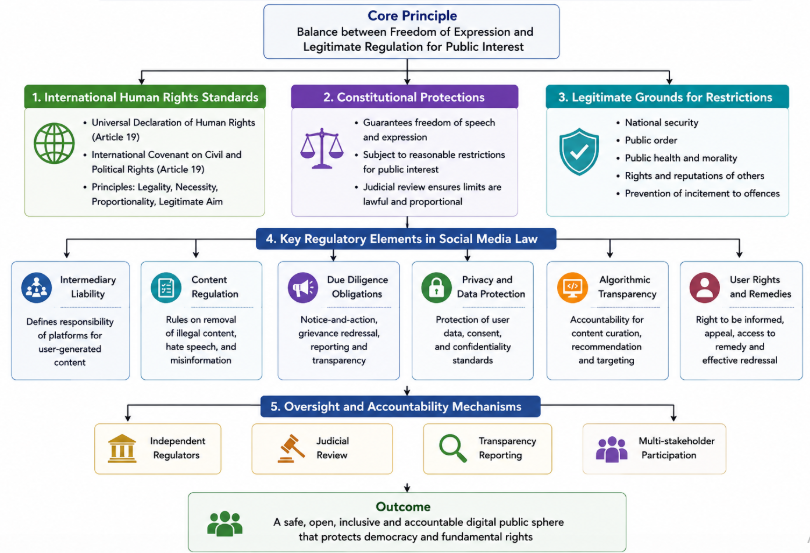
Figure: Conceptual Background
The widespread use of artificial intelligence, automated recommendation algorithms, targeted advertising, and data-driven content moderation has further complicated questions concerning transparency, accountability, and protection of fundamental rights. Consequently, governments, courts, international organizations, and technology companies increasingly face the difficult task of balancing freedom of expression with legitimate objectives such as national security, public order, public health, privacy protection, and prevention of online harm. Freedom of expression is universally recognized as a cornerstone of democratic governance and is protected under numerous international and constitutional legal frameworks. Article 19 of the Universal Declaration of Human Rights and the International Covenant on Civil and Political Rights guarantees every individual the right to seek, receive, and impart information through any media regardless of frontiers, while permitting limited restrictions that are lawful, necessary, and proportionate. Similarly, many democratic constitutions, including the Constitution of India under Article 19(1)(a), guarantee freedom of speech and expression subject to reasonable restrictions relating to sovereignty, security, public order, morality, and other legitimate state interests. As social media platforms have become dominant channels of communication, legal debates increasingly focus on intermediary liability, platform responsibility, algorithmic transparency, content moderation, user privacy, and digital governance. Different jurisdictions have adopted diverse regulatory approaches, ranging from the European Union's emphasis on platform accountability through the Digital Services Act to the United States' strong constitutional protection of free speech under the First Amendment and India's evolving regulatory framework under the Information Technology Act and related intermediary guidelines. This paper critically examines the legal dimensions of social media regulation through a comparative analysis of international human rights principles and national legal systems. It evaluates the constitutional limits of online speech regulation, emerging legal challenges associated with digital platforms, judicial responses to content moderation disputes, and recent legislative reforms aimed at achieving an appropriate balance between protecting freedom of expression and ensuring responsible governance of digital public spaces in an increasingly interconnected and technologically advanced society.
Emerging Regulatory Reforms and Future Directions in Social Media Governance#
The unprecedented growth of social media has compelled governments, international organizations, courts, and technology companies to introduce comprehensive regulatory reforms that seek to balance freedom of expression with platform accountability and public safety. Across the world, legal systems are increasingly shifting from minimal regulation toward risk-based digital governance frameworks that require greater transparency, accountability, and responsibility from online intermediaries. The European Union's Digital Services Act (DSA) represents one of the most comprehensive regulatory models by imposing obligations on very large online platforms to conduct risk assessments, combat illegal content, increase transparency in content moderation, regulate algorithmic recommendation systems, protect users' fundamental rights, and establish independent oversight mechanisms. Similarly, the Digital Markets Act (DMA) promotes fair competition by limiting the market dominance of major technology companies and ensuring greater consumer choice. In India, digital governance has evolved through the Information Technology (Intermediary Guidelines and Digital Media Ethics Code) Rules, 2021, which require intermediaries to exercise due diligence, establish grievance redressal mechanisms, appoint compliance officers, remove unlawful content within prescribed timelines, and cooperate with lawful government investigations while maintaining users' constitutional rights. Judicial decisions have consistently emphasized that any restriction on online speech must satisfy the constitutional principles of legality, necessity, proportionality, and procedural fairness. In the United States, ongoing debates surrounding Section 230 of the Communications Decency Act continue to shape discussions regarding intermediary liability, platform immunity, and content moderation responsibilities. Beyond legislative reforms, technology companies have increasingly adopted community standards, fact-checking partnerships, transparency reports, appeals mechanisms, and independent oversight bodies to improve trust and accountability in content moderation. Emerging regulatory discussions also focus on algorithmic accountability, requiring platforms to explain automated decision-making processes, minimize discriminatory outcomes, and reduce the amplification of harmful or misleading content generated through artificial intelligence.
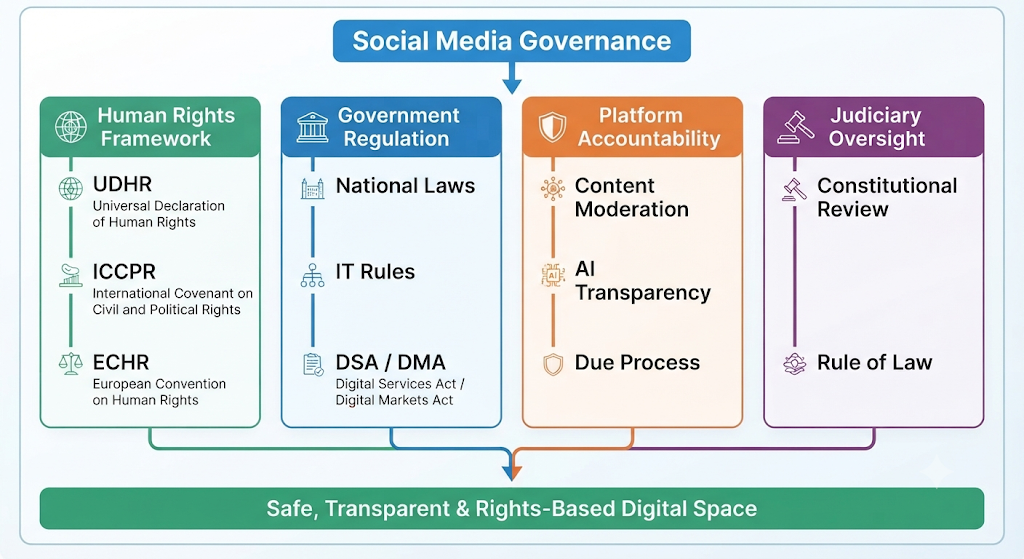
Figure: Legal Framework for Social Media Regulation and Freedom of Expression
The rapid rise of deepfakes, synthetic media, generative AI, and AI-powered recommendation systems has prompted policymakers to consider new legal frameworks governing authenticity verification, digital watermarking, disclosure requirements, and liability for AI-generated misinformation. Another important reform area concerns children's online safety, with many jurisdictions proposing stricter age verification systems, enhanced parental controls, limitations on targeted advertising directed at minors, and stronger protection against online exploitation and cyberbullying. Privacy legislation, including comprehensive data protection laws, increasingly complements social media regulation by requiring informed user consent, responsible data processing, transparency in profiling practices, and enhanced cybersecurity measures. Future legal reforms must also strengthen international cooperation because digital platforms operate across national borders while legal jurisdictions remain territorially limited. Harmonizing international standards on intermediary liability, cross-border data governance, cybercrime, online hate speech, and digital human rights will become increasingly important in ensuring effective regulation without undermining democratic freedoms. Ultimately, sustainable social media governance requires a balanced legal framework that combines constitutional protections for freedom of expression with transparent platform regulation, judicial oversight, technological accountability, user empowerment, and international collaboration. Such an integrated approach can preserve the internet as an open and democratic public sphere while effectively addressing evolving technological risks, protecting individual rights, promoting responsible innovation, and strengthening public trust in the digital information ecosystem.
Conclusion#
Social media has fundamentally transformed the global communication landscape by expanding opportunities for public participation, democratic engagement, access to information, and the exercise of freedom of expression. Digital platforms have empowered individuals, businesses, journalists, activists, and governments to communicate across geographical boundaries with unprecedented speed and reach. However, this transformation has also introduced significant legal and ethical challenges relating to misinformation, hate speech, cyber harassment, privacy violations, algorithmic bias, online extremism, election interference, and the growing influence of artificial intelligence on digital communication. Comparative legal analysis demonstrates that while international human rights instruments strongly protect freedom of expression, they also recognize that this right is not absolute and may be subject to carefully defined restrictions necessary to protect national security, public order, public health, morality, and the rights of others. Different jurisdictions have adopted diverse regulatory approaches reflecting their constitutional values, political systems, and legal traditions. The European Union emphasizes platform accountability and digital transparency through comprehensive legislative frameworks, the United States prioritizes broad constitutional protection of free speech while relying significantly on intermediary immunity, and countries such as India continue to develop evolving regulatory mechanisms balancing constitutional freedoms with digital governance objectives. Despite these developments, challenges relating to cross-border jurisdiction, inconsistent enforcement, private platform governance, algorithmic decision-making, and rapidly evolving artificial intelligence technologies continue to test the effectiveness of existing legal frameworks. Social media companies increasingly function as influential gatekeepers of public discourse, making transparency, procedural fairness, accountability, and independent oversight essential components of modern digital governance. Future legal reforms should focus on developing balanced regulatory models that protect democratic freedoms while effectively addressing unlawful online activities through proportionate, transparent, and rights-based approaches. Strengthening international cooperation, harmonizing digital governance standards, improving judicial oversight, enhancing user awareness, promoting digital literacy, regulating artificial intelligence, and safeguarding personal data will be crucial for ensuring responsible platform governance. Equally important is the adoption of transparent content moderation policies that respect due process, provide effective appeal mechanisms, and minimize arbitrary restrictions on lawful expression. Ultimately, the success of social media regulation depends upon achieving an appropriate balance between protecting individual liberty and ensuring collective security in an increasingly interconnected digital society. A legal framework grounded in constitutional principles, international human rights standards, technological accountability, and democratic values will foster an online environment that encourages innovation, protects fundamental rights, promotes responsible digital participation, and strengthens public trust in the evolving global information ecosystem.
Works Cited#
- Balkin, J. M. (2018). Free Speech in the Algorithmic Society: Big Data, Private Governance, and New School Speech Regulation. University of California Davis Law Review, 51(3), 1149–1210.
- Convention for the Protection of Human Rights and Fundamental Freedoms (European Convention on Human Rights), 1950.
- European Parliament & Council of the European Union. (2022). Digital Services Act (Regulation (EU) 2022/2065).
- European Parliament & Council of the European Union. (2022). Digital Markets Act (Regulation (EU) 2022/1925).
- Government of India. (1950). The Constitution of India.
- Government of India. (2000). The Information Technology Act, 2000.
- Government of India. (2021). Information Technology (Intermediary Guidelines and Digital Media Ethics Code) Rules, 2021.
- Kaye, D. (2019). Speech Police: The Global Struggle to Govern the Internet. Columbia Global Reports.
- Lessig, L. (2006). Code: Version 2.0. Basic Books.
- MacKinnon, R. (2012). Consent of the Networked: The Worldwide Struggle for Internet Freedom. Basic Books.
- Organisation for Economic Co-operation and Development. (2022). OECD Digital Economy Outlook.
- Sunstein, C. R. (2017). #Republic: Divided Democracy in the Age of Social Media. Princeton University Press.
- United Nations. (1948). Universal Declaration of Human Rights.
- United Nations. (1966). International Covenant on Civil and Political Rights.
- United Nations Educational, Scientific and Cultural Organization. (2023). Guidelines for the Governance of Digital Platforms.
- United Nations Human Rights Council. (2018). The Promotion, Protection and Enjoyment of Human Rights on the Internet.
- United Nations. (2015). Transforming Our World: The 2030 Agenda for Sustainable Development.
- Van Dijck, J., Poell, T., & de Waal, M. (2018). The Platform Society: Public Values in a Connective World. Oxford University Press.
- World Economic Forum. (2023). Global Risks Report 2023.
- Zuboff, S. (2019). The Age of Surveillance Capitalism. PublicAffairs.