Abstract
Gender justice has emerged as a fundamental component of constitutional democracy, human rights protection, and sustainable social development. Despite significant constitutional guarantees of equality and non-discrimination, gender-based inequalities continue to persist in education, employment, political participation, healthcare, property ownership, access to justice, and protection against violence. Contemporary legal reforms across various jurisdictions seek to strengthen constitutional safeguards by promoting equal opportunities, eliminating discrimination, protecting vulnerable groups, and ensuring substantive rather than merely formal equality. This study examines the relationship between gender justice and constitutional safeguards through an empirical analysis of recent legal reforms aimed at advancing gender equality and protecting fundamental rights. The study explores constitutional principles of equality, judicial interpretations, legislative interventions, affirmative action policies, gender-sensitive governance, workplace protections, family law reforms, and laws addressing domestic violence, sexual harassment, and gender-based discrimination. It further evaluates the effectiveness of legal reforms in promoting social inclusion, women's empowerment, equal participation in decision-making, and access to justice while identifying continuing challenges in implementation, institutional capacity, cultural attitudes, and legal awareness. The study emphasizes the importance of judicial activism, constitutional interpretation, public policy, legal education, and institutional accountability in strengthening gender justice. It concludes that constitutional safeguards, supported by progressive legislation, effective implementation mechanisms, and inclusive governance, play a critical role in achieving substantive equality, protecting human dignity, and fostering equitable social development in contemporary democratic societies.
- Gender Justice
- Constitutional Safeguards
- Gender Equality
- Human Rights
- Constitutional Law
- Women's Rights
- Legal Reforms
- Equality Before Law
- Non-Discrimination
- Affirmative Action
Introduction#
Gender justice constitutes one of the fundamental principles of constitutional democracy and human rights, emphasizing fairness, equality, dignity, and equal opportunities for individuals regardless of gender. Modern constitutions across the world recognize equality before the law, prohibit discrimination based on sex or gender, and guarantee equal protection of laws to all citizens. These constitutional safeguards provide the legal foundation for protecting civil, political, economic, social, and cultural rights while promoting inclusive and equitable development. Over the past several decades, significant legal reforms have been introduced to eliminate gender discrimination in education, employment, healthcare, inheritance, political participation, property ownership, marriage, family relations, and access to public services. International human rights instruments have further strengthened national commitments toward gender equality by encouraging governments to adopt legislative measures that promote equal participation, protect vulnerable populations, and eliminate gender-based violence. Despite these constitutional guarantees and legislative advancements, gender inequality continues to persist in many societies due to deeply rooted cultural norms, economic disparities, institutional biases, unequal access to opportunities, and inadequate implementation of legal protections. Women and gender minorities frequently experience discrimination in employment, wage disparities, underrepresentation in leadership positions, barriers to education, unequal property rights, domestic violence, workplace harassment, trafficking, and limited access to justice. Consequently, constitutional safeguards alone cannot ensure substantive gender equality unless supported by effective institutions, public awareness, judicial enforcement, and responsive governance.
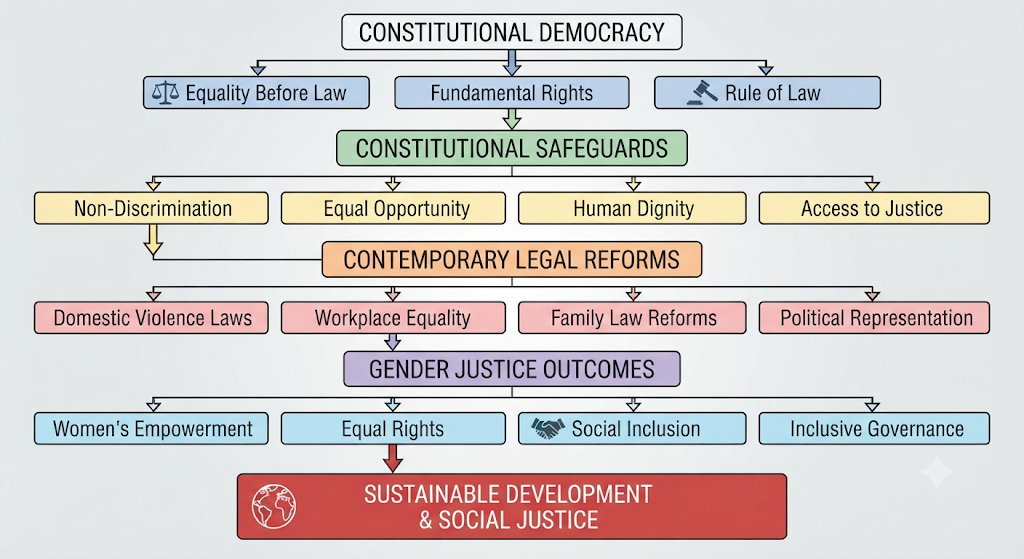
Figure: Conceptual background
Contemporary legal reforms increasingly recognize that achieving gender justice requires moving beyond formal equality toward substantive equality, where legal systems actively address structural disadvantages and historical discrimination. Courts have played a vital role in interpreting constitutional provisions to expand protections against gender discrimination, strengthen reproductive rights, recognize workplace equality, protect survivors of violence, and ensure equal participation in democratic institutions. Legislative reforms addressing domestic violence, sexual harassment, equal remuneration, maternity benefits, parental leave, child protection, political representation, and anti-discrimination have significantly contributed to advancing gender justice in many jurisdictions. Nevertheless, implementation challenges remain substantial due to limited legal awareness, delayed judicial processes, insufficient institutional capacity, inconsistent law enforcement, and socio-cultural resistance. Empirical evaluation of legal reforms is therefore essential to determine whether constitutional guarantees effectively translate into improved social outcomes and meaningful protection of individual rights. Such analysis enables policymakers, judges, researchers, and civil society organizations to identify strengths, weaknesses, and future priorities for strengthening gender-responsive governance. Furthermore, contemporary constitutional jurisprudence increasingly emphasizes intersectionality by recognizing that discrimination may arise from the interaction of gender with factors such as caste, race, ethnicity, disability, age, religion, socioeconomic status, and geographic location. This broader understanding supports more inclusive legal reforms capable of addressing multiple forms of disadvantage simultaneously. In the era of globalization, digital transformation, and evolving human rights standards, strengthening constitutional safeguards for gender justice remains essential for promoting democratic governance, social inclusion, economic development, and sustainable peace. A comprehensive examination of constitutional protections, judicial developments, legislative reforms, and empirical outcomes therefore provides valuable insights into the effectiveness of contemporary legal systems in achieving genuine gender equality and protecting the dignity and rights of all individuals.
Constitutional Principles and Legal Foundations of Gender Justice#
Gender justice is deeply rooted in constitutional law and represents one of the most important pillars of democratic governance, human rights, and the rule of law. Modern constitutions across the world recognize equality, liberty, dignity, and non-discrimination as fundamental principles that guarantee equal protection and equal opportunities for all individuals irrespective of gender. Constitutional provisions prohibiting discrimination on the basis of sex, gender, race, religion, caste, ethnicity, disability, or other social characteristics establish the legal foundation for promoting substantive equality and protecting vulnerable groups from systemic discrimination. While formal equality ensures that all individuals are treated equally before the law, contemporary constitutional jurisprudence increasingly emphasizes substantive equality, recognizing that historically disadvantaged groups often require special legal protections and affirmative measures to achieve genuine equality. Consequently, many constitutional systems authorize affirmative action policies, reservation mechanisms, equal employment opportunities, social welfare programmes, educational support, and legal protections designed to eliminate structural barriers affecting women and gender minorities. Judicial interpretation has played a crucial role in expanding constitutional protections by recognizing gender equality as an inseparable component of fundamental rights, human dignity, personal liberty, and social justice. Constitutional courts in many democratic nations have adopted progressive interpretations that strengthen women's reproductive rights, workplace equality, protection against sexual harassment, equal inheritance rights, political participation, equal remuneration, and protection from gender-based violence. Such judicial activism has significantly contributed to transforming constitutional principles into enforceable legal rights that improve the lives of millions of citizens. Legislative reforms further reinforce constitutional safeguards through comprehensive laws addressing domestic violence, sexual offences, workplace discrimination, trafficking, child marriage, maternity protection, parental leave, family law, education, healthcare, property rights, and equal access to public services. These legal reforms demonstrate the evolving recognition that gender justice extends beyond legal equality to encompass economic empowerment, social inclusion, educational opportunities, healthcare access, and equal participation in political and public life. International human rights instruments have also significantly influenced constitutional development by encouraging governments to harmonize domestic legislation with global principles of gender equality and non-discrimination. National constitutions increasingly incorporate international human rights standards that promote equal opportunities, prohibit discriminatory practices, and strengthen institutional mechanisms responsible for monitoring compliance with constitutional guarantees. Independent human rights commissions, women's commissions, equality bodies, ombudsman institutions, and constitutional courts play essential roles in enforcing legal protections, investigating discrimination, recommending policy reforms, and ensuring accountability among public authorities. Nevertheless, constitutional guarantees alone cannot eliminate gender inequality unless supported by effective implementation, institutional commitment, legal awareness, and public participation. Socio-cultural stereotypes, patriarchal attitudes, economic disparities, limited educational opportunities, and inadequate law enforcement continue to hinder the realization of constitutional rights in many societies. Rural populations, economically disadvantaged communities, marginalized social groups, persons with disabilities, and minority women often face multiple forms of discrimination that require targeted constitutional and legislative interventions. Contemporary constitutional law increasingly recognizes the principle of intersectionality, acknowledging that discrimination may arise from the interaction of gender with caste, ethnicity, religion, age, disability, socioeconomic status, sexual orientation, and geographic location. This broader constitutional approach enables policymakers and courts to develop more inclusive legal remedies that address diverse forms of inequality simultaneously. Furthermore, constitutional governance requires governments to formulate gender-responsive public policies, allocate adequate financial resources, collect gender-disaggregated data, and establish monitoring mechanisms capable of evaluating the effectiveness of legal reforms. Educational institutions, civil society organizations, legal aid services, and community-based organizations also contribute significantly by promoting constitutional literacy, legal awareness, and public participation in advancing gender equality. Ultimately, constitutional principles provide the legal and moral foundation for achieving gender justice by ensuring equality before the law, protecting fundamental rights, promoting human dignity, and creating inclusive democratic societies. Strengthening constitutional safeguards through progressive judicial interpretation, comprehensive legislation, institutional accountability, and effective implementation remains essential for translating legal guarantees into meaningful social transformation and ensuring that every individual enjoys equal rights, equal opportunities, and equal access to justice regardless of gender.
Empirical Analysis of Contemporary Legal Reforms and Their Impact on Gender Equality#
Contemporary legal reforms aimed at promoting gender justice have significantly reshaped constitutional governance by strengthening legal protections against discrimination, expanding access to justice, and improving the social, economic, and political status of women and other marginalized gender groups. An empirical analysis of these reforms demonstrates that constitutional guarantees become effective only when supported by comprehensive legislation, efficient institutions, judicial enforcement, public awareness, and measurable policy outcomes. Across many democratic nations, governments have introduced laws addressing domestic violence, sexual harassment in workplaces and educational institutions, equal remuneration, maternity benefits, parental leave, trafficking prevention, child protection, reproductive rights, inheritance equality, political representation, and anti-discrimination in employment and public services. These reforms have contributed to increasing women's participation in education, the labour market, entrepreneurship, governance, and decision-making processes while strengthening legal mechanisms for reporting discrimination and gender-based violence. Judicial decisions have further expanded constitutional protections by interpreting equality provisions in a progressive manner, recognizing gender equality as an integral component of human dignity, personal liberty, and fundamental rights. Courts have increasingly emphasized substantive equality by requiring governments and institutions to remove structural barriers that historically disadvantaged women and vulnerable populations. Empirical evidence from numerous legal systems indicates that stronger constitutional safeguards combined with effective legislation have improved reporting of domestic violence, enhanced workplace safety, increased legal awareness, strengthened institutional accountability, and encouraged greater participation of women in political and public life. Reservation policies, affirmative action programmes, gender-sensitive budgeting, and equal opportunity legislation have also helped reduce historical inequalities in education, employment, and public administration by creating opportunities for greater social inclusion. However, empirical studies also reveal that legal reforms alone cannot fully eliminate gender disparities because implementation gaps remain widespread. Many victims continue to encounter obstacles when accessing legal remedies due to financial limitations, lengthy judicial procedures, inadequate legal aid, social stigma, fear of retaliation, insufficient institutional capacity, and limited awareness of constitutional rights. Rural communities, economically disadvantaged populations, persons with disabilities, minority groups, and individuals facing multiple forms of discrimination often experience greater difficulties in benefiting from legal protections than urban populations. Workplace discrimination also continues despite comprehensive labour legislation, with women frequently experiencing wage disparities, occupational segregation, limited career advancement, underrepresentation in leadership positions, and unequal access to professional opportunities. Gender-based violence remains a significant challenge despite stricter criminal laws because social attitudes, underreporting, weak enforcement, and delayed judicial processes often reduce the effectiveness of legal reforms. Digital technologies have introduced new dimensions of gender discrimination, including cyberstalking, online harassment, revenge pornography, identity theft, misinformation, cyberbullying, and technology-facilitated abuse, requiring continuous legislative modernization to protect individuals in digital environments. Empirical research further demonstrates that effective implementation depends upon coordinated action among governments, judiciary, law enforcement agencies, educational institutions, civil society organizations, human rights commissions, and community groups. Gender-sensitive judicial training, police capacity building, legal literacy campaigns, victim support services, counselling centres, fast-track courts, and accessible complaint mechanisms have significantly improved enforcement where implemented effectively. Data-driven governance has also emerged as an important strategy for evaluating legal reforms by collecting gender-disaggregated statistics relating to education, employment, political participation, healthcare, crime reporting, judicial outcomes, and access to public services. Such empirical evidence enables policymakers to identify implementation gaps, evaluate policy effectiveness, allocate resources efficiently, and design evidence-based interventions that promote substantive equality. Furthermore, intersectional approaches increasingly recognize that gender inequality interacts with factors such as caste, ethnicity, religion, disability, age, socioeconomic status, and geographic location, requiring more inclusive policy responses that address multiple dimensions of discrimination simultaneously. Ultimately, empirical analysis confirms that contemporary legal reforms have substantially advanced gender justice by strengthening constitutional safeguards and expanding legal protections; however, achieving genuine equality requires continuous legislative reform, effective institutional implementation, judicial accountability, public awareness, and sustained commitment to eliminating structural inequalities. By combining constitutional principles with evidence-based policymaking and inclusive governance, democratic societies can ensure that legal reforms translate into meaningful improvements in the lives of all individuals, thereby promoting justice, dignity, equality, and sustainable social development.
Strengthening Constitutional Safeguards and Policy Measures for Advancing Gender Justice#
The achievement of gender justice requires not only comprehensive constitutional guarantees but also effective implementation mechanisms, progressive public policies, institutional accountability, and sustained social transformation. Although many democratic constitutions recognize equality before the law, prohibit discrimination, and guarantee fundamental rights irrespective of gender, the realization of these constitutional promises depends upon the effectiveness of legislative reforms, judicial interpretation, administrative commitment, and public participation. Strengthening constitutional safeguards therefore requires a multidimensional approach that integrates legal reform, institutional development, education, economic empowerment, technological innovation, and community engagement. One of the most important policy measures involves modernizing gender-related legislation to address emerging social and technological challenges. Governments should periodically review existing laws concerning domestic violence, sexual harassment, workplace discrimination, trafficking, family law, inheritance, reproductive rights, equal remuneration, and political representation to ensure that they remain consistent with constitutional values and international human rights standards.
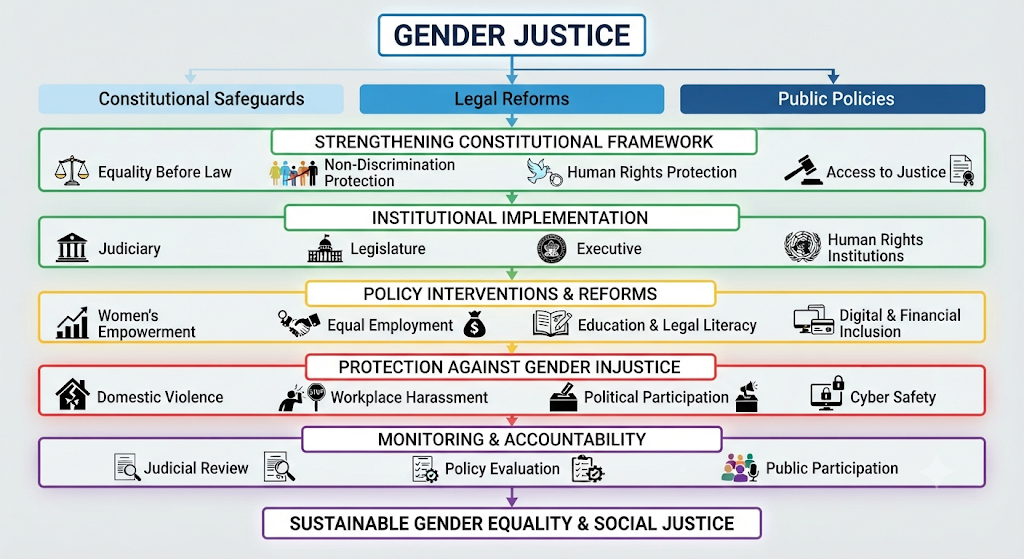
Figure: Strengthening Constitutional Safeguards and Policy Measures for Advancing Gender Justice
Legal reforms should also address emerging forms of gender-based discrimination associated with digital technologies, including cyberstalking, online harassment, non-consensual sharing of intimate images, artificial intelligence bias, cyberbullying, digital identity theft, and technology-enabled violence. Strengthening judicial institutions is equally essential for advancing constitutional safeguards. Specialized courts, fast-track mechanisms, gender-sensitive judicial procedures, legal aid services, victim protection programmes, and alternative dispute resolution mechanisms can improve access to justice while reducing procedural delays. Continuous professional training for judges, prosecutors, police officers, lawyers, and administrative officials should emphasize constitutional values, gender-sensitive investigation techniques, human rights principles, victim-centred approaches, and evolving jurisprudence relating to equality and non-discrimination. Independent constitutional institutions such as human rights commissions, women's commissions, equality commissions, ombudsman offices, and legal services authorities should be empowered with adequate financial resources, investigative powers, and institutional independence to monitor compliance with constitutional obligations and recommend policy reforms. Public policy must also promote equal opportunities in education, employment, healthcare, entrepreneurship, science, technology, political participation, and leadership positions. Governments should encourage women's economic empowerment through skill development programmes, vocational education, financial inclusion initiatives, entrepreneurship support, equal access to credit, digital literacy, and social security measures. Gender-responsive budgeting should be integrated into national and local development planning to ensure equitable allocation of public resources for programmes promoting women's welfare and gender equality. Educational institutions play a fundamental role in promoting constitutional awareness and challenging discriminatory social attitudes. School and university curricula should incorporate constitutional values, human rights education, gender equality, legal literacy, and respect for diversity to cultivate inclusive social attitudes from an early age. Public awareness campaigns involving media organizations, civil society institutions, religious leaders, community organizations, and educational institutions can further reduce gender stereotypes and encourage greater acceptance of equality, mutual respect, and non-discrimination. Technological innovation should also support gender justice by providing accessible legal information, online complaint systems, digital legal aid platforms, emergency response applications, and secure reporting mechanisms for victims of violence and discrimination. Artificial Intelligence and digital technologies may assist governments in monitoring policy implementation, identifying discrimination patterns, improving service delivery, and analyzing gender-disaggregated data for evidence-based policymaking, provided these technologies remain transparent, accountable, and free from algorithmic bias. International cooperation remains equally significant because global human rights frameworks, comparative constitutional jurisprudence, and international best practices provide valuable guidance for strengthening national legal systems. Governments should actively collaborate with international organizations, academic institutions, civil society organizations, and research centres to exchange knowledge, promote legal harmonization, and adopt innovative policy solutions. Regular empirical evaluation of legal reforms should measure progress using indicators such as educational attainment, employment rates, political representation, wage equality, access to healthcare, crime reporting, judicial outcomes, and public perceptions of gender equality. Such evidence enables policymakers to identify implementation gaps and continuously improve legislative and administrative responses. Ultimately, strengthening constitutional safeguards requires a holistic approach that combines progressive legislation, effective institutions, judicial independence, educational reform, technological innovation, economic empowerment, and active citizen participation. By reinforcing constitutional principles through inclusive governance and evidence-based policymaking, societies can create legal systems that genuinely protect human dignity, eliminate discrimination, expand equal opportunities, and promote sustainable gender justice for present and future generations.
Conclusion#
Gender justice represents one of the most fundamental objectives of constitutional democracy, human rights protection, and inclusive social development. The present study demonstrates that constitutional safeguards provide the essential legal foundation for protecting equality, dignity, liberty, and non-discrimination while promoting equal opportunities for all individuals regardless of gender. Contemporary legal reforms have significantly strengthened constitutional governance by introducing progressive legislation addressing workplace equality, domestic violence, sexual harassment, equal remuneration, family law, political participation, reproductive rights, inheritance, education, healthcare, and protection against gender-based discrimination. Judicial interpretation has further expanded constitutional protections by recognizing substantive equality as a core constitutional value requiring governments and public institutions to eliminate structural barriers that historically disadvantaged women and marginalized communities. Nevertheless, empirical analysis indicates that despite substantial legislative progress, the effective realization of gender justice continues to face significant challenges arising from implementation gaps, socio-cultural stereotypes, institutional limitations, inadequate legal awareness, economic disparities, and unequal access to justice. The study highlights that constitutional guarantees alone cannot achieve genuine equality unless supported by effective enforcement mechanisms, responsive public institutions, judicial accountability, legal literacy, and active public participation. Governments therefore have a continuing responsibility to modernize gender-related legislation, strengthen constitutional institutions, improve judicial efficiency, enhance victim protection services, and ensure adequate financial and administrative support for gender-responsive policies. Educational institutions, civil society organizations, media agencies, and community leaders also play indispensable roles in promoting constitutional awareness, challenging discriminatory social attitudes, encouraging gender-sensitive education, and fostering inclusive democratic values. Technological advancements present both opportunities and challenges for gender justice, requiring legal systems to address digital discrimination, cyber harassment, artificial intelligence bias, online violence, and privacy concerns while utilizing digital innovations to improve legal accessibility, public awareness, and evidence-based policymaking. International cooperation and comparative constitutional learning further contribute to strengthening national legal frameworks by facilitating the exchange of best practices, harmonizing human rights standards, and encouraging collaborative approaches to eliminating discrimination. The study concludes that achieving sustainable gender justice requires an integrated approach combining constitutional safeguards, progressive legislation, independent judiciary, accountable governance, economic empowerment, quality education, technological innovation, and continuous empirical evaluation. Such a comprehensive framework ensures that constitutional rights move beyond formal legal recognition to become practical realities experienced equally by all members of society. By strengthening constitutional values of equality, justice, dignity, and non-discrimination through effective legal reforms and inclusive governance, democratic societies can promote human development, social harmony, economic progress, and lasting protection of fundamental rights for present and future generations.
Works Cited#
- United Nations. (1948). Universal Declaration of Human Rights. New York: United Nations.
- United Nations. (1979). Convention on the Elimination of All Forms of Discrimination against Women (CEDAW). New York: United Nations.
- United Nations Development Programme. (2023). Human Development Report 2023/2024. New York: UNDP.
- United Nations Entity for Gender Equality and the Empowerment of Women. (2024). Progress on the Sustainable Development Goals: The Gender Snapshot 2024. New York: UN Women.
- World Bank. (2024). Women, Business and the Law 2024. Washington, DC: World Bank.
- International Labour Organization. (2023). Global Wage Report 2022–23. Geneva: ILO.
- United Nations Educational, Scientific and Cultural Organization. (2024). Global Education Monitoring Report 2024: Gender Report. Paris: UNESCO.
- World Health Organization. (2024). Violence Against Women: Global Health Estimates. Geneva: WHO.
- Organisation for Economic Co-operation and Development. (2023). Gender Equality at the Heart of Economic Recovery. Paris: OECD Publishing.
- Constitution of India. (1950). The Constitution of India. New Delhi: Government of India.
- Sen, Amartya. (1999). Development as Freedom. Oxford University Press.
- Nussbaum, Martha C.. (2000). Women and Human Development: The Capabilities Approach. Cambridge University Press.
- Fredman, Sandra. (2011). Discrimination Law (2nd ed.). Oxford University Press.
- MacKinnon, Catharine A.. (1989). Toward a Feminist Theory of the State. Harvard University Press.
- Cook, Rebecca J.. (1994). Human Rights of Women: National and International Perspectives. University of Pennsylvania Press.
- National Human Rights Commission. (2023). Annual Report 2022–23. New Delhi.
- National Commission for Women. (2024). Annual Report. New Delhi.
- World Economic Forum. (2024). Global Gender Gap Report 2024. Geneva: World Economic Forum.
- United Nations Children's Fund. (2023). State of the World's Children 2023. New York: UNICEF.
- Commonwealth Secretariat. (2022). Advancing Gender Equality Through Constitutional and Legal Reform. London: Commonwealth Secretariat