Abstract
Education is widely recognized as a fundamental human right and a cornerstone of social justice, democratic governance, and sustainable development. It empowers individuals, reduces inequalities, promotes economic growth, and enables the effective realization of other human rights. Despite significant international and national efforts to universalize education, disparities based on socio-economic status, gender, disability, geography, ethnicity, and digital access continue to hinder the achievement of educational equity. Constitutional recognition of the right to education has therefore become an essential mechanism for ensuring equal educational opportunities and holding governments accountable for providing accessible, inclusive, and quality education. International legal instruments, including the Universal Declaration of Human Rights, the International Covenant on Economic, Social and Cultural Rights, the Convention on the Rights of the Child, and the Sustainable Development Goals, establish education as a universal right that must be available, accessible, acceptable, and adaptable for all learners. This paper critically examines the constitutional and policy dimensions of the right to education by analyzing international legal standards, comparative constitutional frameworks, and contemporary educational policies. It further explores legal challenges relating to educational inequality, digital exclusion, privatization of education, inclusive education, and quality assurance. Finally, the study proposes policy and legal reforms aimed at strengthening educational equity, promoting inclusive learning environments, reducing structural inequalities, and ensuring that every individual can fully enjoy the constitutional right to education in an increasingly digital and globalized society.
- Right to Education
- Educational Equity
- Constitutional Law
- Human Rights
- Inclusive Education
- Equality
- Education Policy
- Sustainable Development Goal 4
- Digital Education
- Social Justice
Introduction#
Education occupies a central position in the realization of human dignity, equality, social justice, and democratic citizenship. It equips individuals with knowledge, skills, values, and opportunities necessary for personal development, economic participation, and meaningful engagement in public life. As a fundamental human right, education serves not only as an independent entitlement but also as an enabling right that facilitates the enjoyment of numerous other constitutional and human rights, including freedom of expression, political participation, access to employment, health, and social security. Consequently, modern constitutional democracies increasingly recognize the right to education as an enforceable legal obligation rather than merely a policy objective. International legal developments have significantly contributed to this recognition through instruments such as the Universal Declaration of Human Rights (1948), the International Covenant on Economic, Social and Cultural Rights (1966), the Convention on the Rights of the Child (1989), the Convention on the Rights of Persons with Disabilities (2006), and the United Nations Sustainable Development Goals, particularly Goal 4, which seeks to ensure inclusive and equitable quality education for all. Constitutional frameworks across numerous jurisdictions similarly impose affirmative obligations upon governments to establish accessible, affordable, non-discriminatory, and quality educational systems. In India, the constitutional recognition of the right to education through Article 21A, introduced by the Constitution (Eighty-sixth Amendment) Act, 2002, together with the Right of Children to Free and Compulsory Education Act, 2009, represents a landmark development in guaranteeing free and compulsory education for children between six and fourteen years of age. Nevertheless, ensuring educational equity remains a persistent challenge. Significant disparities continue to exist based on socio-economic background, gender, disability, rural-urban differences, language, ethnicity, caste, migration status, and access to digital technologies. The COVID-19 pandemic further exposed deep inequalities in digital infrastructure, internet connectivity, and technological resources, highlighting the urgent need for inclusive educational policies capable of addressing learning disparities.
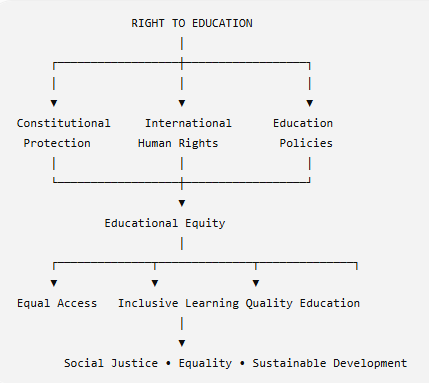
Figure: Conceptual Background
The increasing privatization and commercialization of education have also generated important constitutional and policy debates concerning affordability, equal opportunity, regulatory oversight, and the State's responsibility in guaranteeing equitable access to quality education. Inclusive education for children with disabilities, marginalized communities, indigenous populations, refugees, and economically disadvantaged groups requires comprehensive legal protections, adequate public investment, and effective implementation mechanisms. Educational equity therefore extends beyond equal access to encompass fairness in educational outcomes, resource allocation, curriculum design, teacher quality, and learning opportunities. This paper critically examines the constitutional foundations and policy dimensions of the right to education through the perspectives of international human rights law, comparative constitutional jurisprudence, and contemporary educational governance. It analyzes emerging legal challenges affecting educational equity and proposes reforms aimed at strengthening inclusive, accessible, and high-quality education systems capable of promoting equality, social justice, and sustainable development in the twenty-first century.
International and Constitutional Framework of the Right to Education and Educational Equity#
The recognition of education as a fundamental human right has evolved through a comprehensive framework of international human rights instruments, constitutional provisions, and domestic legislation that collectively seek to guarantee equal educational opportunities and promote educational equity. The Universal Declaration of Human Rights (UDHR), 1948, under Article 26, proclaims that everyone has the right to education and emphasizes that elementary education shall be free and compulsory while higher education should be equally accessible based on merit. Building upon this foundation, the International Covenant on Economic, Social and Cultural Rights (ICESCR), 1966, particularly Articles 13 and 14, recognizes education as an indispensable means of realizing other human rights and obligates States to progressively ensure free, accessible, acceptable, and quality education. The Convention on the Rights of the Child (CRC), 1989 further strengthens these obligations by recognizing every child's right to education without discrimination and requiring States to promote equal educational opportunities while reducing school dropout rates and encouraging regular attendance. The Convention on the Rights of Persons with Disabilities (CRPD), 2006 advances the principle of inclusive education by requiring States to ensure that persons with disabilities have access to education within an inclusive system without discrimination or exclusion. At the global policy level, Sustainable Development Goal 4 (SDG 4) under the 2030 Agenda for Sustainable Development commits States to ensuring inclusive and equitable quality education and promoting lifelong learning opportunities for all. Comparative constitutional frameworks similarly demonstrate increasing recognition of education as a justiciable right. In India, the Constitution originally recognized education through the Directive Principles of State Policy; however, the Constitution (Eighty-sixth Amendment) Act, 2002 inserted Article 21A, making free and compulsory education for children between six and fourteen years a Fundamental Right. This constitutional mandate was implemented through the Right of Children to Free and Compulsory Education Act, 2009 (RTE Act), which prescribes minimum standards relating to school infrastructure, teacher qualifications, pupil-teacher ratios, non-discrimination, and compulsory admission. Landmark decisions such as Mohini Jain v. State of Karnataka (1992) and Unnikrishnan J.P. v. State of Andhra Pradesh (1993) established that the right to education forms an integral component of the constitutional right to life and human dignity under Article 21. Other constitutional democracies have similarly recognized education as a fundamental constitutional value. South Africa's Constitution guarantees the right to basic education without progressive realization limitations, while Germany, Canada, Brazil, and several European nations provide constitutional or statutory protections ensuring equal educational access and prohibiting discrimination. Comparative legal experiences demonstrate that constitutional recognition alone is insufficient unless supported by effective legislation, adequate public funding, independent judicial enforcement, and inclusive educational policies. Consequently, educational equity requires governments not only to guarantee formal access to schools but also to address structural inequalities arising from poverty, gender discrimination, disability, linguistic diversity, geographical disadvantage, and digital exclusion. International and constitutional frameworks therefore establish education as both a legally enforceable right and a fundamental instrument for promoting equality, human dignity, democratic participation, and sustainable development.
Contemporary Challenges to Educational Equity and the Right to Education#
Despite the widespread constitutional recognition of the right to education and the adoption of numerous international legal instruments, achieving genuine educational equity continues to present significant legal and policy challenges. One of the most persistent obstacles is socio-economic inequality, which limits access to quality education for children from economically disadvantaged families due to inadequate infrastructure, financial constraints, lack of educational resources, and unequal learning opportunities. Rural and remote communities often experience shortages of qualified teachers, poor school facilities, inadequate transportation, and limited access to digital technologies, thereby widening educational disparities between urban and rural populations. Gender inequality also remains a serious concern in many regions where social norms, child marriage, gender-based violence, and unequal household responsibilities continue to restrict girls' educational opportunities. Although legal reforms have improved gender parity in school enrollment, significant disparities remain in secondary and higher education. Another major challenge concerns inclusive education for children with disabilities, who frequently encounter physical, social, linguistic, and institutional barriers despite international obligations under the Convention on the Rights of Persons with Disabilities. Many educational institutions continue to lack accessible infrastructure, trained educators, assistive technologies, and inclusive teaching methodologies necessary for meaningful participation. The digital divide, particularly highlighted during the COVID-19 pandemic, exposed profound inequalities in access to online education resulting from inadequate internet connectivity, lack of digital devices, insufficient technological literacy, and unequal digital infrastructure. These disparities disproportionately affected students from marginalized communities and economically weaker sections, significantly impacting learning outcomes. The growing privatization and commercialization of education has generated additional constitutional concerns regarding affordability, equality of opportunity, and the State's responsibility to provide quality public education. Excessive dependence on private educational institutions may widen socio-economic inequalities by limiting access for disadvantaged groups. Educational discrimination based on caste, ethnicity, language, religion, migration status, and indigenous identity further undermines constitutional guarantees of equality and non-discrimination. Refugees, internally displaced persons, migrant workers' children, and minority communities frequently experience interruptions in education due to legal, administrative, or linguistic barriers. Another emerging challenge involves maintaining educational quality alongside expanding access. Inadequate teacher training, outdated curricula, insufficient funding, and poor governance continue to affect educational outcomes in many jurisdictions. Climate change, armed conflicts, and humanitarian crises increasingly disrupt educational systems by damaging infrastructure, displacing populations, and diverting public resources away from education. Furthermore, balancing technological innovation with data privacy, cybersecurity, and ethical use of artificial intelligence in education has become an important contemporary legal issue. Addressing these multidimensional challenges requires comprehensive legal reforms, increased public investment, effective implementation of constitutional guarantees, targeted support for disadvantaged communities, and strong accountability mechanisms capable of ensuring that educational equity extends beyond formal access to encompass equal opportunities, quality learning environments, and meaningful educational outcomes for every individual.
Future Directions and Policy Reforms for Strengthening Educational Equity#
Achieving meaningful educational equity requires comprehensive constitutional, legislative, and policy reforms that move beyond guaranteeing access to education and focus equally on improving educational quality, inclusiveness, and lifelong learning opportunities. Governments should prioritize increased public investment in education to strengthen school infrastructure, recruit qualified teachers, modernize curricula, and ensure equitable distribution of educational resources across rural, urban, and marginalized communities. Constitutional guarantees of the right to education should be supported by effective implementation mechanisms, independent monitoring bodies, and accessible judicial remedies that enable individuals to enforce educational rights when violations occur.
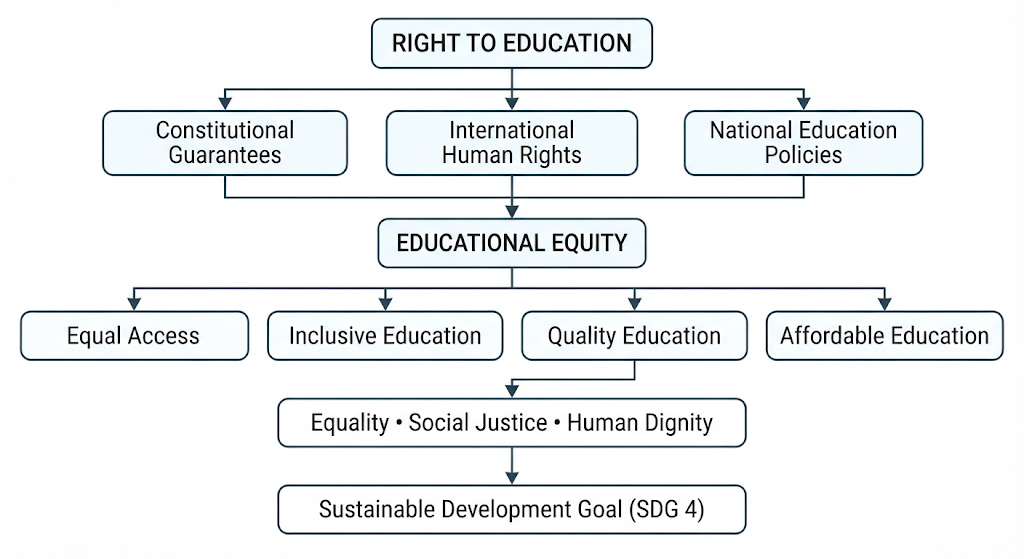
Figure: Right to Education and Educational Equity: Constitutional and Policy Perspectives
Inclusive education should become a central policy objective by ensuring that children with disabilities, indigenous communities, minority groups, refugees, migrant children, and economically disadvantaged learners receive appropriate support through accessible infrastructure, specialized teaching methods, assistive technologies, multilingual education, and anti-discrimination measures. Reducing the digital divide should also become a major policy priority through universal internet access, affordable digital devices, digital literacy programmes, and secure online learning platforms that enable equal participation in technology-enabled education. Governments should adopt regulatory frameworks governing the ethical use of artificial intelligence, learning analytics, and educational technologies while protecting students' privacy, personal data, and cybersecurity. Another important reform involves strengthening early childhood education and lifelong learning systems to promote continuous skill development, employability, and social inclusion throughout an individual's life. Public-private partnerships may complement government initiatives provided that strong regulatory safeguards ensure affordability, quality assurance, transparency, and equal access for disadvantaged students. Teacher education and professional development should receive sustained investment to improve instructional quality, inclusive teaching practices, and digital competencies. Educational policies should further emphasize critical thinking, constitutional values, environmental sustainability, human rights education, gender equality, and digital citizenship to prepare learners for contemporary social and economic challenges. International cooperation through organizations such as UNESCO, UNICEF, and other multilateral institutions should facilitate the exchange of best practices, financial assistance, technological innovation, and policy expertise to help countries achieve Sustainable Development Goal 4. Community participation, parental engagement, and decentralized educational governance can further strengthen accountability and improve local educational outcomes. Ultimately, the realization of the right to education requires governments to recognize education not merely as a social service but as a constitutional obligation and a powerful instrument for promoting equality, human dignity, democratic participation, and sustainable development. By adopting inclusive, equitable, and rights-based educational policies, states can ensure that every individual enjoys equal opportunities to develop their full potential and contribute meaningfully to society in an increasingly interconnected and knowledge-based world.
Conclusion#
The right to education constitutes one of the most fundamental human rights and serves as the foundation for achieving equality, social justice, democratic participation, and sustainable development. Constitutional recognition of education has transformed it from a policy aspiration into an enforceable legal entitlement, imposing affirmative obligations upon governments to provide free, accessible, inclusive, and quality education for all. International human rights instruments, including the Universal Declaration of Human Rights, the International Covenant on Economic, Social and Cultural Rights, the Convention on the Rights of the Child, the Convention on the Rights of Persons with Disabilities, and Sustainable Development Goal 4, collectively reinforce the principle that education must be available, accessible, acceptable, and adaptable to meet the needs of diverse learners. Comparative constitutional experiences demonstrate that legal recognition of educational rights significantly strengthens governmental accountability and enables courts to protect individuals against discrimination, exclusion, and denial of educational opportunities. Nevertheless, constitutional guarantees alone cannot eliminate the structural inequalities that continue to impede educational equity. Socio-economic disparities, gender discrimination, disability, geographical disadvantages, linguistic diversity, digital exclusion, inadequate public funding, and unequal educational resources remain persistent barriers to achieving universal and equitable education. The rapid expansion of digital learning and technological innovation has created new opportunities for improving educational access while simultaneously exposing inequalities in digital infrastructure and technological literacy. Addressing these challenges requires comprehensive policy reforms that prioritize inclusive education, equitable resource allocation, qualified teachers, accessible infrastructure, modern curricula, and robust digital connectivity. Governments should also strengthen legal mechanisms for monitoring educational standards, ensuring accountability, and providing effective remedies where educational rights are violated. Public investment in education should remain a national priority, complemented by carefully regulated public-private partnerships that preserve affordability, quality, and equality of opportunity. Special attention must be given to marginalized communities, including children with disabilities, girls, indigenous populations, refugees, migrant children, and economically disadvantaged groups, ensuring that no learner is excluded from meaningful educational opportunities. International cooperation, knowledge sharing, and continued implementation of global education commitments are equally important for achieving equitable educational systems worldwide. Ultimately, the right to education extends beyond classroom access; it encompasses the creation of learning environments that promote dignity, equality, critical thinking, and lifelong learning. By adopting rights-based educational policies grounded in constitutional principles and international human rights standards, states can empower individuals, reduce inequalities, strengthen democratic institutions, and foster sustainable development. Ensuring educational equity is therefore not only a constitutional obligation but also an essential investment in human potential, social cohesion, and the long-term progress of society.
Works Cited#
- Convention on the Rights of Persons with Disabilities. (2006). United Nations Convention on the Rights of Persons with Disabilities. United Nations.
- Government of India. (1950). The Constitution of India. Ministry of Law and Justice.
- Government of India. (2009). The Right of Children to Free and Compulsory Education Act, 2009. Ministry of Education.
- International Covenant on Economic, Social and Cultural Rights. (1966). United Nations Treaty Series.
- Mohini Jain v. State of Karnataka, (1992) 3 SCC 666.
- Organisation for Economic Co-operation and Development. (2023). Education at a Glance 2023: OECD Indicators. OECD Publishing.
- Right of Children to Free and Compulsory Education Rules. (2010). Government of India.
- Sen, A. (1999). Development as Freedom. Oxford University Press.
- Sustainable Development Goal 4. (2015). Transforming Our World: The 2030 Agenda for Sustainable Development. United Nations.
- Tomasevski, K. (2006). The State of the Right to Education Worldwide. Free or Fee.
- UNESCO. (1960). Convention against Discrimination in Education. UNESCO.
- UNESCO. (2023). Global Education Monitoring Report 2023. UNESCO.
- UNICEF. (2023). The State of the World's Children 2023. UNICEF.
- United Nations. (1948). Universal Declaration of Human Rights. United Nations.
- United Nations. (1966). International Covenant on Economic, Social and Cultural Rights. United Nations.
- United Nations. (1989). Convention on the Rights of the Child. United Nations.
- United Nations. (2015). Transforming Our World: The 2030 Agenda for Sustainable Development. United Nations.
- Unnikrishnan J.P. v. State of Andhra Pradesh, (1993) 1 SCC 645.
- World Bank. (2023). World Development Report 2023: Migrants, Refugees, and Societies. World Bank.
- World Bank. (2024). Education Global Practice Annual Report. World Bank.