Abstract
Artificial Intelligence (AI) is rapidly transforming judicial systems worldwide by enhancing the efficiency, consistency, and accessibility of legal decision-making. AI-powered technologies such as predictive analytics, natural language processing, legal research tools, and decision-support systems are increasingly being integrated into courts to reduce case backlogs, improve administrative efficiency, and assist judges in analyzing complex legal data. While these technological advancements offer significant benefits, they also raise important legal and ethical concerns regarding fairness, transparency, accountability, privacy, judicial independence, and algorithmic bias. Unlike conventional decision-making processes, AI systems often function through complex algorithms that may lack explainability, making it difficult to understand how judicial recommendations are generated. Such opacity challenges fundamental principles of due process, equality before the law, and the right to a fair trial. Furthermore, concerns regarding data protection, cybersecurity, discrimination, and the allocation of legal responsibility for AI-generated decisions have intensified debates among policymakers, legal scholars, and judicial institutions. This paper critically examines the legal and ethical dimensions of AI in judicial decision-making through a comparative analysis of emerging regulatory approaches in jurisdictions such as the European Union, the United States, China, and India. It explores the evolving role of AI as a judicial support mechanism while emphasizing that judicial discretion and constitutional values must remain central to legal adjudication. The study concludes that responsible AI governance requires transparent algorithms, human oversight, ethical safeguards, robust regulatory frameworks, and international cooperation to ensure that technological innovation strengthens rather than undermines the rule of law, judicial independence, and public confidence in the administration of justice.
- Artificial Intelligence
- Judicial Decision-Making
- Algorithmic Bias
- Judicial Ethics
- Rule of Law
- Explainable AI
- Legal Technology
- AI Governance
- Digital Justice
- Human Rights
Introduction#
Artificial Intelligence (AI) has emerged as one of the most transformative technologies of the twenty-first century, reshaping governance, commerce, healthcare, education, finance, and public administration. Within the legal sector, AI has significantly altered traditional judicial processes by introducing intelligent systems capable of analyzing legal documents, predicting case outcomes, conducting legal research, assisting in sentencing recommendations, and automating routine administrative tasks. Courts across several jurisdictions have begun adopting AI-based applications to improve efficiency, reduce delays, and enhance access to justice. The growing volume of litigation, increasing judicial workload, and demand for timely dispute resolution have encouraged governments and judicial institutions to explore AI as a complementary tool rather than a replacement for human judges. Technologies based on machine learning, natural language processing, and predictive analytics can process vast quantities of legal information within seconds, enabling judges and legal practitioners to make more informed decisions. Despite these advantages, AI has generated significant legal and ethical concerns. Judicial decisions directly affect constitutional rights, individual liberties, property interests, and social justice. Consequently, introducing algorithmic systems into judicial decision-making raises questions concerning fairness, transparency, accountability, due process, privacy, and judicial independence. Unlike traditional legal reasoning, many AI systems function as "black boxes," making it difficult to explain how particular outcomes are generated. Such opacity challenges one of the fundamental principles of justice—that judicial decisions should be reasoned, transparent, and open to scrutiny. Moreover, AI systems trained on historical legal data may reproduce existing societal biases, resulting in discriminatory outcomes affecting marginalized communities. Issues relating to algorithmic bias, data quality, cybersecurity, explainability, and legal liability have therefore become central to contemporary discussions on AI governance.
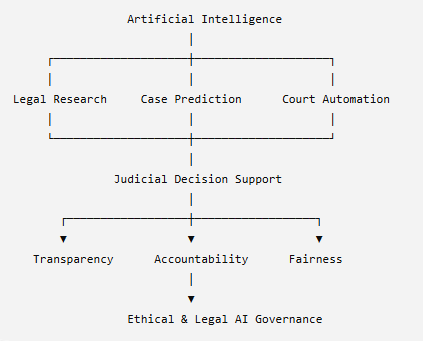
Figure: Conceptual Background
The legal regulation of AI in judicial systems is evolving across different jurisdictions. The European Union has introduced comprehensive regulatory initiatives emphasizing trustworthy AI, transparency, risk-based governance, and human oversight. The United States has adopted sector-specific approaches while encouraging responsible AI innovation through judicial ethics guidelines and constitutional protections. China has expanded the use of AI-powered smart courts while simultaneously strengthening regulatory oversight over algorithmic governance. India has initiated digital judicial reforms through e-Courts and AI-assisted legal research while maintaining that judicial discretion cannot be delegated to machines. These developments demonstrate that AI should function as a decision-support tool rather than an autonomous decision-maker. This paper examines the legal and ethical dimensions of AI in judicial decision-making by analyzing the opportunities, challenges, regulatory developments, and comparative legal approaches governing responsible AI deployment in courts. It argues that technological innovation must remain consistent with constitutional values, human rights, judicial independence, and the rule of law to preserve public confidence in modern justice systems.
Legal Framework Governing Artificial Intelligence in Judicial Decision-Making#
The rapid integration of Artificial Intelligence (AI) into judicial systems has created an urgent need for comprehensive legal frameworks capable of regulating its development, deployment, and use while safeguarding constitutional values and fundamental rights. Unlike conventional judicial tools, AI systems influence legal research, case management, sentencing recommendations, dispute resolution, and predictive analysis, thereby directly affecting the administration of justice. Consequently, legal regulation must ensure that AI operates as a judicial support mechanism rather than replacing human judicial discretion. One of the fundamental legal principles governing AI in judicial decision-making is the preservation of the rule of law, which requires judicial decisions to be transparent, reasoned, accountable, and subject to legal scrutiny. AI-generated recommendations should therefore remain advisory, with judges retaining the ultimate authority and responsibility for final decisions. Human oversight is essential to prevent excessive reliance on automated systems and to ensure that constitutional guarantees such as equality before the law, due process, judicial independence, and the right to a fair hearing are preserved. Data protection legislation also constitutes a critical component of AI governance because judicial AI systems rely heavily on extensive datasets containing sensitive personal information. Accordingly, compliance with privacy laws, data minimization principles, cybersecurity standards, and informed data governance mechanisms is necessary to prevent unauthorized access, misuse, or discriminatory profiling. The European Union has emerged as a global leader in regulating AI through a risk-based regulatory approach that emphasizes transparency, accountability, explainability, and human oversight for high-risk AI systems, including those used within judicial institutions. The EU's regulatory framework requires providers of judicial AI systems to conduct conformity assessments, maintain technical documentation, implement risk management procedures, and ensure that automated decisions remain subject to meaningful human review. Similarly, the Council of Europe and the European Commission for the Efficiency of Justice have issued ethical principles encouraging transparency, non-discrimination, quality, security, and user control in AI-assisted judicial processes. In the United States, although no comprehensive federal AI legislation specifically governs judicial decision-making, constitutional protections under the Due Process Clause and Equal Protection Clause continue to regulate the use of algorithmic decision-making. American courts have increasingly scrutinized AI-assisted sentencing tools and predictive risk assessment systems to determine whether algorithmic opacity violates defendants' constitutional rights. China has adopted an extensive "Smart Courts" initiative, integrating AI into judicial administration while simultaneously introducing regulations governing recommendation algorithms, data security, and algorithmic transparency. Chinese courts increasingly utilize AI for document analysis, evidence management, and case allocation; however, judicial responsibility continues to rest with human judges. India has likewise embraced digital judicial transformation through the e-Courts Mission Mode Project, virtual courts, AI-assisted legal research platforms such as SUPACE, and digital case management systems. Importantly, the Supreme Court of India has consistently emphasized that AI should assist judges rather than replace judicial reasoning or constitutional interpretation. Furthermore, constitutional protections relating to privacy, dignity, equality, and access to justice—as recognized in judicial precedents—provide the normative foundation for regulating AI within the Indian legal system. International organizations, including UNESCO and the OECD, have also developed ethical AI principles advocating fairness, transparency, accountability, human rights protection, and responsible innovation. Collectively, these legal developments indicate that effective AI governance requires a balanced regulatory framework that simultaneously promotes technological innovation and preserves judicial independence, constitutional supremacy, public accountability, and procedural fairness. As AI technologies continue to evolve, legal frameworks must remain adaptive, ensuring that automation strengthens rather than compromises the legitimacy, integrity, and public trust upon which democratic judicial systems fundamentally depend.
Ethical Challenges of Artificial Intelligence in Judicial Decision-Making#
The increasing adoption of Artificial Intelligence (AI) in judicial decision-making has generated significant ethical concerns that extend beyond technical efficiency to the very foundations of justice, fairness, and democratic governance. Although AI has the potential to improve judicial administration by accelerating legal research, case management, and decision-support processes, its use in courts must comply with universally accepted ethical principles that safeguard human dignity, equality, transparency, accountability, and judicial independence. One of the most significant ethical challenges is algorithmic bias, which arises when AI systems are trained on historical legal data that may reflect existing societal, racial, gender, or socio-economic prejudices. Since machine learning algorithms learn from past decisions, they may unintentionally reproduce discriminatory patterns, leading to unequal treatment of similarly situated individuals. Such outcomes directly conflict with the principles of equality before the law, non-discrimination, and impartial justice that form the cornerstone of constitutional democracies. Another critical concern is the lack of transparency and explainability associated with many AI systems, particularly those based on deep learning. Often referred to as "black-box" models, these systems generate recommendations without providing clear reasons for their conclusions. Judicial decisions, however, must be reasoned, transparent, and capable of judicial review. If judges rely heavily on opaque AI-generated recommendations, litigants may be deprived of their ability to understand, challenge, or appeal the basis of judicial decisions, thereby undermining procedural fairness and due process. Accountability represents another complex ethical issue. Unlike human judges, AI systems cannot assume legal or moral responsibility for erroneous decisions. Consequently, uncertainty arises regarding liability when algorithmic recommendations contribute to wrongful convictions, discriminatory sentencing, or violations of fundamental rights. Determining whether responsibility lies with software developers, technology providers, judicial institutions, or individual judges remains a major regulatory challenge. Ethical governance therefore requires clearly defined accountability mechanisms that ensure human judges retain ultimate responsibility for all judicial outcomes. Privacy and data protection constitute equally important ethical considerations because AI systems rely on large volumes of judicial records, personal information, biometric data, and sensitive legal documents for training and operation. Unauthorized access, inadequate cybersecurity, or improper data processing may compromise confidentiality and violate individuals' privacy rights. Accordingly, AI systems deployed within judicial institutions must adhere to strict principles of data minimization, informed governance, cybersecurity protection, and lawful processing of personal information. Judicial independence also faces ethical challenges in the context of increasing technological dependence. Courts must ensure that AI functions solely as an advisory tool rather than exerting undue influence over judicial reasoning or replacing human judgment. Excessive reliance on algorithmic recommendations could diminish judicial discretion and weaken public confidence in the independence of courts. Furthermore, AI systems should never determine legal outcomes autonomously in matters involving constitutional rights, criminal liability, or complex questions of legal interpretation where human reasoning, empathy, and contextual understanding remain indispensable. Ethical concerns also arise regarding access to justice and the digital divide. While technologically advanced judicial systems may improve efficiency in developed jurisdictions, unequal access to digital infrastructure, legal technology, and technical expertise may disadvantage economically weaker populations or developing countries. Responsible AI governance therefore requires inclusive implementation strategies that ensure equal access to digital justice for all citizens. Finally, public trust remains the ultimate ethical consideration. The legitimacy of judicial institutions depends not only on legally correct decisions but also on public confidence that justice is administered fairly, impartially, and transparently. AI can strengthen this confidence only if its deployment is accompanied by robust ethical safeguards, independent oversight, regular algorithmic audits, transparency obligations, human supervision, and continuous evaluation for bias and fairness. Consequently, ethical principles should guide every stage of AI development and deployment, ensuring that technological innovation supports rather than compromises the constitutional values, human rights, and moral foundations upon which modern judicial systems are built.
Comparative Analysis and Emerging Global Trends in AI-Based Judicial Decision-Making#
The adoption of Artificial Intelligence (AI) in judicial decision-making varies considerably across jurisdictions, reflecting differences in legal traditions, constitutional values, technological capabilities, and regulatory priorities. Nevertheless, a common global trend is the recognition that AI should function as a decision-support tool rather than a substitute for judicial reasoning. The European Union (EU) has emerged as the global leader in establishing a comprehensive legal framework for trustworthy AI. Through the AI Act and complementary ethical guidelines, the EU adopts a risk-based approach that classifies AI systems used in judicial administration as high-risk applications requiring strict compliance with transparency, accountability, human oversight, cybersecurity, and fundamental rights protections. Judicial AI systems within the EU must undergo conformity assessments, maintain technical documentation, and ensure that automated recommendations remain subject to meaningful human review. This regulatory approach seeks to balance technological innovation with constitutional safeguards and public trust. In contrast, the United States follows a decentralized and sector-specific approach. While no comprehensive federal legislation exclusively governs judicial AI, constitutional guarantees under the Due Process Clause, Equal Protection Clause, and judicial precedents regulate algorithmic decision-making. Courts have increasingly examined predictive risk assessment tools to determine whether algorithmic opacity, discriminatory outcomes, or proprietary software violate defendants' constitutional rights. Judicial institutions generally employ AI for legal research, document review, and administrative efficiency while maintaining that final adjudicatory authority rests solely with human judges. China represents another significant model through its extensive Smart Courts initiative, which integrates AI into litigation management, evidence review, legal document generation, online dispute resolution, and case allocation. Chinese courts have embraced AI to improve judicial efficiency and reduce procedural delays while simultaneously introducing regulations governing algorithmic recommendation systems, cybersecurity, and data governance. Although AI plays a substantial operational role, judicial responsibility continues to remain with judges rather than automated systems. India has adopted a cautious yet progressive approach to AI integration within its judicial system. Initiatives such as the e-Courts Mission Mode Project, virtual courts, AI-assisted legal research tools like SUPACE, digital filing systems, and online dispute resolution mechanisms demonstrate the judiciary's commitment to technological modernization. However, Indian courts consistently emphasize that AI should assist judicial functions without replacing constitutional interpretation, judicial discretion, or independent legal reasoning. Privacy rights, constitutional morality, and access to justice remain central considerations in the deployment of AI within the Indian legal framework. Beyond these major jurisdictions, international organizations have also contributed significantly to shaping global AI governance. UNESCO's Recommendation on the Ethics of Artificial Intelligence, the OECD AI Principles, and the Council of Europe's ethical guidelines advocate human-centered AI development founded upon transparency, fairness, accountability, non-discrimination, privacy protection, and respect for human rights. Emerging global trends indicate increasing emphasis on Explainable Artificial Intelligence (XAI), algorithmic auditing, human oversight, responsible data governance, ethical certification, and cross-border regulatory cooperation. Governments are also exploring regulatory sandboxes that encourage innovation while ensuring legal compliance and risk management. Another notable trend is the integration of AI with digital courts, blockchain-based evidence management, and online dispute resolution platforms, which together enhance judicial efficiency and accessibility. Despite variations in legal approaches, there is broad international consensus that AI should complement—not replace—human judges, particularly in cases involving constitutional interpretation, criminal justice, and fundamental rights. Comparative analysis therefore demonstrates that successful AI adoption in judicial systems depends not merely on technological advancement but on the establishment of transparent legal frameworks, robust ethical safeguards, continuous human supervision, and effective accountability mechanisms capable of preserving judicial independence, public confidence, and the rule of law in the digital age.
Global AI in Judicial Systems
│
│ │ │ │#
European United China India
Union States
Risk-based Due Process Smart Courts AI-assisted
Regulation & Fair Trial & Automation e-Courts
└──────────────┴──────────────┴──────────────┘#
│
Common Global Principles
│
Transparency • Accountability • Human Oversight
Privacy • Explainability • Judicial Independence
│
▼
Responsible AI Governance
Figure: Conceptual Background
Conclusion#
Artificial Intelligence has emerged as a transformative force capable of reshaping judicial administration by improving efficiency, consistency, and accessibility within modern legal systems. Through intelligent technologies such as machine learning, natural language processing, predictive analytics, and automated legal research, AI has significantly enhanced the ability of courts to manage increasing workloads, reduce procedural delays, and support evidence-based decision-making. Nevertheless, the integration of AI into judicial processes presents complex legal and ethical challenges that extend beyond technological considerations to the protection of constitutional values, human rights, judicial independence, and public confidence in the rule of law. Throughout this study, it has been demonstrated that while AI can substantially improve judicial efficiency, it cannot replicate essential human qualities such as moral reasoning, contextual interpretation, empathy, and judicial discretion, which remain indispensable in the administration of justice. The comparative analysis of legal frameworks adopted by the European Union, the United States, China, and India illustrates that jurisdictions increasingly recognize the necessity of maintaining meaningful human oversight over AI-assisted judicial systems. Common regulatory themes include transparency, accountability, explainability, privacy protection, non-discrimination, cybersecurity, and respect for due process. These principles collectively emphasize that AI should function as a decision-support mechanism rather than an autonomous adjudicator. Ethical concerns relating to algorithmic bias, opaque decision-making, data privacy, accountability, and unequal access to digital justice require continuous regulatory attention to prevent technological systems from reinforcing existing social inequalities or undermining constitutional guarantees. Effective governance therefore depends upon robust legal frameworks supported by independent oversight, algorithmic auditing, periodic risk assessments, and responsible data management practices. Furthermore, interdisciplinary collaboration among legal scholars, judges, policymakers, computer scientists, and ethicists is essential for developing trustworthy AI systems that align with democratic values and evolving societal expectations. As AI technologies continue to advance, judicial institutions must adopt adaptive regulatory strategies capable of balancing innovation with the preservation of fairness, transparency, and judicial integrity. Investments in explainable AI, ethical AI governance, judicial capacity building, and international regulatory cooperation will play a crucial role in ensuring responsible technological adoption. Ultimately, the future of AI in judicial decision-making should be guided by the principle that technology exists to strengthen human justice rather than replace it. When implemented within transparent legal frameworks and supported by strong ethical safeguards, AI has the potential to enhance the quality, accessibility, and efficiency of judicial systems while preserving the rule of law, protecting fundamental rights, and reinforcing public trust in democratic institutions. Responsible integration of AI will therefore represent not only a technological advancement but also an opportunity to modernize justice systems in a manner that remains firmly rooted in constitutional principles and human dignity.
Works Cited#
- Alemanno, A. (2022). *Artificial intelligence and the future of European Union law*. Oxford University Press.
- Ashley, K. D. (2017). *Artificial intelligence and legal analytics: New tools for law practice in the digital age*. Cambridge University Press.
- Bench-Capon, T., & Sartor, G. (2021). Explainable AI and legal reasoning: Challenges and opportunities. *Artificial Intelligence and Law, 29*(2), 101–120. https://doi.org/10.1007/s10506-021-09289-5
- European Commission. (2021). *Proposal for a regulation laying down harmonised rules on artificial intelligence (Artificial Intelligence Act)*. https://eur-lex.europa.eu
- European Commission for the Efficiency of Justice. (2018). *European ethical charter on the use of artificial intelligence in judicial systems and their environment*. Council of Europe. https://rm.coe.int
- Floridi, L., & Cowls, J. (2019). A unified framework of five principles for AI in society. *Harvard Data Science Review, 1*(1). https://doi.org/10.1162/99608f92.8cd550d1
- Goodman, B., & Flaxman, S. (2017). European Union regulations on algorithmic decision-making and a "right to explanation". *AI Magazine, 38*(3), 50–57.
- Katz, D. M., Bommarito, M. J., & Blackman, J. (2017). A general approach for predicting the behavior of the Supreme Court of the United States. *PLOS ONE, 12*(4), e0174698. https://doi.org/10.1371/journal.pone.0174698
- OECD. (2019). *OECD principles on artificial intelligence*. https://oecd.ai
- Pasquale, F. (2015). *The black box society: The secret algorithms that control money and information*. Harvard University Press.
- Russell, S., & Norvig, P. (2021). *Artificial intelligence: A modern approach* (4th ed.). Pearson.
- Sourdin, T. (2021). *Judge v. Robot: Artificial intelligence and judicial decision-making*. Edward Elgar Publishing.
- Supreme Court of India. (2021). *SUPACE (Supreme Court Portal for Assistance in Court Efficiency): AI-based judicial assistance initiative*. https://main.sci.gov.in
- Surden, H. (2019). Artificial intelligence and law: An overview. *Georgia State University Law Review, 35*(4), 1305–1335.
- UNESCO. (2021). *Recommendation on the ethics of artificial intelligence*. https://unesdoc.unesco.org
- Veale, M., & Borgesius, F. Z. (2021). Demystifying the Draft EU Artificial Intelligence Act. *Computer Law Review International, 22*(4), 97–112.
- Wachter, S., Mittelstadt, B., & Floridi, L. (2017). Why a right to explanation of automated decision-making does not exist in the General Data Protection Regulation. *International Data Privacy Law, 7*(2), 76–99.
- World Economic Forum. (2022). *The future of artificial intelligence in justice systems*. https://www.weforum.org
- Zalnieriute, M., Moses, L. B., & Williams, G. (2019). The rule of law and automation of government decision-making. *Modern Law Review, 82*(3), 425–455. https://doi.org/10.1111/1468-2230.12412
- Zarsky, T. (2016). The trouble with algorithmic decisions: An analytic roadmap to examine efficiency and fairness in automated decision-making. *Science, Technology, & Human Values, 41*(1), 118–132.